
BC Place Vancouver — World Cup 2026 Venue Guide | KICKSTAKE
 Available in US
Loading...
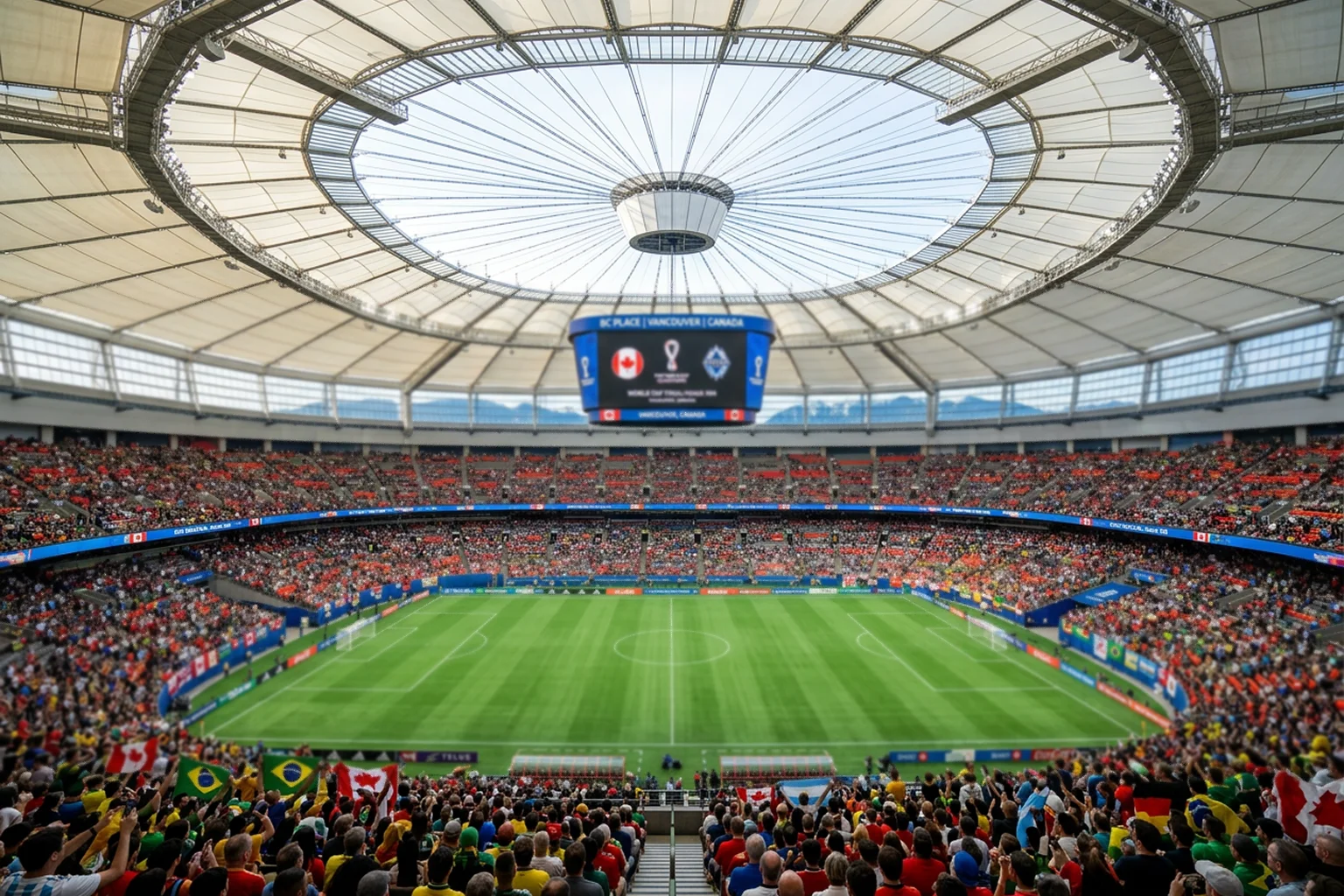
The retractable roof changes everything. BC Place in Vancouver offers something no other Canadian venue provides: climate control that eliminates weather variables from match calculations. When Canada plays their second and third Group B matches under that iconic white dome, they compete in conditions optimized for football regardless of Pacific Northwest weather patterns. For bettors positioning on Vancouver fixtures, this controlled environment shapes how you should approach every market.
BC Place serves as Canada’s western World Cup 2026 venue, hosting six group-stage matches and one Round of 32 knockout fixture. The stadium sits in downtown Vancouver’s False Creek neighbourhood, surrounded by a city whose mild climate and passionate soccer culture create ideal hosting conditions. Understanding BC Place’s unique characteristics — particularly its roof and time zone positioning — separates informed bettors from those who treat all venues identically.
About BC Place
BC Place opened in 1983 as Canada’s first covered stadium, originally featuring an air-supported fabric roof that kept the interior pressurized. A 2011 renovation replaced that structure with a retractable cable-supported roof that opens in approximately 20 minutes, allowing natural light and ventilation when weather permits. The current capacity of 54,500 makes it the largest World Cup venue in Canada, nearly doubling BMO Field’s 30,991 seats.
The playing surface is artificial turf — FieldTurf Revolution 360 — which differs from natural grass venues elsewhere in the tournament. FIFA granted a waiver for BC Place’s artificial surface given the logistical challenges of installing natural grass under a retractable roof. This surface distinction affects player movement, ball behaviour, and injury risk in ways that bettors should incorporate into their analysis.
Stadium dimensions meet international requirements at 105 by 68 metres, with the pitch oriented roughly east-west. When the roof closes, artificial lighting provides consistent illumination that eliminates shadow effects present in open-air venues. The controlled environment creates playing conditions that favour technical football over physical approaches dependent on weather variables.
The roof closure decision rests with stadium management based on weather forecasts and FIFA requirements. For World Cup 2026, the roof will likely remain closed for evening matches to optimize broadcast lighting and closed during any precipitation. Afternoon matches with clear weather may see the roof open, introducing variable conditions that affect betting calculations.
World Cup 2026 Matches at BC Place
BC Place hosts seven World Cup 2026 fixtures: six group-stage matches and one Round of 32 knockout game. Canada plays twice here during the group stage, making Vancouver critical for CanMNT’s home-soil advantage.
| Date | Match | Round | Time (ET) | Time (PT) |
|---|---|---|---|---|
| June 14 | Group Match TBD | Group Stage | 6:00 PM | 3:00 PM |
| June 18 | Canada vs Qatar | Group B | 6:00 PM | 3:00 PM |
| June 20 | Group Match TBD | Group Stage | 6:00 PM | 3:00 PM |
| June 24 | Switzerland vs Canada | Group B | 3:00 PM | 12:00 PM |
| June 25 | Group Match TBD | Group Stage | 6:00 PM | 3:00 PM |
| June 27 | Group Match TBD | Group Stage | 3:00 PM | 12:00 PM |
| July 2 | Round of 32 | Knockout | 6:00 PM | 3:00 PM |
The July 2 Round of 32 match carries particular significance for Canadian betting. If Canada wins Group B, they play their knockout opener at BC Place — extending home advantage into the elimination rounds. This pathway creates futures betting opportunities: back Canada to reach the quarter-finals at enhanced odds knowing their Round of 32 match would occur on home turf against a third-place qualifier.
Vancouver as a World Cup Host City
Vancouver’s Pacific coast location creates unique World Cup dynamics. The city sits three time zones behind Eastern Canada (PT vs ET), meaning afternoon kickoffs in Vancouver occur during evening hours for viewers in Toronto, Montreal, and the Maritimes. This scheduling maximizes Canadian television audience while providing comfortable local kickoff times that fill BC Place with energized supporters.
The city’s multicultural population reflects Canada’s immigration patterns with significant Asian communities. Chinese-Canadian and South Asian populations exceed 500,000 combined in Metro Vancouver, creating passionate supporter bases for any Asian teams scheduled at BC Place. Korean, Japanese, and Indian communities organize supporter groups that transform ostensibly neutral fixtures into de facto home games for their national teams.
Vancouver’s proximity to Seattle — home to the Sounders and a passionate American soccer culture — means cross-border travel will bring American supporters to BC Place fixtures. The two-hour drive from Seattle to Vancouver creates potential for significant US supporter contingents at any Group D matches scheduled in Vancouver, complicating crowd atmosphere assessments.
The city’s mild June climate averages 17-21°C with moderate humidity — conditions that favour European teams accustomed to similar weather. Unlike Toronto’s potential for humid heat waves, Vancouver rarely experiences temperature extremes that affect player performance. This climate neutrality reduces weather-based betting angles compared to southern American venues.
Betting Considerations — Roof, Pitch, Time Zone
The artificial turf surface at BC Place produces distinct playing characteristics that affect betting markets. Ball speed increases on artificial surfaces compared to natural grass, favouring teams that play direct, quick passing football over those relying on controlled possession. The consistent bounce eliminates unpredictable bobbles that natural grass produces, benefiting technically proficient teams.
Injury patterns differ on artificial turf. Studies suggest slightly elevated injury rates for players unaccustomed to synthetic surfaces, particularly for muscle strains and ligament stress. European teams whose domestic leagues play exclusively on natural grass may face adaptation challenges, while MLS-experienced players and CONCACAF nations comfortable with artificial surfaces hold subtle advantages.
The retractable roof’s climate control eliminates rain delays and weather-affected matches. For live betting, this certainty removes weather-based market movements that create opportunities at open-air venues. BC Place fixtures produce more predictable conditions, reducing variance in ways that favour pre-match positioning over in-play adjustments.
Time zone considerations affect live betting logistics for Eastern Canadian bettors. A 3:00 PM PT kickoff translates to 6:00 PM ET — prime evening viewing. But noon PT matches start at 3:00 PM ET, potentially catching Eastern bettors during work hours when attention splits between screens. Plan your live betting schedule around BC Place kickoff times to ensure focus during critical match moments.
Home advantage compounds at BC Place when Canada plays. The 54,500 capacity creates wall-of-sound atmospheres that smaller venues cannot match. CanMNT’s Vancouver supporters — organized through the Voyageurs supporter group — generate coordinated chanting that influences referee decisions and opponent psychology. Back Canadian home advantage at BC Place with higher conviction than typical home-field calculations suggest.
The Whitecaps Factor
BC Place serves as home to the Vancouver Whitecaps, Canada’s western MLS franchise. The stadium’s soccer configuration, supporter culture infrastructure, and operational experience with high-attendance matches all benefit from Whitecaps tenure. This institutional knowledge shapes World Cup preparations in ways that repurposed American football stadiums cannot replicate.
Whitecaps supporters — organized primarily through the Southsiders group — provide the foundation for CanMNT atmosphere at BC Place. Their chants, tifo displays, and coordinated support create environments that visiting teams find intimidating. This supporter infrastructure amplifies home advantage beyond what stadium capacity alone suggests.
For bettors, the Whitecaps connection means BC Place operates as a genuine soccer venue rather than a stadium temporarily configured for the sport. The sightlines, acoustics, and atmosphere are optimized for football in ways that enhance the competitive advantage Canada enjoys when playing at home. Position Canadian bets accordingly — BC Place is not a neutral venue; it is Canadian football’s Pacific fortress.
Round of 32 Implications
The July 2 Round of 32 match at BC Place represents potentially the most significant fixture in Canadian World Cup history. If Canada wins Group B — a realistic outcome given their favourable draw and home advantage — they return to Vancouver for their knockout opener against a third-place qualifier from Groups E, F, G, I, or J. This pathway means Canada could face teams like Ecuador, Tunisia, Sweden, Senegal, Norway, Algeria, or Austria in the Round of 32.
The betting implications compound across multiple markets. Canada to win Group B at approximately 1.85 gains additional value knowing that group victory delivers a Vancouver knockout match. Canada to reach the quarter-finals at approximately 4.50 becomes more attractive when the Round of 32 path runs through home territory. Position early on these futures before market adjustment reflects the venue advantage.
For the Round of 32 match itself, expect BC Place to reach full 54,500 capacity with overwhelming Canadian support. The atmosphere will rival any knockout match globally, creating home advantage that transforms theoretical probability calculations. Whoever faces Canada in that fixture encounters not just a talented squad but an entire nation’s passion concentrated in downtown Vancouver.
BC Place represents Canadian football’s greatest stage — a world-class venue hosting world-class football for the first time. The retractable roof, artificial surface, and Pacific time zone create unique betting considerations that reward careful analysis. Position for Canadian home advantage, account for surface differences, and enjoy watching history unfold in Vancouver’s downtown dome.
