
World Cup 2026 Prop Bets — Best Props & How to Find Value | KICKSTAKE
 Available in US
Loading...
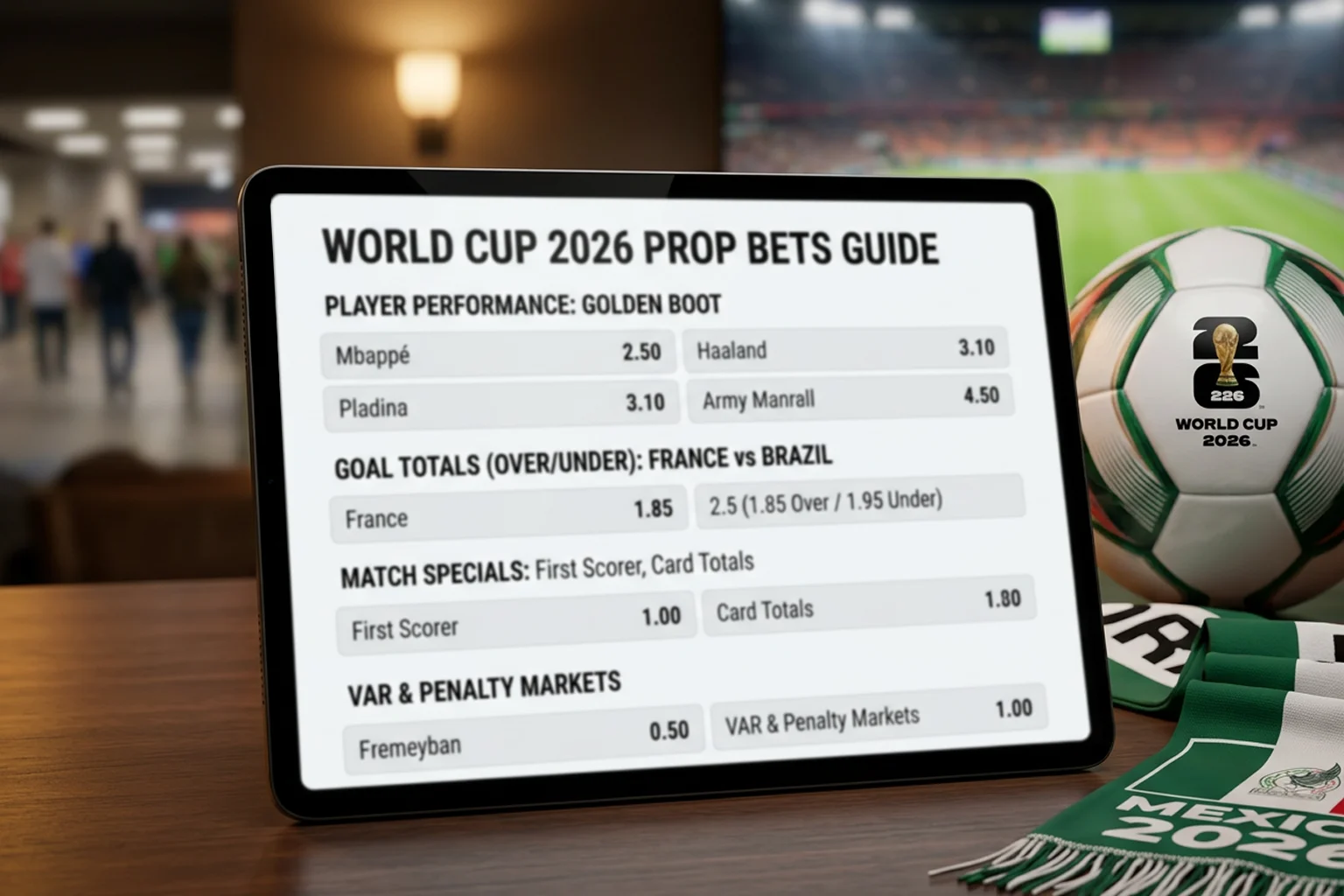
My most profitable bet of the 2022 World Cup wasn’t on any match result or futures market — it was a prop bet on Lionel Messi to score a penalty in the tournament at 2.25 odds. The logic was straightforward: Argentina would likely earn penalty kicks across seven potential matches, Messi takes Argentina’s penalties, and he hadn’t missed one for Argentina in over five years. That single prop paid more than three match bets combined. Prop betting at the World Cup offers this kind of edge when you understand what the bookmakers are pricing and where their models fall short.
The 48-team format at 2026 expands prop markets exponentially. More matches mean more player props, more game props, and more tournament specials than any previous World Cup. Canadian sportsbooks are already listing hundreds of prop betting options for the tournament, from straightforward player goal totals to exotic specifications like “number of red cards in Group F.” This guide breaks down prop categories, explains where value typically hides, and identifies specific betting angles for June and July.
Types of World Cup Prop Bets Explained
Prop bets — short for proposition bets — cover outcomes within matches or tournaments that don’t directly determine match winners. They split into three categories that require different analytical approaches.
Player Props
Player props focus on individual performance: goals scored, assists provided, shots on target, cards received, or simply whether a player appears on the pitch. The most common World Cup player props include anytime goalscorer markets where you back a player to score at any point during a match, first goalscorer markets with higher odds reflecting reduced probability, and player to be shown a card markets that target aggressive midfielders or tactical foulers.
Value in player props often emerges from role changes between club and country. A midfielder who rarely scores for his Premier League side might take penalty kicks for his national team, dramatically improving his goalscoring probability. A defender who plays conservatively in Serie A might push forward more aggressively in an international system, increasing shot volume and goal threat. The bookmakers price player props based on combined data that doesn’t always separate these role variations.
Tournament-level player props extend the timeframe: total goals scored, total assists, most cards received across the competition. These aggregate props reward understanding of team advancement probability alongside individual output. A prolific striker whose team exits in the group stage can’t match a moderate scorer whose team reaches the semi-finals. Team context matters as much as individual quality.
Game Props
Game props address match characteristics beyond the final result. Common World Cup game props include total goals with over/under lines typically set at 2.5, both teams to score at yes/no prices, exact score predictions at double-digit odds, and timing markets like “first goal before 15 minutes” or “no goal in the first half.”
The 2026 World Cup introduces game props that didn’t exist at previous tournaments: higher total lines reflecting the expanded fixture list, corner and card accumulations across matchdays, and penalty-specific markets acknowledging the statistical likelihood of penalties in VAR-era football. These newer markets often carry larger holds because bookmakers have less historical data to price them accurately — which also means sharper bettors can find edges.
Value in game props typically hides in situational awareness. A dead rubber group match where both teams have secured advancement produces different characteristics than a must-win elimination scenario. Matchday three fixtures often see higher totals because teams chase results or coast defensively, creating polarized outcomes that median-based lines don’t capture.
Tournament Specials
Tournament specials cover outcomes that span multiple matches or the entire competition. These include Golden Boot winner, Golden Ball (best player) winner, Golden Glove (best goalkeeper) winner, and structural predictions like “any team to win all group matches” or “penalty shootout in the final.”
The most interesting tournament specials at 2026 relate to the expanded format: “any debutant to reach the round of 16” targets Curaçao, Jordan, Cape Verde, and Uzbekistan collectively; “any co-host to reach the semi-finals” combines USA, Mexico, and Canada paths; “group decided on goal difference” becomes more likely with 12 groups rather than eight. These structural props require probabilistic reasoning across multiple scenarios rather than individual match assessment.
How to Spot Value in Prop Markets
Prop markets carry higher holds than match betting — often 8-12% on player props versus 4-6% on match results. This margin means value requires bigger edges to overcome, but those edges exist because prop markets receive less attention from sharp bettors who focus on higher-liquidity match markets.
The first value signal is pricing inconsistency across sportsbooks. If one platform offers Canada to score first at 2.20 and another offers 2.50 for the identical market, the spread suggests uncertainty about true probability. This inconsistency indicates less mature pricing where your analysis can find edges. Compare three or four sportsbooks on any prop before placing — the variance in World Cup prop pricing routinely exceeds 15%.
The second value signal comes from public money overinflating certain outcomes. Anytime goalscorer markets on superstar players — Kylian Mbappé, Erling Haaland, Lionel Messi — attract recreational betting volume that shortens their odds below fair value. Meanwhile, less glamorous but statistically productive players fly under the radar. Vinícius Jr. might offer better anytime goalscorer value than Mbappé simply because the betting public thinks “Mbappé” when they think “France goals.”
The third value signal emerges from situational misalignment. Bookmakers price props based on baseline statistics that don’t fully account for tournament-specific contexts. A goalkeeper facing Haiti’s attack in a group match gets priced on his career clean sheet rate, not the specific weakness of the opponent. A striker playing against a team that has conceded 12 goals in qualifiers gets priced on his overall scoring frequency, not the defensive deficiencies he’ll exploit. Tournament football creates situational edges that baseline statistics miss.
The fourth value signal relates to correlation. Backing both “Brazil to win” and “Vinícius Jr. to score” in the same match creates positive correlation — if Brazil dominates, both become more likely. Some bookmakers don’t adjust single-match prop odds sufficiently for these correlations, meaning separate prop bets offer better combined value than parlays that would apply correlation adjustments.
Our Top Prop Bets for the 2026 World Cup
These selections apply the value-identification framework above to specific 2026 tournament props. Odds will shift before June — these represent current pricing and reasoning worth monitoring as the tournament approaches.
Jonathan David anytime goalscorer versus Bosnia and Herzegovina at approximately 1.70 targets Canada’s opening match where home-field advantage and opponent quality align. David’s 2025-26 Ligue 1 form demonstrated consistent finishing, and Bosnia’s defence allowed 11 goals during qualifying. The prop prices David’s goalscoring probability around 59%, which understates his true likelihood given the situational advantages. This prop represents better value than the match result because it isolates a specific outcome where we have high confidence.
France versus Iraq under 2.5 goals at approximately 2.00 fades the assumption that heavy favourites produce blowouts. Didier Deschamps manages tournament football conservatively — France’s 2022 group stage produced scores of 4-1, 2-1, and 0-1, averaging 2.0 goals per match. Iraq qualified through playoffs with a defensive approach that will prioritize damage limitation over open play. This prop offers value because public betting pushes overs in mismatches while the actual characteristics of both teams suggest a controlled French victory.
Any penalty scored in the tournament at approximately 1.12 barely registers as a bet, but combining it with other high-probability props creates a low-odds accumulator with genuine certainty. The 2022 World Cup featured 19 penalty kicks across 64 matches. The 2026 tournament spans 104 matches — the probability of at least one penalty approaches certainty. This prop becomes useful as a parlay base that maintains viability while adding other selections.
Morocco to keep a clean sheet versus Haiti at approximately 1.60 targets Morocco’s defensive strength against tournament debutants. The Atlas Lions conceded one goal — an own goal — across five matches in Qatar 2022. Haiti qualified through CONCACAF but struggled against even regional opponents, scoring just 14 goals in 10 qualifying matches. Morocco’s organized backline should dominate an overmatched attack. The 1.60 pricing implies 62% probability; I’d argue the true figure exceeds 70%.
Most cards in Group F at approximately 2.25 targets the tournament’s most competitive group. Netherlands, Japan, Tunisia, and Sweden all play physical football when tested, and the stakes of a tight group produce caution that manifests as tactical fouling. Group F matches should feature more yellow cards than average because every point matters and none of the four teams can afford open, expansive play. This structural prop exploits group composition rather than individual match characteristics.
Prop Bet Traps to Watch Out For
Prop markets attract recreational bettors with their entertainment appeal, which means bookmakers price certain traps knowing the public will fall into them.
First goalscorer markets carry inflated holds because they combine goal-scoring probability with timing probability. A striker who scores 50% of the time scores first perhaps 15% of the time — the rest go to teammates, own goals, or opponents. The odds don’t compress proportionally, meaning you’re paying substantial hold for the timing specification. Anytime goalscorer markets offer cleaner exposure to the same basic thesis.
Exact score betting looks attractive at 8.00 to 15.00 odds but carries effective holds above 40% in most markets. The distribution of possible scores is wide enough that even the most likely outcomes — 1-0, 2-1, 2-0 — carry individual probabilities below 10%. You need to be very confident in specific scorelines to overcome that margin, and match characteristics rarely provide that certainty.
Player-specific tournament props on goalscorers below 30.00 odds often represent poor value because they don’t account for team advancement probability. Backing Erling Haaland to win the Golden Boot at 9.00 ignores that Norway might not advance past the group stage, capping Haaland’s goal-scoring opportunities at three or four matches. The price doesn’t sufficiently discount for Norway’s elimination probability.
Both teams to score in knockout matches looks like value at extended odds (often 2.20+) but faces the structural reality that knockout football rewards defensive solidity. Semi-finals and finals regularly end 1-0 because teams with advancement at stake protect leads rather than chasing further goals. The BTTS yes probability drops substantially in single-elimination contexts compared to group stages where goal difference matters.
Finding Your Prop Betting Edge
Prop betting rewards specialization. Rather than dabbling across dozens of prop markets, focus on one or two categories where your knowledge creates genuine edge. If you follow Brazilian football closely, Vinícius Jr.’s shot volume and finishing efficiency become assessable in ways the casual bettor can’t match. If you understand Japanese tactical systems, Japan game props offer edges invisible to bettors who only see “Group F underdog.”
Track your prop bets separately from match betting to evaluate category-specific performance. If your player props win at 55% but your game props win at 47%, the data directs you toward specialization. Prop betting’s higher holds mean even modest edges compound into meaningful returns when concentrated in your strongest areas.
The 48-team World Cup creates a prop betting landscape larger than any previous tournament. Canadian sportsbooks will list thousands of individual markets across 104 matches. The bookmakers can’t price all of them accurately — not with the same precision they bring to match results. Your job is finding the markets where their approximations create opportunity. The props exist. The value exists. The question is whether you’ll do the work to find it before June 11th.
