
2026 World Cup Bracket Predictions — Full Knockout Path | KICKSTAKE
 Available in US
Loading...
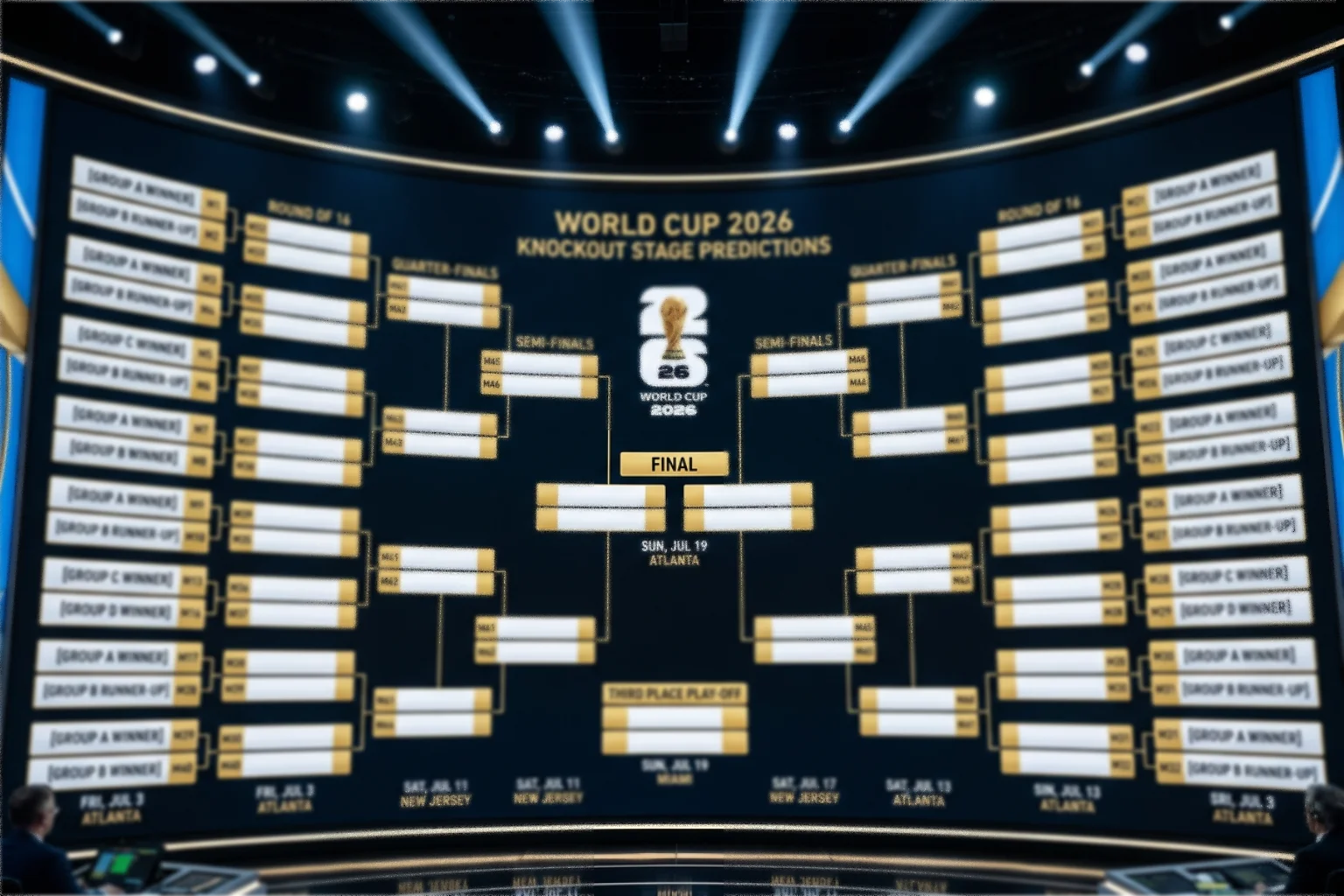
Predicting 32 consecutive knockout matches sounds like madness until you realize the alternative is pretending you don’t have opinions. I’ve covered three World Cups as a betting analyst, and the pattern repeats: the pundits who hedge every prediction are the ones nobody remembers, while the analysts who commit to specific paths — right or wrong — provide the frameworks that shape understanding. This bracket prediction represents my current assessment of how the 2026 World Cup knockout stages will unfold, based on group projections, head-to-head analysis, and the structural advantages that the 48-team format creates.
The expanded bracket introduces a round of 32 that previous World Cups lacked, adding an entire layer of elimination matches before the traditional round of 16 begins. Group winners face third-place qualifiers in that opening knockout round, while group runners-up face each other in more balanced matchups. This structure rewards winning groups more significantly than previous formats — a distinction that shapes everything from betting approaches to tactical management during the group stage.
How the 48-Team Knockout Bracket Works
Understanding the bracket structure clarifies why certain paths become advantageous. The 48-team format produces 12 group winners, 12 group runners-up, and 8 best third-place finishers advancing to a 32-team knockout bracket. Group winners face third-place teams in the round of 32, while group runners-up face other group runners-up. The bracket then narrows through round of 16, quarter-finals, semi-finals, and final.
The pairing mechanism matters for predictions. Group A’s winner plays one of the best third-place finishers determined after all groups complete. Group B’s winner faces a different third-place team. The specific pairings depend on which groups produce the eight qualifying third-place finishers, creating uncertainty that only resolves on June 26th when group stages conclude.
For bracket predictions made before the tournament, I’m projecting group outcomes first, then mapping those outcomes to bracket positions. Where third-place qualification creates ambiguity, I’m selecting the most probable scenarios based on group difficulty assessments. The predictions below represent the most likely path, not the only possible path — variance in group stages cascades through the entire bracket.
Round of 32 — Our Predictions
The round of 32 pits group winners against third-place survivors and group runners-up against each other. These matches take place from June 28th through July 2nd across venues in all three host countries. Group winners hold significant advantages — they’ve earned favourable pairings by topping their groups and enter with confidence from undefeated or dominant group performances.
In the first bracket segment, I project Brazil defeating a third-place finisher (likely Tunisia or Sweden from Group F), France defeating Iraq’s third-place advancement, and Argentina defeating Jordan if they survive Group J as the best third. These matches should produce comfortable wins for the favourites, though the 48-team format means third-place qualifiers include some quality sides — Tunisia and Sweden both have knockout experience from previous World Cups.
Canada’s round of 32 match generates the most interest for Canadian bettors. If Canada wins Group B, they face a third-place team at BC Place in Vancouver on July 2nd. The most likely opponents are third-place finishers from Groups E, F, G, I, or J — potentially Ecuador, Sweden, Iran, Senegal, or Austria. Of these, Ecuador and Iran represent manageable opponents where Canada’s home advantage should prove decisive. Senegal would present the toughest test, but even that matchup favours Canada in Vancouver’s electric atmosphere.
England versus Mexico emerges as the marquee round of 32 clash if both finish as group runners-up. England behind Croatia in Group L, Mexico behind South Korea in Group A — both outcomes are plausible given group compositions. This match at Hard Rock Stadium in Miami would feel like a knockout final in round one, with the winner facing a significantly easier path forward. My prediction: England edges Mexico 2-1 through superior individual quality despite Mexico’s passionate crowd support.
Germany faces a third-place opponent after winning Group E, likely one of the weaker qualifying third-place teams. Switzerland faces a tougher draw if they finish second in Group B behind Canada — potentially meeting Group A’s winner Mexico at SoFi Stadium. Morocco versus USA presents another round of 32 possibility if Morocco finishes second in Group C to Brazil and USA wins Group D. That matchup would test Morocco’s 2022 semi-final credentials against American home advantage.
The Netherlands and Japan both advance from Group F in my projection, meaning they avoid each other until potential later rounds. Netherlands as group runners-up faces a challenging draw — potentially Group E’s runner-up Côte d’Ivoire or Group H’s runner-up Uruguay. Japan as third-place qualifier faces a group winner, likely Belgium from Group G, creating an intriguing tactical battle where Japanese counter-attacking suits them against Belgium’s attacking vulnerabilities.
Round of 16 Picks
Round of 16 matches run from July 4th through July 7th, condensing the bracket to 16 teams fighting for quarter-final positions. By this stage, weaker teams have been eliminated and every match carries knockout intensity. My projections assume round of 32 results went according to form — upsets at that stage would cascade through subsequent predictions.
The bracket’s top half produces four round of 16 matchups I project as: Brazil versus Belgium, France versus England, Germany versus Switzerland, and Canada versus Morocco. Brazil should handle Belgium’s aging squad; Vinícius Jr.’s pace exploiting Belgium’s slow centre-backs decides it. France versus England becomes the first true heavyweight clash — I lean France based on their tournament pedigree, predicting a 2-1 win where Kylian Mbappé proves the difference. Germany overcomes Switzerland through superior quality despite Swiss tactical discipline. Canada versus Morocco in a potential Los Angeles match tests whether home continent advantage extends beyond group stages — I predict Morocco’s experience wins a tight 1-0 affair.
The bracket’s bottom half features: Argentina versus Japan, Spain versus Croatia, Netherlands versus Colombia, and Portugal versus USA. Argentina should overcome Japan despite Samurai Blue’s upset potential — Julián Álvarez’s all-around play proves too much. Spain defeats Croatia in a rematch that mirrors their Nations League final, with La Roja’s youth overwhelming Croatia’s aging midfield. Netherlands versus Colombia becomes the most entertaining match of the round, with Colombia’s attacking flair matching Dutch technical quality — I project Netherlands to advance on penalties after a 2-2 draw. Portugal edges USA in a controversial match decided by late VAR intervention — 2-1 Portugal with American supporters questioning officiating.
Quarter-Finals and Semi-Finals
Quarter-finals compress eight remaining teams into four matches from July 9th through July 12th. These are the fixtures where World Cup legacies crystallize — a quarter-final win guarantees semi-final status that marks a tournament’s defining moments.
My quarter-final projections: Brazil defeats France in a clash that lives up to its billing, 2-1 with Vinícius Jr. and Mbappé both scoring in an all-time great World Cup match. Germany defeats Morocco as the Atlas Lions’ run ends one stage short of their 2022 achievement — German tactical adjustments neutralize Morocco’s defensive organization. Argentina defeats Spain in a battle of recent tournament champions, with Argentine experience in tight matches proving decisive at 1-0. Netherlands defeats Portugal in another penalty shootout after 1-1 in normal time, Dutch composure from the spot continuing a trend.
Semi-finals pit Brazil versus Germany and Argentina versus Netherlands. Both represent classic World Cup matchups with historical weight. Brazil defeats Germany 2-0 to avenge the 7-1 humiliation of 2014 — though the revenge narrative overstates how much current players think about a match from 12 years ago, Brazilian motivation in semi-finals runs deep regardless. Argentina defeats Netherlands in a rematch of their 2022 quarter-final, this time with less controversy but similar intensity — 2-1 Argentina with Enzo Fernández scoring the decisive goal.
The Final — Our Pick to Win It All
Brazil versus Argentina at MetLife Stadium on July 19th would represent the greatest World Cup final in history. Two South American giants, five World Cup titles between them, meeting on North American soil to determine continental and global supremacy. The narrative writes itself — and the football would justify the hype.
My prediction: Brazil defeats Argentina 3-2 in a final that mirrors the 2022 classic against France. Vinícius Jr. scores twice, Julián Álvarez pulls one back for Argentina, Rodrygo adds Brazil’s third, and a late Lautaro Martínez goal creates a nervy finish. Brazil ends their 24-year World Cup drought, Vinícius claims the Golden Boot and Golden Ball, and the 2026 tournament enters history as the tournament that restored Brazilian football to its throne.
This prediction carries enormous uncertainty — any knockout bracket prediction does. A different group stage outcome, a single upset in the round of 32, an injury to a key player changes everything. But committing to a specific prediction forces analytical discipline that hedging doesn’t require. I believe Brazil’s attacking depth and tournament draw positioning make them slight favourites over Argentina’s defending champions. The margins are razor-thin, and Argentina lifting the trophy again wouldn’t surprise anyone. But bracket predictions demand choices, and my choice is Brazil.
Canada’s Predicted Path Through the Bracket
For Canadian bettors and supporters, the bracket path matters most. My projection has Canada winning Group B over Switzerland, earning a home round of 32 match at BC Place against a third-place qualifier. If that opponent is Ecuador or Iran, Canada should advance. If it’s Senegal, the match becomes a coin flip.
Assuming Canada reaches the round of 16, they’d face Morocco in my projection — a tough draw against the team that reached semi-finals in 2022. Morocco’s defensive organization would frustrate Canada’s attacking ambitions, and I project Morocco advancing 1-0. Canada’s World Cup ends in the round of 16, a significant achievement for a team playing in only their second World Cup.
The alternative path requires Canada to finish second in Group B behind Switzerland, which changes round of 32 and 16 opponents completely. Second-place finish sends Canada to SoFi Stadium to face Group A’s winner (likely Mexico) or another group runner-up in a less favourable draw. Home advantage disappears, crowd support diminishes, and Canada’s path through the bracket steepens considerably.
This structural difference reinforces why Group B’s outcome matters so much. Canada winning their group versus finishing second could mean the difference between quarter-final dark horse and round of 32 exit. The June 24th match against Switzerland in Vancouver might be the most consequential match in Canadian men’s football history — not hyperbole when bracket implications weigh so heavily.
What the Bracket Means for Your Bets
Bracket predictions inform betting in two primary ways. First, they help assess futures odds by mapping team paths to potential obstacles. Brazil’s path in my projection — Belgium, France, Germany, Argentina — is brutal on paper but demonstrates they’d prove themselves worthy champions by beating elite opposition. Argentina’s path — Japan, Spain, Netherlands, Brazil — similarly tests their credentials at every stage. Teams whose bracket paths avoid heavyweights until semi-finals might offer value in futures markets.
Second, bracket predictions identify specific matches worth targeting for match betting. The Brazil versus France quarter-final I’m projecting would be the tournament’s most bet match outside the final — knowing it might happen helps prepare analysis. England versus Mexico in round of 32, if both finish as group runners-up, becomes a must-bet match based on competitive dynamics.
Canada’s path specifically shapes how Canadian bettors approach the tournament. Backing Canada to reach the quarter-finals at approximately 5.00 offers value if you believe they win Group B and navigate round of 32 successfully. The price drops significantly if Switzerland tops the group and Canada faces a tougher bracket path. Monitoring Group B outcomes becomes essential for live betting adjustments.
This bracket represents one probabilistic path through 32 potential knockout matches. The actual tournament will deviate — upsets happen, penalties fall randomly, red cards shift dynamics. But having a predicted structure helps identify value when odds diverge from projected outcomes. If bookmakers price Brazil versus France at even odds but I project Brazil as slight favourites, the analytical framework creates betting opportunity. The bracket isn’t destiny. It’s a tool for finding edges when reality meets expectations.
