
World Cup 2026 Group G — Belgium's Last Dance Betting Preview | KICKSTAKE
 Available in US
Loading...
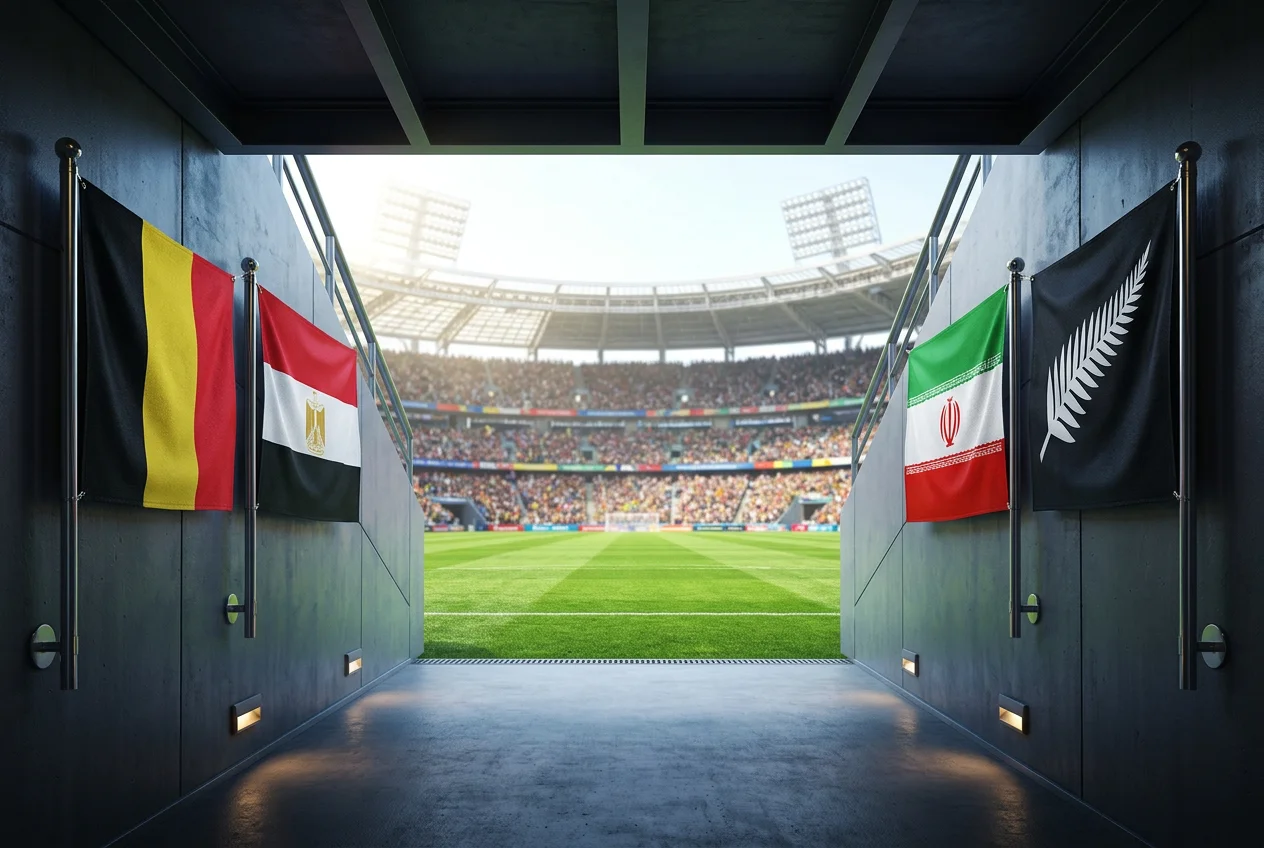
Belgium’s golden generation meets Africa and the Middle East for what could be their final collective World Cup appearance. Kevin De Bruyne, Romelu Lukaku, and the core that reached third place in 2018 have aged beyond their prime years, and World Cup 2026 Group G represents either a last hurrah or an embarrassing farewell. The stakes for Belgian football extend beyond tournament advancement — they need to prove this generation was not a beautiful failure.
Egypt brings Mohamed Salah to his first World Cup since 2018’s brief appearance. Iran carries the banner for Asian football with a squad that qualified comfortably through AFC competition. New Zealand returns to the World Cup for the first time since 2010, completing a group that offers Belgium clear favourite status but no guarantee of smooth passage.
The Four Teams
Belgium peaked at the 2018 World Cup, finishing third with a squad featuring prime Hazard, De Bruyne, and Lukaku. Subsequent tournaments have delivered diminishing returns: quarter-final exit in Euro 2020, group-stage elimination at the 2022 World Cup after scoreless first-half performances against Morocco and Croatia. The golden generation tarnished itself through the inability to convert talent into trophies.
Manager Domenico Tedesco inherited a squad in transition. De Bruyne remains world-class when fit but carries the workload burden of Manchester City’s demanding season. Lukaku’s form fluctuates wildly — he can dominate inferior defences or disappear against organized opponents. The defensive generation has turned over significantly, with Jérémy Doku now providing the creative wing play that Eden Hazard once offered. Belgium’s ceiling remains high, but their floor dropped substantially since 2018.
Egypt’s qualification campaign featured Mohamed Salah’s brilliance dragging a limited squad through fixtures they had no business winning. The Liverpool forward remains among the world’s elite attackers at 34, though his international supporting cast lacks the quality that surrounds him at club level. Manager Hossam Hassan has built a team around Salah’s ability to score from individual moments rather than systematic attacking play.
Egyptian World Cup history includes just three appearances — 1934, 1990, and 2018 — with a combined record of one draw and five defeats. The 2018 campaign saw Salah injured in the Champions League final weeks before the tournament, limiting his effectiveness. A fully fit Salah in 2026 transforms Egyptian ceiling projections, though their defensive limitations remain concerning against quality opposition.
Iran qualified comfortably as Asian runners-up behind Japan, conceding just six goals across 10 matches. Manager Carlos Queiroz returned for a third stint with the Iranian national team, bringing the tactical discipline that characterized their 2014 and 2018 campaigns. Mehdi Taremi leads the attack with the intelligent movement that has made him one of Europe’s most underrated strikers, while Sardar Azmoun provides complementary finishing when fit.
Iranian teams frustrate opponents through defensive organization and tactical patience. They held Portugal to a 1-1 draw in 2018 and nearly qualified from a group featuring Spain, Portugal, and Morocco. Against Belgium’s aging core and Egypt’s defensive fragility, Iran represents a genuine upset threat capable of spoiling favourites’ aspirations.
New Zealand returns to the World Cup after missing the 2014, 2018, and 2022 editions. Manager Darren Bazeley has assembled a squad mixing A-League professionals with lower-tier European players, anchored by captain Chris Wood’s Premier League-proven finishing. The All Whites’ 2010 campaign produced three draws — including against defending champions Italy — demonstrating Oceanian teams can compete through resilience and set-piece threat.
Realistic expectations acknowledge New Zealand as Group G’s weakest side. Their goal is to avoid embarrassment, earn respect through competitive performances, and perhaps create one memorable result that justifies Oceanian participation in the expanded format. For bettors, New Zealand offers half-time draw props and correct score longshots rather than match-winner value.
Schedule and Venues
Group G fixtures span the northeastern and southern United States, with all six matches played in stadiums exceeding 60,000 capacity.
| Date | Match | Venue | Time (ET) | Time (PT) |
|---|---|---|---|---|
| June 15 | Belgium vs Egypt | Mercedes-Benz Stadium, Atlanta | 3:00 PM | 12:00 PM |
| June 15 | Iran vs New Zealand | Gillette Stadium, Foxborough | 6:00 PM | 3:00 PM |
| June 21 | Belgium vs Iran | Lincoln Financial Field, Philadelphia | 3:00 PM | 12:00 PM |
| June 21 | Egypt vs New Zealand | Hard Rock Stadium, Miami | 6:00 PM | 3:00 PM |
| June 27 | Belgium vs New Zealand | NRG Stadium, Houston | 6:00 PM | 3:00 PM |
| June 27 | Egypt vs Iran | Lincoln Financial Field, Philadelphia | 6:00 PM | 3:00 PM |
Belgium plays in three different cities across 12 days — Atlanta, Philadelphia, and Houston. The travel burden compounds for an aging squad managing fitness across a gruelling group stage. Egypt vs Iran on June 27 could determine second place if both teams take care of business against New Zealand, creating a decisive fixture with genuine stakes.
Key Matchups
Belgium vs Egypt opens Group G with a fixture that pits golden-generation twilight against individual brilliance. Mohamed Salah versus Belgium’s reconstructed defence represents the match’s defining battle. If Salah finds space against Tedesco’s backline — which struggled against Morocco’s pace in 2022 — Egypt could deliver the upset that transforms Group G dynamics.
Belgium should win, but the margin matters enormously for tiebreaker calculations. Belgium to win by exactly one goal at approximately 3.50 offers value given Egypt’s defensive organization and Salah’s counter-attacking threat. Under 2.5 goals is the safer angle — expect a tense 1-0 or 2-1 Belgian victory rather than a comfortable rout.
Egypt vs Iran on June 27 is the group’s sleeper fixture. Both teams should beat New Zealand and take at least one point from Belgium, making this head-to-head potentially decisive for second place. Egyptian attacking talent exceeds Iran’s, but Iranian defensive discipline has frustrated superior opponents at every World Cup since 2014.
Draw is undervalued at approximately 3.40. Both teams will be cautious knowing the stakes, and neither possesses the attacking depth to dominate the other. A 1-1 result that leaves both teams with five points — sufficient for knockout advancement — suits both managers’ conservative approaches.
Belgium vs Iran on June 21 in Philadelphia tests Belgian patience against Iranian organization. Iran will sit deep in a compact 4-5-1, absorbing Belgian possession and waiting for transition moments. De Bruyne’s creativity must unlock spaces that Iran’s disciplined lines deliberately eliminate. This match projects as lower-scoring than Belgium’s attacking reputation suggests.
Group G Odds
Belgium dominates betting markets despite their recent tournament failures. Egypt’s Salah factor creates a clear second-favourite status that Iran challenges.
| Market | Belgium | Egypt | Iran | New Zealand |
|---|---|---|---|---|
| To Win Group G | 1.50 | 4.00 | 6.00 | 35.00 |
| To Qualify (Top 2) | 1.15 | 1.90 | 2.75 | 12.00 |
| To Finish Bottom | 20.00 | 4.50 | 3.25 | 1.40 |
Belgium at 1.50 to win the group is slightly overvalued given their 2022 group-stage exit. The implied probability of 67% assumes smooth passage that Belgium’s recent history does not support. If you believe Belgium still possesses elite quality, their group-winner odds are fair. If you recognize the aging trajectory, look elsewhere for value.
Iran at 2.75 to qualify offers the group’s best value. Their defensive organization limits opponents’ scoring opportunities, and their path to four points is clear: beat New Zealand, draw Belgium, and draw or beat Egypt. Iranian teams consistently outperform expectations at World Cups, making their underdog pricing attractive.
Egypt at 1.90 to qualify is fairly priced given Salah’s individual brilliance. They should beat New Zealand and have genuine upset potential against Belgium. The risk is their match against Iran — if both teams are cautious, a draw could leave Egypt needing goal-difference tiebreakers that their limited attacking depth cannot guarantee.
Our Prediction
Belgium wins Group G with seven points. Egypt finishes second with five points. Iran finishes third with four points. New Zealand finishes bottom with zero points.
The projected path: Belgium edges Egypt 2-1 in their opener, draws 0-0 with Iran in a frustrating second match, and beats New Zealand 3-0 to secure top position. Egypt recovers from the Belgian loss to beat New Zealand 2-0 and draw 1-1 with Iran. Iran’s four points come from the Belgian draw, the Egyptian draw, and a 2-0 victory over New Zealand.
This scenario reflects Belgian quality prevailing despite reduced dominance compared to their 2018 peak. Egypt’s Salah dependence creates volatility — they are dangerous when he produces individual brilliance but limited when opponents neutralize him. Iran represents the group’s most undervalued team, capable of finishing second if Belgium or Egypt stumbles.
The best value bet in Group G is Iran to qualify at 2.75. Their defensive pedigree and tournament experience justify shorter odds than the market offers. Belgian qualification at 1.15 is too short given their recent failures — avoid betting on or against Belgium at current prices.
The Salah Factor
Mohamed Salah’s tournament presence creates unique betting dynamics. Unlike most World Cup forwards, Salah produces goals from nothing — individual brilliance that defies team quality limitations. Egypt’s expected goals per match increases by approximately 0.5 when Salah is in form compared to when he carries injury concerns or fatigue.
Salah anytime scorer in Egypt’s matches offers consistent value throughout the group stage. His odds typically sit around 2.20 against quality opposition, representing approximately 45% implied probability. Salah’s actual conversion rate from chances created exceeds 50% when he is fit and confident, suggesting value across all three Egyptian fixtures.
If you believe Belgium’s defence has regressed — a reasonable position given 2022 evidence — Salah to score first in Belgium vs Egypt at approximately 5.00 offers asymmetric upside. Belgium conceded first in two of three group matches at the 2022 World Cup. Salah’s pace in transition and clinical finishing could capitalize on Belgian defensive vulnerability.
Group G ultimately tests whether Belgium’s golden generation has one more tournament run remaining or whether age has caught up with their collective ambitions. The betting markets favour Belgian pedigree, but their recent performances suggest that faith is misplaced. Position for Iranian value, track Salah’s pre-tournament fitness, and expect tighter margins than Belgian fans hope to see.
New Zealand’s Oceanian Mission
Every World Cup needs its David, and New Zealand fills that role in Group G. The All Whites return to the World Cup after a 16-year absence, carrying the hopes of a footballing nation that prioritizes rugby yet produces passionate supporters whenever the round ball takes centre stage.
Captain Chris Wood provides genuine Premier League quality as the focal point of New Zealand’s attack. His aerial presence from crosses and set pieces creates opportunities that lower-ranked opponents rarely threaten. In a group-stage context where New Zealand faces extended defensive spells against Belgium, Egypt, and Iran, Wood’s ability to capitalize on limited chances becomes their primary avenue to points.
New Zealand’s 2010 campaign offers historical encouragement. They drew all three matches — including a 1-1 result against defending champions Italy — and departed the tournament unbeaten despite finishing bottom of their group on goal difference. That resilience suggests Oceanian teams can compete through defensive organization and mental fortitude even when outclassed technically.
For betting purposes, New Zealand to score in any match at approximately 2.50 offers value across all three fixtures. Their set-piece threat and Chris Wood’s aerial prowess mean even heavy defeats could include a consolation goal. Half-time draw in Belgium vs New Zealand at approximately 2.75 captures the potential for New Zealand to hold firm in the first 45 minutes before Belgian quality eventually prevails.
Group G presents clear hierarchies that the betting markets accurately reflect. Belgium tops the group despite their aging core because talent still matters. Egypt advances through Salah’s individual brilliance. Iran earns respect through defensive organization. New Zealand competes honourably but exits at the group stage. The value lies not in disrupting this order but in finding mispriced margins within it — Iranian qualification odds, Egyptian goal-scorer props, and half-time draws that nervous favourites cannot avoid.
