
All 48 World Cup 2026 Teams — Betting Tiers & Rankings | KICKSTAKE
 Available in US
Loading...
Forty-eight teams enter the 2026 World Cup. Only one lifts the trophy on July 19 at MetLife Stadium. The gap between those two numbers represents the entire challenge of tournament betting — identifying which of those forty-eight squads will exceed their odds, which will disappoint, and which sit precisely where the market says they belong.
I’ve covered three World Cups as a betting analyst, and the expanded 48-team format for 2026 introduces complexity that previous tournaments didn’t have. Sixteen additional teams means sixteen additional variables. Four debutant nations — Curaçao, Jordan, Cape Verde, and Uzbekistan — enter without any World Cup history to analyze. Six late qualifiers emerged from playoffs just weeks before draw seedings locked in. The gap between the strongest and weakest participants has never been wider in World Cup history.
This overview organizes all forty-eight teams into four betting tiers based on realistic tournament expectations, current squad quality, historical performance, and odds valuation across major sportsbooks. Tier 1 holds genuine title contenders whose outright odds sit below 10.00. Tier 2 captures dark horses and quarterfinalist-caliber squads priced between 10.00 and 40.00. Tier 3 covers teams expected to reach the knockout rounds but unlikely to advance deep into the bracket. Tier 4 comprises long shots, debutants, and squads whose primary goal is avoiding embarrassment during the group stage.
Every assessment reflects the tournament as it stands in April 2026 — finalized groups, confirmed qualification, and current betting markets. Squad compositions will shift before June kickoff as managers finalize their 23-player rosters and injuries reshape depth charts. But the fundamental tier placements rely on structural factors — national team infrastructure, playing pool depth, tactical sophistication, tournament pedigree — that won’t change between now and Estadio Azteca’s opening whistle.
| Tier | Teams | Odds Range | Tournament Expectation |
|---|---|---|---|
| 1 — Title Contenders | 6 | Under 10.00 | Semi-finals or better |
| 2 — Dark Horses | 10 | 10.00 – 40.00 | Quarter-finals |
| 3 — Knockout Hopefuls | 14 | 40.00 – 150.00 | Round of 32 or 16 |
| 4 — Group-Stage Exits | 18 | Over 150.00 | Survival and experience |
How We Rank the 48 Teams
During the 2022 World Cup, I watched Morocco systematically dismantle pre-tournament projections by reaching the semi-finals from a starting position nobody predicted. My model had them as a Tier 3 team — knockout-round hopeful, plucky but limited. They embarrassed that assessment and everyone else’s along the way. That experience taught me humility about any ranking system, including the one I’m about to present.
The tier structure combines five factors that historically correlate with World Cup success. No single factor dominates because tournament football rewards completeness rather than isolated excellence. A team might possess the best striker in the world yet lack the defensive organization to survive penalty shootouts. Another might play beautiful football at club level but dissolve when international pressure mounts.
Current squad quality receives the heaviest weight — roughly forty percent of the evaluation. This assessment examines the starting eleven strength, bench depth, and positional balance. A national team can only select players eligible for their nation, creating structural advantages for countries with large football-playing populations or strong youth development systems. France can field a starting eleven entirely from Champions League knockout-round clubs. Curaçao cannot. That gap matters more than any other factor.
Historical World Cup performance contributes twenty percent. Nations with consistent tournament pedigree — multiple quarter-final appearances, past championships, experience in pressure moments — carry advantages that transcend current squad composition. Germany’s four-star crest represents a century of knockout-round experience embedded in their national team culture. Cape Verde’s first-ever qualification means every match brings unprecedented pressure. Historical weight decays over time, so Brazil’s 2002 victory matters less than Germany’s 2014 triumph, which matters less than Argentina’s 2022 championship.
Qualification path analysis accounts for fifteen percent. Teams that dominated their confederation’s qualifying group signal different preparedness than teams that scraped through playoffs. The 2026 cycle’s six playoff qualifiers — Czechia, Bosnia and Herzegovina, Türkiye, Sweden, Iraq, and DR Congo — enter with less momentum and fewer meaningful matches against top opposition than teams that cruised through qualification.
Tactical sophistication and coaching quality contribute fifteen percent. International management differs fundamentally from club coaching — limited training time, infrequent matches, squad assembly challenges. Managers with major tournament experience and proven systems offer advantages over first-time tournament coaches still learning the job. Jesse Marsch’s appointment to Canada, for example, brought MLS and Bundesliga tactical experience that Herdman’s departure had threatened to remove.
The final ten percent addresses current form and intangible factors — injury concerns, team chemistry, generational timing. Belgium’s golden generation is aging out. Spain’s youth core is peaking at exactly the right moment. Argentina carries the psychological boost of defending champions. These contextual elements resist quantification but influence outcomes significantly.
Odds valuation provides a reality check against market consensus. If my tier assessment diverges dramatically from betting markets, I interrogate that gap. Sometimes I’m seeing something bookmakers have underweighted — Morocco in 2022, for instance. More often, the market knows something I’ve missed. Humility demands acknowledging that collective market wisdom often outperforms individual analysis.
Tier 1 — Title Contenders
Six teams enter the 2026 World Cup with realistic championship aspirations and odds below 10.00 at major sportsbooks. These aren’t just the usual suspects wearing prestigious crests — each possesses the squad depth, tactical organization, and tournament pedigree required to win seven consecutive knockout matches against escalating opposition. Reaching a World Cup semi-final is difficult. Winning one requires everything to align perfectly.
France anchors this tier with the most complete squad on paper. Kylian Mbappé operates in his absolute prime at 27, backed by a supporting cast that includes Aurélien Tchouaméni, William Saliba, and a generation of players who’ve experienced three consecutive World Cup semi-final runs. Les Bleus won in 2018, lost the 2022 final in a penalty shootout after Mbappé’s hat-trick briefly made the impossible seem achievable, and enter 2026 as many bookmakers’ outright favourite. Didier Deschamps’ tournament management remains best-in-class — his squads consistently overperform underlying metrics when trophies are on the line.
Argentina enters as defending champions with the psychological edge that provides. The 2022 victory in Qatar exercised thirty-six years of demons and granted this generation of Argentine players a confidence that previous squads lacked. Lionel Messi’s participation remains uncertain — at 38, this would be his sixth World Cup if he commits to the tournament. Regardless of Messi’s decision, Argentina’s squad features Julián Álvarez, Enzo Fernández, and a defensive structure that conceded only one goal in the 2022 knockout rounds until the final.
England represents the largest English-speaking market’s best chance at a first World Cup title since 1966. Harry Kane leads a forward line supplemented by genuine world-class depth across every position. England’s tournament runs under Gareth Southgate — 2018 semi-finals, 2020 Euro final, 2022 quarter-finals, 2024 Euro final — demonstrate consistent knockout-round competence without quite closing the deal. The questions about whether England can win the decisive moments against peer opponents remain unanswered but not unanswerable.
Brazil’s 24-year title drought continues to define their World Cup narrative. The Seleção remain among the tournament’s most talented squads, with Vinícius Júnior, Rodrygo, and Endrick representing a Brazilian attacking core that club football rates extraordinarily highly. Yet Brazil has failed to reach a World Cup semi-final since 2014, and their 2022 quarter-final exit to Croatia on penalties extended a pattern of knockout-round underperformance. The talent is undeniable. The tournament execution demands proof.
Spain enters riding the momentum of Euro 2024 glory, where a squad averaging under 25 years old dismantled every opponent and announced themselves as the present rather than the future of international football. Pedri, Gavi, Lamine Yamal, and Nico Williams form a technical core unlike anything Spain has possessed since the tiki-taka peak of 2010. Luis de la Fuente’s system builds on Spanish tradition while adding a directness previous iterations lacked. The youth of this squad cuts both ways — inexperience in seven-match tournament runs could prove decisive against more battle-hardened opponents.
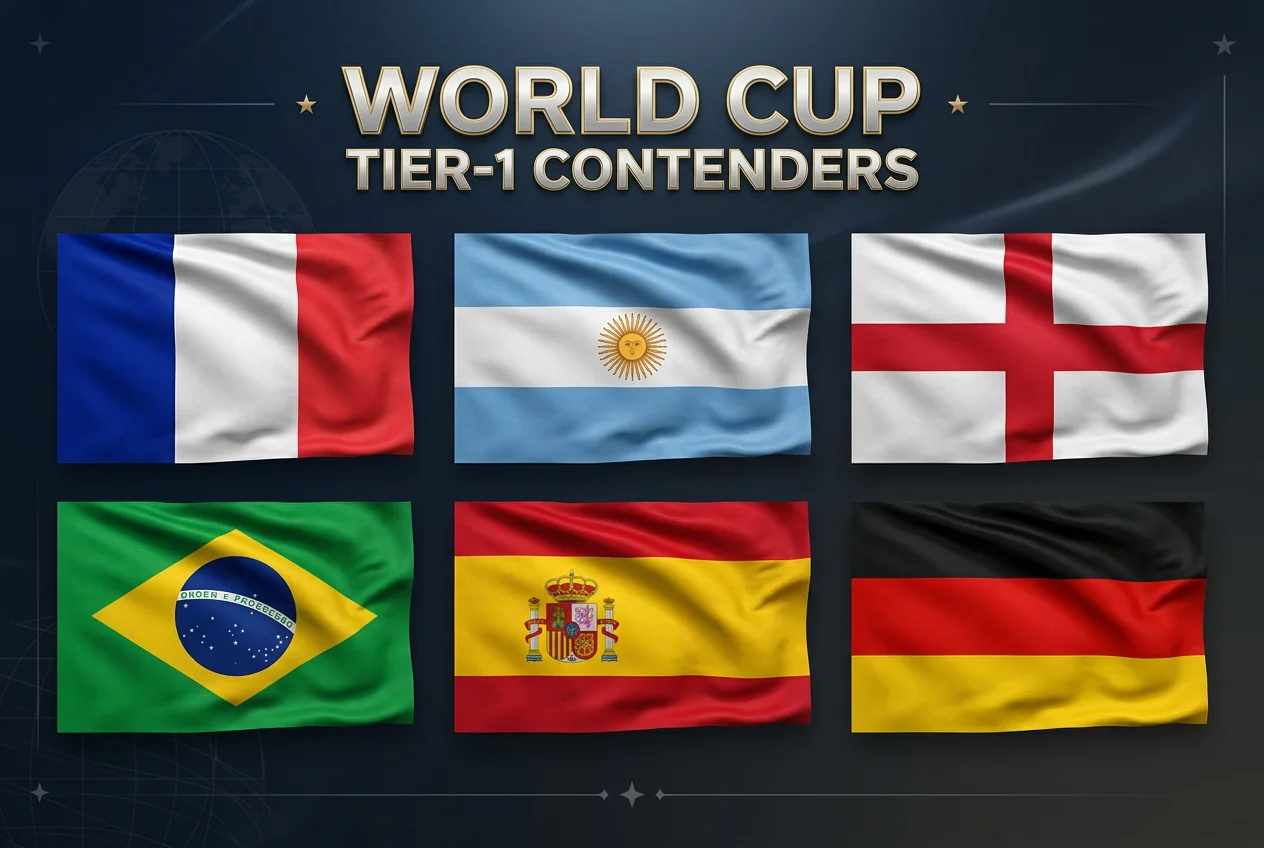
Germany rounds out Tier 1 with a redemption narrative that either validates their 2024 Euros resurgence or exposes it as a false dawn. Back-to-back group-stage exits in 2018 and 2022 humiliated a footballing nation accustomed to at least quarter-final appearances. Julian Nagelsmann’s appointment and the home Euros lifted German spirits, and a semifinal run on home soil suggested the corner had been turned. Florian Wirtz, Jamal Musiala, and an injection of young talent have revitalized a squad that looked finished three years ago.
Each Tier 1 team carries specific vulnerabilities that opponents will target. France’s depth masks occasional tactical predictability. Argentina’s Messi dependency could become Messi absence. England’s historical knockout fragility hasn’t fully disappeared. Brazil’s defensive structure remains more suspect than their attack is dominant. Spain’s youth cuts both ways in pressure moments. Germany’s recent tournament trauma could resurface when margins tighten. Title contender status means having the quality to overcome these limitations — not an absence of limitations altogether.
Tier 2 — Quarterfinalists and Dark Horses
Netherlands coach Ronald Koeman described his 2026 squad as “the best we’ve produced since 2010.” That may be hyperbole from a man whose job requires optimism, but the Dutch genuinely combine attacking firepower with defensive solidity for the first time in years. They headline a Tier 2 that features ten teams capable of reaching the quarter-finals and — with favourable draws and fortunate bounces — potentially deeper.
The difference between Tier 2 and Tier 1 comes down to consistency under pressure. Tier 2 teams can beat any opponent on a given day but haven’t demonstrated the ability to win six or seven consecutive knockout matches against escalating quality. Morocco proved in 2022 that Tier 2 assessments can be spectacularly wrong. Any of these ten squads could do the same.
Portugal carries star power that approaches Tier 1 levels but lacks the squad balance of the six teams above them. The Cristiano Ronaldo question — whether the 41-year-old still adds value to a tournament squad — overshadows discussion of a Portuguese core that includes Rúben Dias, Bruno Fernandes, and Rafael Leão. Portugal’s transition to a post-Ronaldo identity has been repeatedly delayed, and the 2026 World Cup may finally force the question.
Netherlands benefits from a golden generation timing that saw their best players mature simultaneously. Virgil van Dijk commands the defense, Frenkie de Jong and Cody Gakpo provide midfield and attacking thrust, and the Dutch approach features enough pragmatism to grind out results when technical superiority isn’t working. Group F pairs them with Japan, Tunisia, and Sweden — a demanding draw where no advancement is guaranteed.
Belgium’s golden generation reached the 2018 semi-finals and declined steadily thereafter. Kevin De Bruyne and Romelu Lukaku remain elite talents at 34 and 33 respectively, but the supporting cast that once ranked Belgium as FIFA’s number one nation has aged out or regressed. This tournament likely represents the final chance for this particular Belgian core, and desperation can fuel unexpected runs.
Croatia has defied demographic logic by reaching two of the last three World Cup finals or semi-finals. Luka Modrić at 40 stretches credibility, yet the squad surrounding him features Joško Gvardiol, Mateo Kovačić, and a midfield that never stops working. Croatian tournament pedigree commands respect regardless of objective squad assessment.
Uruguay punches above their weight in every tournament they enter. A nation of 3.5 million people has produced Darwin Núñez, Federico Valverde, and a competitive squad that drew Group H alongside Spain — an immediate test of their Tier 2 credentials. La Celeste lacks the depth to sustain a deep run through injuries but has the starting eleven quality to beat anyone over ninety minutes.
Morocco’s 2022 semi-final run demands ongoing respect. Achraf Hakimi and Sofiane Amrabat headline a squad that has added even more European club experience since Qatar. The Atlas Lions draw Group C with Brazil, Haiti, and Scotland — a group they could plausibly win if they replicate their 2022 form against Spain and Portugal.
Colombia enters after a Copa América final appearance and a qualification campaign that demonstrated genuine cohesion. Luis Díaz, James Rodríguez’s revival, and an energetic pressing system make Colombia dangerous to any opponent. Group K pairs them with Portugal, Uzbekistan, and DR Congo — a draw that offers a realistic path to the knockout rounds.
United States benefits from co-host status and a young core that has developed through European club football. Christian Pulisic, Weston McKennie, and Tyler Adams provide a spine that understands high-level pressure. The USMNT has talked about deep World Cup runs for decades without delivering one. This generation carries the weight of those expectations alongside the home-field advantage of playing in front of American crowds.
Japan fields perhaps the most European-integrated Asian squad in World Cup history. Players from the Premier League, Bundesliga, La Liga, and Serie A comprise a starting eleven that stunned Germany and Spain during the 2022 group stage. Group F with Netherlands, Tunisia, and Sweden presents a path to the knockout rounds if Japan’s club form transfers to international competition.
Switzerland draws Canada’s Group B and represents the most consistent of the consistent performers. The Swiss haven’t missed a World Cup or Euros knockout round since 2012, an eight-tournament streak built on organization rather than individual brilliance. Granit Xhaka captains a squad that won’t scare opponents but equally won’t beat themselves.
Tier 3 — Knockout-Round Hopefuls
Fourteen teams enter the 2026 World Cup with realistic knockout-round aspirations but face structural limitations that make quarter-final appearances unlikely. These squads typically possess one or two genuinely elite players surrounded by competent but unspectacular supporting casts. Their ceiling is a Round of 16 upset; their floor is a respectable group-stage exit where they take points off a bigger name.
Canada leads this tier from a Canadian perspective — and I’ll address CanMNT’s specific path in detail below. For now, note that co-host advantage, favourable Group B draw, and a generation of talent led by Alphonso Davies create genuine knockout-round expectations beyond mere participation.
Mexico enters every World Cup with passion that exceeds outcomes. El Tri hasn’t advanced past the Round of 16 since 1986, a streak that weighs heavily on a football-mad nation. Group A with South Korea, South Africa, and Czechia offers a manageable path to yet another knockout-round appearance — and then the familiar challenge of progressing further than seven consecutive generations have managed.
Senegal combines African football’s technical flair with European tactical discipline under Aliou Cissé. Sadio Mané aged out of his peak, but Ismaïla Sarr and emerging talents maintain the Lions of Teranga’s competitiveness. Group I alongside France, Norway, and Iraq presents the challenge of escaping a group headlined by a Tier 1 power.
Denmark impressed throughout Euro 2024 qualification before disappointing in the tournament proper. The Danish core of Christian Eriksen, Pierre-Emile Højbjerg, and a solid defensive foundation could have warranted Tier 2 placement in a different moment. Their 2024 struggles suggested timing issues that might resolve by June 2026.
Ecuador qualified by defeating Brazil during South American qualification, a result that earned respect beyond typical CONMEBOL newcomer expectations. Their young squad, highlighted by Moisés Caicedo’s emergence as a Premier League midfield star, brings energy and pressing intensity to Group E with Germany, Côte d’Ivoire, and Curaçao.
Serbia possesses attacking talent — Dušan Vlahović, Aleksandar Mitrović, and playmaking options — that deserves a deeper tournament run than they typically deliver. Balkan football underperforms tournament expectations with almost mechanical regularity. Whether Serbia breaks that pattern in 2026 depends on intangibles that resist prediction.
Côte d’Ivoire won the 2024 Africa Cup of Nations on home soil, a triumph that suggests tournament-winning capacity. Whether that form transfers to a World Cup stage against European and South American opposition remains uncertain. Group E with Germany offers an immediate test of their credentials.
South Korea fields Son Heung-min in what may be his final World Cup. The Tottenham captain has carried Korean hopes for a decade, and the supporting cast — while improved — doesn’t match Son’s individual quality. Group A with Mexico provides a fascinating matchup of historic underperformers.
Türkiye qualified through the playoffs after a Euro 2024 quarter-final run reignited national football optimism. Arda Güler’s emergence as a Real Madrid regular gives Türkiye a genuine star around whom to build. Group D alongside USA means facing another co-host, with both nations desperate to avoid early exits.
Australia has evolved from overachieving minnows to legitimate tournament participants. The Socceroos’ 2022 Round of 16 run proved they can compete at this level, even if they lack the depth to sustain it through multiple knockout rounds. Group D offers winnable matches against Paraguay and Türkiye.
Iran brings defensive organization and counterattacking efficiency to Group G with Belgium, Egypt, and New Zealand. Team Melli can frustrate opponents and nick results without ever controlling matches — a template that occasionally produces deep tournament runs but more often yields to superior quality.
Norway qualifies for their first World Cup since 1998, with Erling Haaland as the most dangerous single player in the tournament. A squad built around one generational talent can beat anyone over ninety minutes. Whether Norway has the supporting infrastructure to win multiple consecutive knockout matches is another question entirely.
Egypt qualifies behind Mohamed Salah, whose individual brilliance masks a squad that lacks comparable quality in most other positions. The Pharaohs can compete against anyone through Salah moments but will struggle to dominate possession or territory against organized opponents. Group G with Belgium represents a significant challenge.
Algeria enters with the talent to surprise and the organizational dysfunction to disappoint. Riyad Mahrez’s international career winds down, but a new generation featuring Amine Gouiri and Rayan Cherki provides attacking options. Group J alongside Argentina tests whether Algeria can replicate Saudi Arabia’s 2022 upset magic.
Tier 4 — Group-Stage Exits and Debutants
Eighteen teams enter the 2026 World Cup with outright odds exceeding 150.00. For these squads, the tournament represents achievement through qualification rather than realistic championship aspirations. Some will take points off bigger names. A few might even reach the knockout rounds through the expanded 48-team format’s best-third-place pathway. None should be expected to challenge for the trophy.
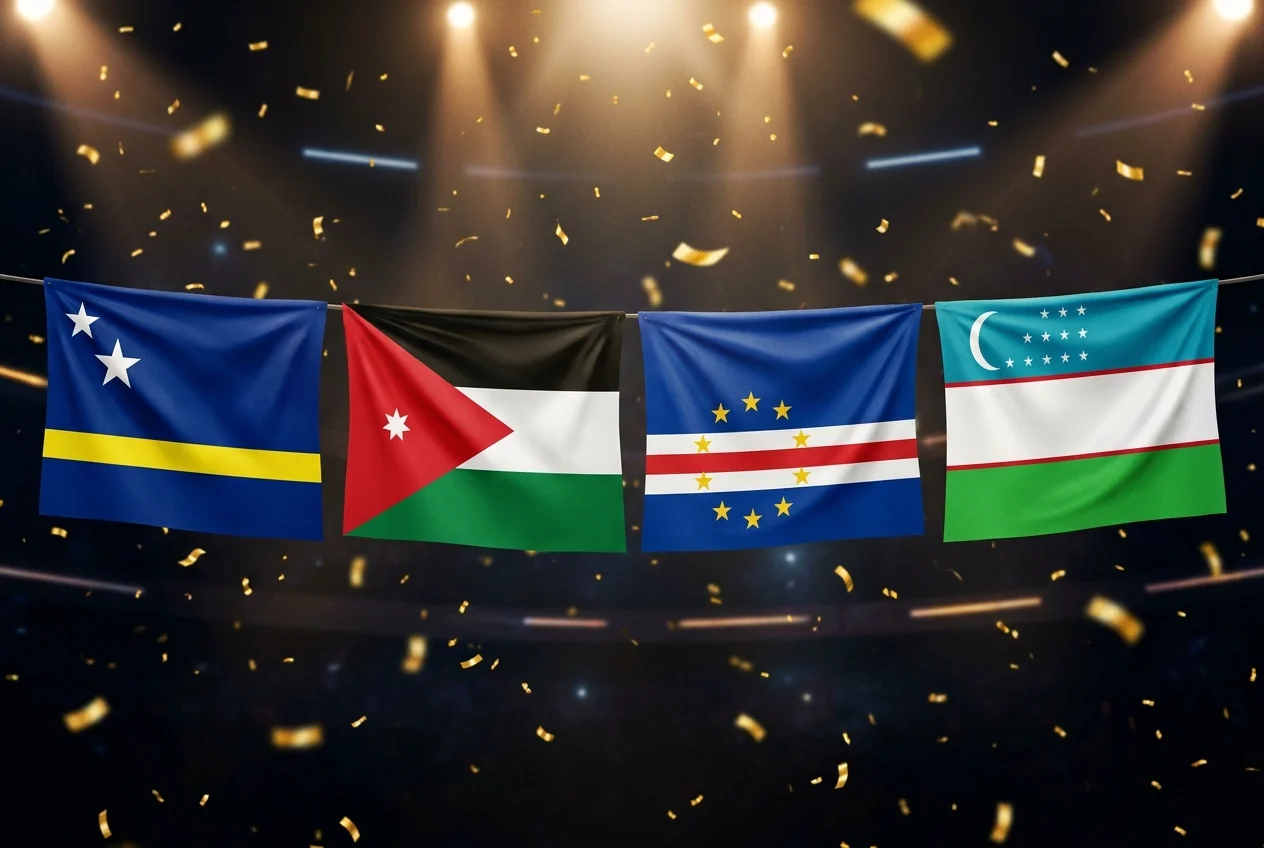
Tier 4 includes all four World Cup debutants — Curaçao, Jordan, Cape Verde, and Uzbekistan — alongside returning nations whose previous appearances ended in group-stage humiliation. These teams deserve respect for qualifying through competitive paths but face structural disadvantages that even flawless tournament execution cannot overcome.
Curaçao makes history as the smallest nation ever to qualify for a World Cup, with a population of approximately 150,000. The Dutch Caribbean island produced a squad through diaspora players carrying Dutch, Venezuelan, and other dual nationalities. Group E with Germany, Côte d’Ivoire, and Ecuador guarantees Curaçao will play in stadiums holding more people than live on their entire island. Every match is a celebration regardless of scoreline.
Jordan’s first World Cup qualification triggered national celebrations that exceeded any football result in the nation’s history. Yazan Al-Naimat and the domestic core supplemented by European-based players give Jordan a fighting chance to compete in Group J. Draws against Argentina seem unlikely, but taking points off Algeria or Austria enters the realm of possibility.
Cape Verde’s journey from a nation of 500,000 to World Cup participant represents one of the tournament’s most compelling stories. The island nation off West Africa has built a competitive squad through European diaspora players and domestic development. Group H with Spain, Saudi Arabia, and Uruguay offers little margin for error.
Uzbekistan qualified through Asia’s expanded pathway and brings genuine enthusiasm to their first World Cup. The Central Asian nation has developed a competitive regional presence without ever reaching the global stage. Group K alongside Portugal and Colombia presents immediate challenges that may overwhelm their preparations.
Qatar enters just four years after hosting the tournament, where they lost all three group-stage matches by a combined 7-1 scoreline. The 2022 performance represented the worst by any World Cup host in history. Group B with Canada, Switzerland, and Bosnia offers marginally more favorable matchups, but Qatar must demonstrate dramatic improvement to avoid another embarrassing exit.
Saudi Arabia peaked with their stunning 2022 upset of Argentina, then lost to Poland and Mexico to crash out in the group stage. The Green Falcons face Spain in Group H — a rematch of competitive 2022 lineups — with realistic hopes of progressing as a third-place finisher if they can replicate their upset potential.
Bosnia and Herzegovina qualified through the playoffs and face Canada in the Group B opener at BMO Field. The Bosnian golden generation of Džeko and Pjanić has passed, leaving a transitional squad that secured qualification through collective effort rather than individual brilliance. Their ceiling is third place in Group B; their floor is three losses.
Tunisia returns after a 2022 campaign where they drew with Denmark, beat France, and narrowly missed knockout qualification. The Eagles of Carthage consistently compete at World Cups without advancing, and Group F with Netherlands, Japan, and Sweden continues that pattern of difficult draws.
Czechia emerged from European playoffs to claim one of the tournament’s final spots. A transitional squad lacking the star power of their Euro 2004 generation enters Group A against Mexico, South Korea, and South Africa with modest expectations.
Sweden qualified through the playoffs after missing the 2022 World Cup entirely. The Swedish squad has regenerated since Zlatan Ibrahimović’s international retirement, building a younger identity that hasn’t yet proven itself on the global stage. Group F with Netherlands and Japan provides immediate tests.
Scotland returns after qualifying for consecutive major tournaments — a feat that would have seemed impossible a decade ago. Steve Clarke’s pragmatic approach produced results against Germany and Spain during Euro 2024. Group C with Brazil and Morocco demands similar giant-killing performances.
Ghana’s Black Stars carry historical tournament pedigree — 2010 quarter-finals, 2014 disappointment — without a current squad that matches those peaks. Group L alongside England and Croatia presents two matches against Tier 1 and Tier 2 opponents where points seem unlikely.
Panama returns for only their second World Cup after 2018’s maiden qualification ended in three group-stage losses. Group L with England, Croatia, and Ghana offers one potentially competitive fixture and two expected defeats.
Paraguay qualified from South American qualification but lacks the star power of peak Guaraní teams. Group D with USA, Australia, and Türkiye provides a path to potential knockout qualification through the best-third-place pathway, requiring Paraguay to compete rather than merely participate.
South Africa returns for the first time since hosting in 2010, when Bafana Bafana became the first hosts eliminated in the group stage. Group A’s opening match against Mexico at Estadio Azteca tests whether this generation can improve on that disappointing result.
Iraq qualified through Asian playoffs for their first World Cup since 1986. The Lions of Mesopotamia carry historical national football pride but enter Group I against France, Senegal, and Norway with minimal expectations of advancement.
New Zealand represents Oceania as the confederation’s sole qualifier. The All Whites’ only previous World Cup appearance in 2010 produced three draws and zero advancement. Group G with Belgium, Egypt, and Iran offers slightly more favorable odds of snatching points.
DR Congo qualified through African playoffs, securing their first World Cup appearance since 1974 when they played as Zaire. The Leopards’ return represents national pride above competitive expectation, with Group K alongside Portugal and Colombia providing daunting challenges.
Haiti qualifies for only their second World Cup, fifty-two years after their 1974 debut. The Caribbean nation has endured extraordinary off-field challenges, making qualification an achievement that transcends football. Group C with Brazil, Morocco, and Scotland provides minimal competitive margin, but every match represents history.
Canada’s Path — What the Tiers Mean for CanMNT
Alphonso Davies was nineteen years old when Canada qualified for the 2022 World Cup, ending a thirty-six-year absence from the tournament. The Bayern Munich fullback is now twenty-five, entering his athletic prime alongside a generation of Canadian players who have reached levels their predecessors never touched. Jonathan David scores goals for Lille in Ligue 1. Cyle Larin has bounced around European leagues while maintaining international scoring form. Tajon Buchanan brings pace and directness that terrifies fullbacks. Stephen Eustáquio provides midfield control that previous Canadian squads lacked entirely.
I rate Canada as a strong Tier 3 team — knockout-round hopeful with genuine upset potential. The tier system places them alongside Mexico, Senegal, and Denmark rather than with Switzerland or Uruguay in Tier 2. This assessment reflects historical tournament inexperience and defensive vulnerabilities more than any shortage of attacking talent. Canada can beat anyone in a single match. Whether they can win four or five consecutive knockout fixtures to reach a semi-final stretches credibility.
Group B represents the most favorable draw Canada could have reasonably expected. Switzerland provides legitimate Tier 2 competition — a team Canada must approach as equals rather than superiors. Qatar’s 2022 disaster suggests a beatable opponent despite their tournament hosting experience. Bosnia and Herzegovina qualified through playoffs and lack the individual quality to overwhelm Canadian defenders. This group invites Canada to not merely advance but to win it, securing a more favorable Round of 32 pathway.
The co-host advantage cannot be overstated. Canada plays all three group-stage matches on home soil — the June 12 opener against Bosnia and Herzegovina at BMO Field in Toronto, the June 18 match against Qatar at BC Place in Vancouver, and the crucial June 24 group finale against Switzerland also at BC Place. Home crowds, familiar conditions, minimal travel, and the psychological comfort of playing before Canadian supporters provide tangible competitive edges that tier rankings struggle to quantify.
If Canada wins Group B — which current odds price as genuinely plausible — they face a best-third-place opponent from Groups E, F, G, I, or J in the Round of 32 at BC Place on July 2. That pathway could mean Japan, Tunisia, Sweden, Norway, or Austria rather than a Tier 1 heavyweight. Advancing as group winners extends the home advantage and avoids the tournament’s most dangerous teams until the quarter-finals at earliest.
Finishing second in Group B produces a less favorable path — Round of 32 against Group A’s runner-up, likely Mexico or South Korea, at SoFi Stadium in Los Angeles on June 28. That match moves to American soil, eliminates home advantage, and potentially pits Canada against Mexico in a CONCACAF rivalry match carrying enormous regional significance. The difference between first and second place extends far beyond the group stage.
Canada’s tier placement matters for betting because it establishes expectations. Backing Canada to reach the quarter-finals offers value if you believe they can outperform Tier 3 projections. Backing them to win the World Cup at odds typically exceeding 50.00 requires a belief in massive tier transcendence that no analytical framework supports. The sweet spot for Canadian bettors lies in markets that reward knockout-round advancement without demanding championship glory — group winner, to reach Round of 16, to reach quarter-finals.
Best Value Bets by Tier
Value exists when odds exceed a team’s realistic probability of achieving an outcome. Finding value requires disagreeing with market consensus in ways that prove correct more often than wrong. These tier-based value assessments identify teams whose odds appear mispriced relative to their structural position and tournament context.
Within Tier 1, Spain offers the clearest value proposition at current odds typically ranging from 7.00 to 9.00 for the outright title. The Euro 2024 victory demonstrated that their young core can handle tournament pressure. Unlike France or Argentina, Spain doesn’t carry the psychological burden of recent finals losses or defending champion expectations. Their trajectory points upward while several peers have plateaued or begun declining. If you’re taking a Tier 1 team for the championship, Spain’s combination of quality and odds represents the most favorable ratio.
Tier 2 value concentrates in Morocco and Colombia. Morocco’s 2022 semi-final run wasn’t a fluke — the squad has maintained quality and added experience. Their outright odds between 25.00 and 40.00 underweight the possibility of another deep run. Group C with Brazil presents challenges, but Morocco already beat Spain and Portugal in 2022 knockout rounds. Writing them off as a one-tournament wonder ignores structural quality that persists.
Colombia entered 2024 as Copa América finalists and qualified for 2026 by playing some of the most attractive football in South American qualification. James Rodríguez’s revival and Luis Díaz’s Liverpool emergence provide star power that markets undervalue relative to European squads with comparable talent. Colombia at 25.00 to 35.00 for a quarter-final appearance offers better value than several Tier 1 teams’ outright odds.
Tier 3 value lies in Canada and Norway for different reasons. Canada’s co-host advantage, favorable group draw, and generational talent peak create conditions for outperformance that pure squad analysis misses. Markets pricing Canada to win Group B around 3.50 underestimate the cumulative impact of three home matches and legitimate quality at key positions.
Norway’s value case centers entirely on Erling Haaland. A striker who has scored over forty goals per season for Manchester City enters a tournament where he’s only ever played once — the 2022 World Cup that Norway failed to qualify for. Haaland has never experienced World Cup pressure. He might struggle. He might also score eight goals and drag Norway to the quarter-finals through sheer individual dominance. At odds typically around 80.00 to 100.00 for deep tournament advancement, the upside potential justifies the risk.
Tier 4 offers minimal outright value because structural limitations are real. However, specific match markets and group-stage propositions create opportunities. Saudi Arabia to upset Spain in Group H echoes their 2022 Argentina match. Qatar to beat Bosnia and Herzegovina represents a winnable fixture for a team that has improved since their hosting disaster. These narrow markets offer value that tournament outrights cannot.
The most dangerous value trap involves backing aging golden generations at inflated odds. Belgium, Croatia, and Portugal all feature legendary players in their final tournaments, and nostalgia inflates public money on sentimental favourites. Markets correct for this overexposure, meaning genuine value often lies in fading these squads rather than backing them. When Kevin De Bruyne and Luka Modrić exit this World Cup, their nations won’t automatically replace them with comparable talents.
Reading the Field Before Kickoff
Forty-eight teams. Four tiers. One trophy. The analytical framework above provides structure for approaching a tournament that will inevitably defy predictions at multiple turns. Germany looked vulnerable before 2014 and won the World Cup. France looked invincible before 2002 and crashed out without scoring a goal. Morocco looked like first-round fodder before 2022 and reached the semi-finals. Tiers describe probability distributions, not certainties.
The expanded 48-team format makes prediction even harder. Eight best third-place finishers advance to the knockout rounds, meaning teams with four points — or even three — might progress depending on goal difference calculations across twelve separate groups. A single upset ripples through bracket projections in ways that 32-team tournaments didn’t produce. More variables create more variance.
Use these tier rankings as starting points rather than conclusions. When you see Canada priced at 3.50 to top Group B, ask whether that reflects a Tier 3 team’s realistic ceiling or whether co-host advantages justify lower odds. When you see Belgium at 15.00 for the title, ask whether their aging stars can sustain knockout-round intensity or whether market sentiment reflects past glory more than present reality. When you see Curaçao at 1000.00, recognize that some odds accurately price near-impossibility rather than undervaluing hidden quality.
The tournament begins June 11 at Estadio Azteca. Between now and then, injuries will reshape squads, form will fluctuate through final preparation matches, and late-breaking news will shift odds across every market. This overview captures the field as it stands in April 2026. Staying informed requires ongoing attention through the final days before kickoff.
