
Canada World Cup 2026 — Betting Picks, Odds & Group B Guide | KICKSTAKE
 Available in US
Loading...
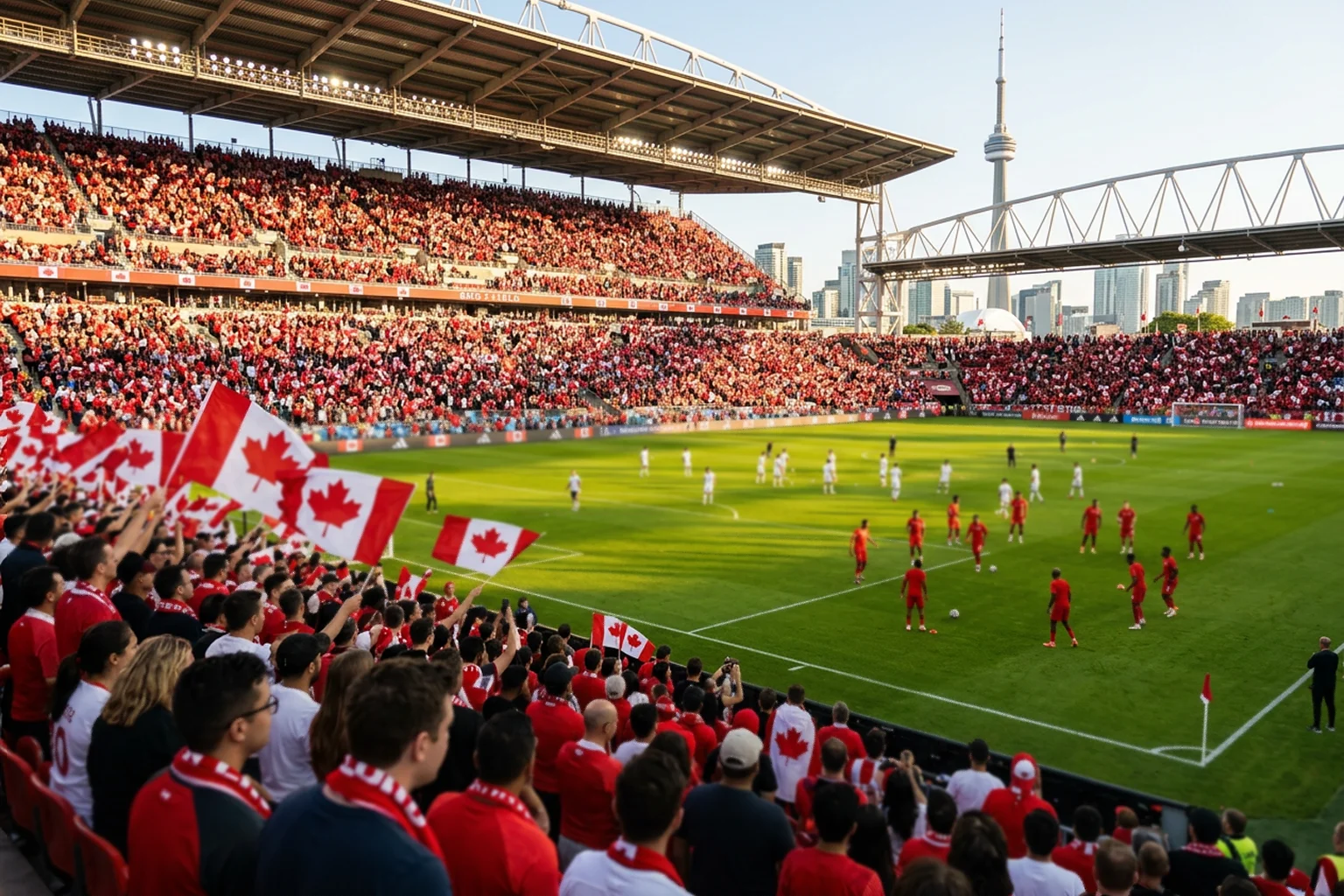
Thirty-six years between World Cup appearances. Then two in a row. And now, for the first time in history, the tournament comes to Canada. I was in Doha when the CanMNT took the pitch against Belgium in November 2022 — their first World Cup match since 1986 — and the atmosphere among the Canadian contingent carried an energy that transcended the 0-1 loss. That energy multiplies exponentially when the same squad walks onto BMO Field in Toronto or BC Place in Vancouver with home supporters creating noise levels opponents have never faced from a Canadian crowd.
Canada World Cup 2026 betting presents something genuinely unprecedented: a host nation whose soccer trajectory has shifted dramatically in the past five years, now entering a major tournament with home-field advantage, a golden generation of players, and a draw that looks navigable on paper. This page breaks down everything I see from a betting perspective — the squad dynamics, the Group B opposition, match-by-match analysis, odds positioning, and where value might hide in this historic campaign.
The Squad That Makes History Feel Possible
During qualifying for the 2022 World Cup, I tracked CanMNT matches from the opening window through that November night in Qatar. What struck me was not individual brilliance — though there was plenty — but the collective belief that permeated the group. That intangible quality matters for betting because it influences performance in pressure moments: late-game scenarios, penalty areas, the mental grind of tournament soccer.
Alphonso Davies remains the headline, and rightfully so. His transition from Vancouver Whitecaps academy product to Champions League winner with Bayern Munich and now Real Madrid establishes him among the elite left-backs globally. In national team context, Davies often pushes higher, contributing to attacks in ways his club roles sometimes restrict. Against Bosnia and Herzegovina, expect him to torment right-sided defenders with pace that distorts defensive shapes. His presence stretches pitches, creates space for central players, and demoralizes opponents who cannot match his acceleration. For prop bets involving assists or chances created, Davies merits attention throughout the group stage.
Jonathan David anchors the attack. His scoring record at Lille — thirty-plus goals across consecutive Ligue 1 seasons — confirms an instinct for finding the net that translates internationally. David plays as a nine who combines movement, finishing composure, and link-up intelligence. He took Canada’s first World Cup goal in 2022 against Croatia (via an own goal he forced) and has scored across European and CONCACAF competition consistently. Betting on David to score anytime in any given group match offers value when his odds drift, though favorites pricing limits expected value. Tournament top scorer for Canada is a market worth exploring given his likely minutes and positioning.
Cyle Larin brings physicality and aerial threat. At 188 centimeters, Larin wins headers in both boxes and offers a Plan B when opponents pack central areas. His club career has taken him through Turkey, Belgium, and Spain, with varying degrees of success, but international duty often extracts his best performances. In matches where Canada needs to force late equalizers or chase results, Larin’s introduction changes the tactical picture. Set-piece betting — first goal header, any goal header — suits his skill set in specific game states.
Tajon Buchanan provides versatility across the front line. He can operate as a winger, wing-back, or even inverted forward depending on tactical needs. Buchanan’s move to Inter Milan raised his profile but limited minutes behind established starters. National team duty gives him runway, and his pace and directness complement Davies on the opposite flank. Canada’s ability to stretch opponents horizontally owes much to Buchanan’s off-ball movement.
Stephen Eustáquio controls midfield with a mature understanding of tempo and positioning. His time at Porto refined a game already impressive during CONCACAF qualifiers. Eustáquio dictates passing rhythm, recovers possession efficiently, and takes set pieces. His influence is quieter than Davies or David but equally critical to how Canada performs against organized defenses.
Jesse Marsch inherited a squad built by John Herdman and has impressed this attacking identity with greater tactical flexibility. Marsch’s experience in the Bundesliga, Premier League, and MLS gives him reference points for both the physicality of CONCACAF and the technical demands of European opposition like Switzerland. His emphasis on pressing, transitions, and organized defensive structures suits a tournament environment where opponents rotate less frequently than domestic leagues. The coaching setup represents a strength rather than a question mark heading into June.
Group B Opponents — What the Numbers Say
Switzerland, Qatar, and Bosnia and Herzegovina. On paper, this draw falls somewhere between favorable and manageable. No traditional powerhouse lurks. No Group of Death designation applies. Yet each opponent presents distinct challenges that require tactical preparation and betting calibration.
Switzerland arrives as the most credentialed side. The Swiss have reached knockout rounds at each of the past four major tournaments — World Cups in 2018 and 2022, European Championships in 2020 and 2024. That consistency reflects deep squad talent, coaching continuity under Murat Yakin, and a cultural expectation of advancement. Switzerland plays pragmatic, defensively solid soccer that frustrates opponents expecting easy dominance. Granit Xhaka marshals midfield with physical presence and experience. Breel Embolo offers goal threat from central positions. Switzerland rarely capitulates but also rarely overwhelms. Matches involving them tend toward modest totals — under 2.5 goals hits frequently in their tournament history. Canada versus Switzerland on June 24 in Vancouver likely decides group positioning, and the betting angle involves respecting Swiss defensive structure rather than expecting blowouts.
Qatar enters its second consecutive World Cup after hosting in 2022. That edition went poorly: three group-stage losses, zero goals scored, early elimination as expected once the home advantage of controlled environments dissipated. This Qatar side has rebuilt somewhat, adding younger players alongside veterans of the 2022 squad, but remains limited at World Cup level. Akram Afif provides creative spark; Almoez Ali offers experience. The defensive unit, however, has struggled against fast, direct attacks in Asian qualifying and international friendlies. Canada’s speed through Davies and Buchanan could exploit transitional vulnerabilities. This match on June 18 in Vancouver represents Canada’s clearest path to three points, and betting markets should reflect that expectation through pricing.
Bosnia and Herzegovina qualified via European playoffs, indicating a squad capable of knockout-format pressure without top-tier European consistency. The team lacks household names but possesses organizational competence and defensive resolve. Edin Džeko, if fit and selected at his age, adds experience and aerial presence. Younger players have emerged through qualifying to add dynamism. Bosnia will park defensively against a host nation in Toronto and look to counter or steal a set-piece goal. This opener on June 12 carries enormous stakes — Canada winning sets up the group optimally; Canada dropping points introduces pressure. Betting on Canada to win with modest margins reflects the likely tactical reality.
Match-by-Match Breakdown
Each of Canada’s three group matches carries distinct context. Let me walk through them with the specificity that betting preparation demands.
June 12, BMO Field, Toronto: Canada versus Bosnia and Herzegovina. The first World Cup match on Canadian soil since 1986 happens here. Atmosphere will reach fever pitch, and the Canadian players — many of whom grew up attending TFC matches at this stadium — will feel the weight of the moment. Bosnia knows this and will attempt to silence the crowd early, sitting deep and absorbing pressure. Canada’s challenge involves patience: breaking down a compact defense without forcing the issue. Expect low first-half scoring, with Canada’s best chances coming from wide areas and set pieces. The match result market may favor Canada at prices around 1.80-1.90 decimal odds, reflecting home advantage and squad quality. Value potentially exists in half-time draw or under 1.5 first-half goals if Bosnia’s approach plays out. For the full ninety minutes, I lean toward Canada winning by a single goal — 1-0 or 2-1 — rather than a comfortable margin.
June 18, BC Place, Vancouver: Canada versus Qatar. This match moves to the Pacific coast, kickoff at 6:00 PM Eastern (3:00 PM local). BC Place’s retractable roof eliminates weather variance, and the crowd will match Toronto’s intensity. Qatar’s 2022 failures loom over this matchup, and the psychological edge favors Canada. Tactically, expect Canada to dominate possession and territory. Qatar will struggle to sustain pressure or create quality chances. The question is how many goals Canada can score, not whether they win. Betting on Canada to win by two or more goals, or correct scores of 2-0, 3-0, 3-1, offers potential value depending on pricing. Over 2.5 total goals fits if Canada controls tempo and scores early; under 2.5 remains possible if Canada wins 1-0 or 2-0 in a methodical display. Jonathan David to score anytime should price attractively here.
June 24, BC Place, Vancouver: Switzerland versus Canada. The group-stage finale often determines final standings, and this match likely decides who tops Group B versus who finishes second. Switzerland’s disciplined approach limits open play. Canada’s ability to break down organized defenses — tested less frequently than their transition excellence — gets examined. If both teams have already qualified heading into this match, rotation could factor. If one needs a result, intensity shifts. This match profiles as the tightest of the three, with draw the most probable outcome if both approach conservatively. Under 2.5 goals hits frequently in Swiss tournament matches. Betting on draw-or-Switzerland or under totals reflects their defensive identity. Canada winning outright requires something they have rarely demonstrated: patience against a European side that invites pressure and counters precisely.
Home Advantage — More Than Noise
The last host nation to fail exiting the group stage at a World Cup was South Africa in 2010, and they faced tougher opposition than Canada draws in Group B. Host advantage encompasses crowd support, familiar conditions, reduced travel, and psychological comfort. For betting purposes, quantifying this advantage matters.
Research on home advantage in international soccer suggests roughly a ten-percent boost in win probability compared to neutral venues. Canada plays all three group matches domestically — two in Vancouver, one in Toronto. Switzerland, Qatar, and Bosnia travel across time zones, adjust to North American conditions, and face hostile environments. This compounds the quality gap already favoring Canada over Qatar and Bosnia.
Time zone familiarity affects physical performance. Canada’s players, many based in European leagues, will have returned to North American schedules weeks before the tournament. Opponents arriving from Europe and Asia face jet lag adjustment during critical preparation windows. Vancouver’s Pacific timezone means 3:00 PM local kickoffs translate to late night in Europe — opponents’ body clocks may not sync perfectly with match demands.
Crowd acoustics matter for communication. BC Place’s enclosed roof amplifies sound levels beyond typical outdoor stadiums. BMO Field’s intimate capacity — expanded for World Cup but still relatively compact — places supporters close to the pitch. Opponents attempting to organize defensive walls, coordinate pressing triggers, or communicate set-piece assignments face acoustic challenges they may not have encountered in qualifying.
Familiarity with pitch surfaces, dimensions, and stadium layouts gives Canada subtle advantages. Players who have trained and competed at these venues understand sight lines, how balls travel, where shadows fall during evening matches. These micro-factors rarely decide matches alone but accumulate across ninety minutes.
Odds Positioning and Where Value Hides
Current outright markets price Canada somewhere between twenty and thirty to one for tournament winner — longer than most co-hosts historically command. This reflects global skepticism about Canada’s ceiling despite favorable circumstances. I disagree with the assessment but acknowledge the challenge of backing Canada at those prices given bracket paths that likely include elite opponents by quarter-finals.
Group B winner odds represent the more actionable market. Canada and Switzerland typically price similarly, between even money and slight odds-against. I view Canada as undervalued here because home advantage over three matches tips close races, and Switzerland’s road record at major tournaments is less impressive than their overall knockout consistency. Betting Canada to win Group B at anything above even money offers value.
To reach the quarter-finals — a market some operators offer — requires Canada winning Group B and then defeating a Round of 32 opponent (likely a third-place finisher from another group) followed by a Round of 16 win (likely against a Group A runner-up or similar). The path exists without facing elite opposition until later rounds. Canada reaching quarters prices at longer odds than progression chances justify, making this market interesting for tournament accumulators.
Individual match markets reward attention to specific game states. Canada to win first half at home prices longer than their dominance probability suggests. Both teams to score in Canada-Switzerland offers value if you believe Canada’s attacking quality forces even defensively solid opponents into compensating. Clean sheet bets against Qatar could land if Canada’s defense, often overlooked amid attacking narratives, maintains the solidity shown during qualifying.
Player props merit scrutiny. Alphonso Davies to record an assist prices based on attacking output that his national team role often exceeds compared to club duties. Jonathan David to score two or more goals across the group stage — priced as an accumulator — reflects his finishing quality against the opponents he will face. Stephen Eustáquio to receive a yellow card prices on discipline profiles that may undervalue his tendency for tactical fouls in tight matches.
If Canada Advances — The Knockout Path
Group B winners play their Round of 32 match on July 2 at BC Place in Vancouver — a fourth consecutive home game for Canada if they top the group. The opponent would come from the best third-place teams, likely representing Groups E, F, G, I, or J. These teams might include Ecuador, Tunisia, Sweden, Norway, or Austria — none of whom represent insurmountable obstacles. A home knockout match against a wounded third-place finisher profiles well for Canada.
Group B runners-up face a tougher path: a June 28 match at SoFi Stadium in Los Angeles against the Group A runner-up. Mexico, South Korea, South Africa, or Czechia could occupy that slot. Mexico in Los Angeles offers Mexico near-home advantage given the city’s demographics, a significant swing against Canada. South Korea or Czechia would be more neutral. This bracket disparity makes topping the group valuable beyond pride.
Beyond the Round of 32, Canada’s path depends on bracket unfolding. Round of 16 opponents could include Group A winners (likely Mexico) or Group D winners (likely USA). The prospect of Canada versus USA in a World Cup knockout match — hosts colliding — represents the marketing dream and a genuinely competitive fixture. Betting on such a match materializing requires both teams winning their groups and Round of 32 matches, an accumulator with reasonable probability.
Quarter-finals likely bring elite European or South American opposition depending on bracket half. France, Spain, Argentina, and Brazil occupy different bracket sections. Reaching that stage would represent a historic Canadian achievement; progressing further enters aspirational territory that current squad depth may not support. For betting purposes, Canada reaching quarters offers value; Canada reaching semifinals requires tournament chaos or a bracket draw softer than expected.
Three Value Bets Worth Considering
After nine years covering tournament betting, I have learned that value concentrates in specific market inefficiencies. Here are three angles on Canada that price better than probability suggests.
Canada to win Group B at plus-odds. The home advantage over three matches, combined with Switzerland’s inconsistent road tournament performances and Canada’s quality edge over Qatar and Bosnia, makes group-winning probability higher than markets imply. If this prices at plus-110 American odds or equivalent, the expected value calculation favors the bet.
Jonathan David to finish as Canada’s top group-stage scorer at plus-money. David starts every match, takes penalties if awarded, and operates in finishing positions. Alphonso Davies may price similarly but creates rather than finishes. Cyle Larin offers competition but likely starts fewer minutes. David’s strike rate justifies expectation of multiple goals across three group matches.
Canada to win to nil in at least one group match. Qatar’s offensive limitations make a clean sheet likely in that fixture. Bosnia’s defensive focus could also yield a 1-0 or 2-0. Bookmakers often price win-to-nil aggregates across multiple matches inefficiently. Combining favorable individual probabilities into a “Canada wins to nil at least once” bet captures value across the group.
The broader point transcends these specific bets. Canada enters the 2026 World Cup with the most favorable combination of circumstances in the nation’s soccer history: home advantage, a manageable group, a deep and experienced squad, and a coach who understands tournament demands. The market has not fully priced this confluence. Whether through group winner markets, player props, or match-specific angles, opportunities exist for bettors who recognize what this moment represents for Canadian soccer.
