
2026 World Cup Group Stage Predictions — All 12 Groups | KICKSTAKE
 Available in US
Loading...
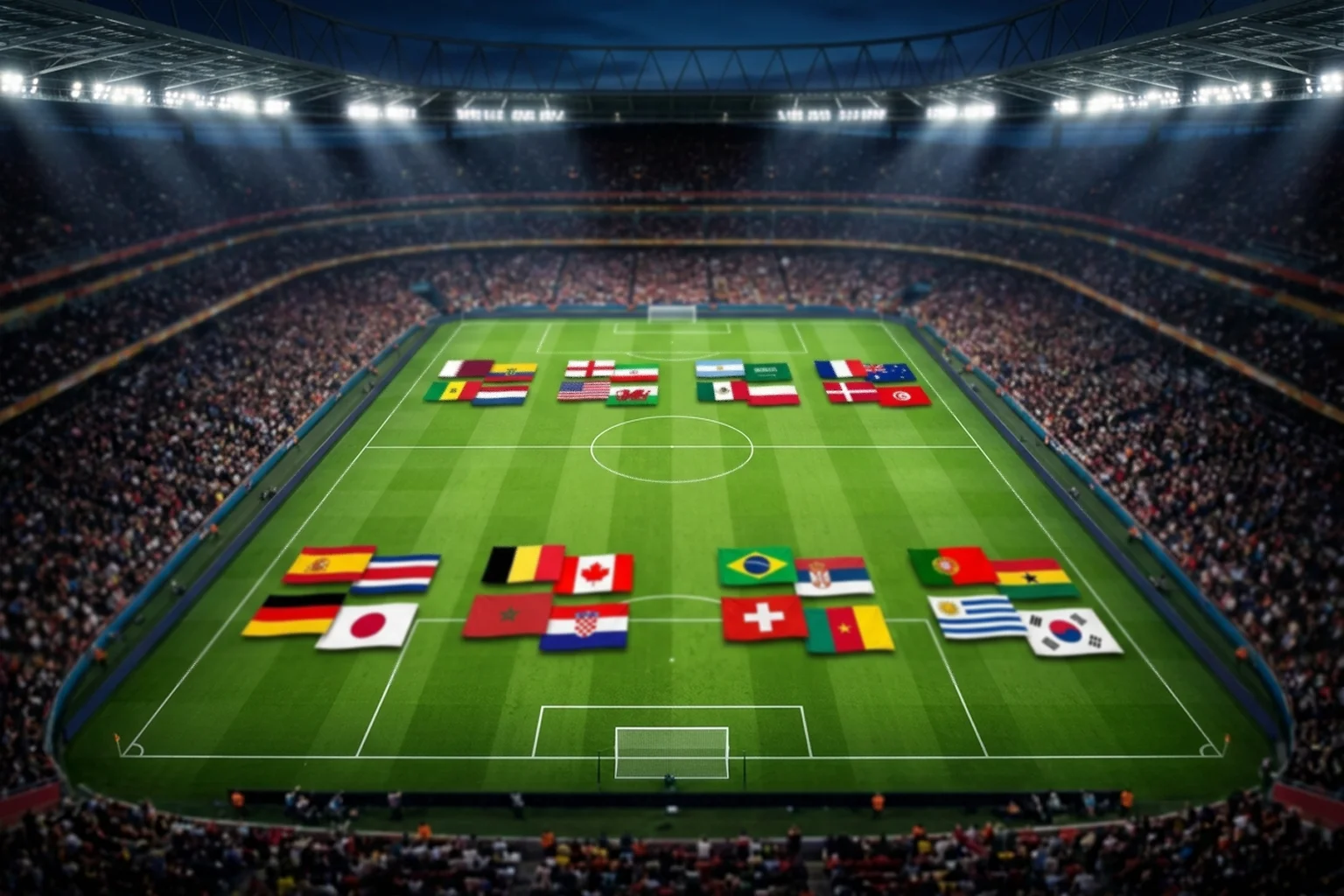
Three weeks. Twelve groups. Thirty-two teams advancing. Eight going home with their heads held high as best third-place finishers. And forty more packing their bags before the real tournament begins. These are my group stage predictions for the 2026 World Cup — every advancement call, every upset watch, every confidence rating laid bare for you to agree with, argue against, or completely ignore when building your betting strategy.
I’ve spent the past several months analyzing qualification campaigns, tracking friendlies, monitoring injury lists, and running probability models against historical World Cup data. What follows isn’t guesswork — it’s a synthesis of form, tactical matchups, tournament experience, and that ineffable quality that separates teams who thrive under pressure from those who buckle. The 48-team format means more pathways through the group stage than ever before, but it also means more traps, more surprises, and more opportunity for the sharp bettor who spots value before the casual fan catches up.
How I Approach These Predictions
Before I dive into the groups themselves, let me explain what’s actually happening under the hood. Every analyst has their methodology, and transparency matters when you’re using someone else’s picks to inform your own decisions.
I weight four primary factors when projecting group stage outcomes. First: current form, measured over the 12 months preceding the tournament. This captures the team’s recent competitive rhythm, which matters enormously when you’re playing three games in roughly ten days. A team that’s been playing meaningful matches — Nations League, qualifiers, continental competitions — enters with sharper reflexes than one that’s coasted on reputation alone.
Second: tournament pedigree. World Cups have their own internal logic. Teams like Croatia and Morocco have proven they understand the knockout-or-nothing mentality that defines these events. Others — Belgium immediately comes to mind — have the individual talent but somehow implode when the stakes reach their peak. I track how squads and coaching staffs perform specifically in World Cup environments, not just in qualifiers against weaker opposition.
Third: tactical matchups within the group itself. A team might be objectively weaker than their opponent but stylistically equipped to frustrate them. Japan’s high-pressing game, for instance, causes problems for possession-dominant sides who expect time on the ball. I analyze head-to-head dynamics within each group, looking for mismatches that raw FIFA rankings miss entirely.
Fourth: the intangibles. Home advantage for the three co-hosts. Travel distances and climate adaptation. Depth of squad, because this format compresses fixtures and punishes teams relying on eleven players. Coaching experience at major tournaments. Even fan support — playing in front of 70,000 supporters who chant your name versus a neutral or hostile crowd genuinely affects performance.
For each group, I assign a confidence rating from one to five. A five doesn’t mean I’m certain — nothing in football is certain, as Leicester City’s 5,000-to-1 Premier League triumph taught us. It means the outcome feels predictable within normal variance. A one means the group is genuinely chaotic, and betting the favorite carries substantial risk. Use these ratings to calibrate your own conviction.
Groups A Through D — The Americas and Co-Hosts
Let me start where the tournament itself starts: with Mexico hosting the opener at Estadio Azteca on June 11. Group A features Mexico, South Korea, South Africa, and Czechia — a mixture of co-host pressure, Asian consistency, African unpredictability, and European grit.
Mexico to advance: confidence 4/5. El Tri haven’t missed a knockout round since 1978, and they’re not starting now on home soil. Their supporters will pack every stadium, their players know the altitude and conditions, and manager Jaime Lozano has built a squad that blends experienced Liga MX stalwarts with European-based talent. South Korea pushes them close — Son Heung-min remains world-class even as he ages, and the Koreans’ fitness and tactical discipline travel well. I have Mexico first, South Korea second.
The upset watch here is South Africa. Bafana Bafana qualified with genuine momentum, their domestic league has improved dramatically, and they caught lightning in a bottle during AFCON qualifying. If South Korea rotate heavily in game three thinking they’ve secured qualification, South Africa could steal the points needed for a best third-place finish. Czechia, while technically sound, lack the firepower to challenge all three opponents.
Group B belongs to Canada by birthright — or at least that’s what home advantage and a favorable draw suggest. Canada, Switzerland, Qatar, and Bosnia and Herzegovina compete across Toronto and Vancouver, with the hosts playing all three matches on Canadian soil. My confidence in Canada advancing sits at 4/5, driven almost entirely by location. Jesse Marsch’s squad has genuine talent — Alphonso Davies remains one of the world’s best left-backs, Jonathan David has proven himself in Ligue 1, and the defensive spine has solidified over the past two years. They’ll be heavily backed by home crowds who’ve waited decades for this moment.
Switzerland advances as runners-up, confidence 3/5. The Swiss are tournament specialists who grind out results against technically superior opposition. Their midfield discipline frustrates creative teams, and they rarely lose games they should win. Qatar, despite being 2022 hosts, struggled outside their own environment and lack the quality to trouble either favorite. Bosnia brings genuine European pedigree but arrived through playoffs and haven’t played at a World Cup since 2014 — too much rust to overcome a Swiss machine.
Group C is Brazil’s to lose, and historically, Brazil doesn’t lose group stages. They’ve won their group in six of the last eight World Cups. Morocco, Haiti, and Scotland complete the quartet. Brazil first feels obvious — my confidence is 5/5 on their advancement, though whether they finish first or second depends on Morocco’s ambition. The Atlas Lions proved in 2022 that they can compete with anyone, and Walid Regragui has kept the core together while adding emerging talent. Morocco second, confidence 4/5.
Haiti and Scotland compete for pride more than advancement. Scotland’s 2022 didn’t happen — they failed to qualify — and their 2024 Euros ended with zero points and early elimination. Steve Clarke’s side is structured but lacks goals. Haiti are World Cup debutants in the modern era, riding CONCACAF momentum but facing a significant quality gap.
Group D is where the tournament’s first major narrative unfolds: USA on home soil with everything to prove. Paraguay, Australia, and Türkiye stand between the Americans and a Round of 32 place. I have USA first with 4/5 confidence — the young core of Christian Pulisic, Weston McKennie, and Tyler Adams has matured, the home crowds will be deafening, and Gregg Berhalter (or whoever coaches by then) has had years to prepare for this exact moment.
The second spot is tighter. Türkiye qualified through playoffs but possess individual brilliance in Arda Güler and Hakan Çalhanoğlu. Australia grind out results — they’ve made the Round of 16 before and have a coach in Graham Arnold who understands tournament football. Paraguay rebuild continually but never quite reach their historical peaks. I lean Türkiye second, but this is a 2/5 confidence call. Any of the three could take it.
Groups E Through H — Europe’s Heavyweights
Group E brings Germany’s redemption arc into focus. Two consecutive group-stage exits — 2018 and 2022 — have wounded German football’s pride. They face Côte d’Ivoire, Ecuador, and Curaçao in a draw that practically demands they advance. My confidence in Germany is 4/5, docked one point because of those recent failures. Julian Nagelsmann has rebuilt around young talent like Jamal Musiala and Florian Wirtz, but this generation hasn’t proven themselves when World Cup pressure arrives.
Côte d’Ivoire takes second, confidence 3/5. The Elephants won AFCON 2024 on home soil and have momentum that African teams rarely carry to World Cups. Sébastien Haller leads a balanced attack, and their midfield features multiple players at top European clubs. Ecuador are dangerous — their 2022 squad impressed before falling to Senegal — but they’ve lost key players and haven’t replaced them adequately. Curaçao, the smallest nation ever to qualify for a World Cup by population, will celebrate every moment but aren’t advancing.
Group F might be the tournament’s most balanced quartet. Netherlands, Japan, Tunisia, and Sweden — four teams who could realistically finish anywhere from first to fourth. I’m giving Netherlands top spot at 3/5 confidence, acknowledging that Dutch football has been inconsistent since their 2022 quarterfinal exit. Ronald Koeman’s side relies heavily on individual brilliance from Virgil van Dijk and Cody Gakpo, but when that brilliance arrives, it’s devastating.
Japan takes second, confidence 3/5. The Samurai Blue have beaten Germany and Spain in recent World Cups — they’re past the point where anyone should underestimate them. Their domestic league has improved, their European exports multiply each year, and manager Hajime Moriyasu has instilled a fearless attacking mentality. Tunisia could play spoiler if either favorite stumbles, and Sweden’s rebuild under Jon Dahl Tomasson has produced promising results without yet proving tournament-ready.
Group G features Belgium’s final chance at redemption. The “golden generation” — De Bruyne, Lukaku, Courtois — are reaching the end of their international careers without a major trophy. Egypt, Iran, and New Zealand round out the group. Belgium first at 3/5 confidence, reflecting my genuine uncertainty about whether this group still has the collective hunger to grind through difficult matches. Their 2022 was disastrous: out in the group stage with a whimper rather than a bang.
Egypt advances second at 3/5 confidence. Mohamed Salah remains one of the world’s best players, and if he produces three standout performances in the group stage, Egypt qualify regardless of their supporting cast. Iran are tough to break down but rarely convert defensive solidity into advancement. New Zealand represent Oceania proudly but face a quality gap that competitive spirit alone can’t bridge.
Group H is a blockbuster: Spain and Uruguay in the same group, with Saudi Arabia and Cape Verde completing the quartet. Spain advances first at 4/5 confidence — they’re reigning European champions with perhaps the most talented young squad in world football. Pedri, Gavi (if fit), Lamine Yamal, and Nico Williams represent a generational shift that peaked perfectly for Euro 2024. Luis de la Fuente has found the formula.
Uruguay takes second at 3/5 confidence. La Celeste always compete at World Cups — their DNA demands it. Marcelo Bielsa has injected fresh ideas into an aging core, and new talents like Facundo Pellistri provide the pace that Darwin Núñez and Federico Valverde’s creativity needs. Saudi Arabia could shock again (everyone remembers Argentina 2022), but lightning rarely strikes twice. Cape Verde are tournament debutants who’ll enjoy the occasion without threatening advancement.
Groups I Through L — South American Flair
Group I is France’s to control. The 2018 champions and 2022 finalists enter as perpetual favorites, and their squad depth is almost unfair. Senegal, Norway, and Iraq provide opposition that ranges from dangerous to developmental. France first at 5/5 confidence — Kylian Mbappé alone should be enough, and he’s surrounded by talent that most nations can only dream about.
Senegal takes second at 3/5 confidence. The Lions of Teranga lost Sadio Mané to age and injury but still boast quality throughout their squad. Édouard Mendy in goal, Kalidou Koulibaly in defense, and Ismaïla Sarr in attack form a spine that can challenge anyone on a good day. Norway’s Erling Haaland factor creates uncertainty — if he hits form, they could upset Senegal for second. But Norway have historically underperformed at major tournaments, and I’m not betting against that trend until proven otherwise. Iraq are debutants through playoffs and will struggle against all three opponents.
Group J features the defending champions: Argentina with Lionel Messi potentially playing his final World Cup. Algeria, Austria, and Jordan complete the group. Argentina first at 5/5 confidence — they’ve won Copa América twice and the World Cup since their last group-stage slip in 2002. Whether Messi plays every minute or manages his fitness, Lionel Scaloni’s squad is deep enough to handle group-stage opponents without breaking stride.
Algeria advances second at 3/5 confidence. The Fennecs have genuine talent — Riyad Mahrez may be past his peak, but players like Ismaël Bennacer and Yacine Adli have emerged at top European clubs. Austria are dangerous with Marko Arnautović and David Alaba (if fit), and they shouldn’t be dismissed entirely. Jordan are World Cup debutants who earned their spot through a surprisingly strong Asian qualification but face a substantial step up in class.
Group K pits Portugal against Colombia in what should be a fascinating tactical battle. Uzbekistan and DR Congo complete the quartet. Portugal first at 4/5 confidence — Cristiano Ronaldo may finally be absent (or significantly reduced), but the next generation is arguably more talented as a collective. Bruno Fernandes, Bernardo Silva, and João Félix lead a squad that underperformed at Euro 2024 but has the quality to dominate a group of this difficulty.
Colombia takes second at 3/5 confidence. Los Cafeteros reached the 2024 Copa América final and play with a joy that translates well to World Cup atmospheres. Luis Díaz has become a genuine star, and James Rodríguez somehow produces his best football at major tournaments despite declining club form. Uzbekistan are debutants with a solid qualification campaign behind them. DR Congo arrived through playoffs and lack the tournament experience to challenge the favorites.
Group L completes the draw with a 2018 semi-final rematch: England against Croatia. Ghana and Panama round out the group. England first at 4/5 confidence — they’ve reached semi-finals or better at the last three major tournaments and possess perhaps the deepest squad in world football. New manager (post-Southgate) inherits a group of players who know how to handle knockout pressure.
Croatia second at 4/5 confidence. They’ve made World Cup finals and semi-finals in recent editions, and their experience is unmatched. Luka Modrić may finally retire after this tournament, but the supporting cast — Joško Gvardiol, Mateo Kovačić, Josip Stanišić — has grown into leadership roles. Ghana’s 2022 ended in group-stage disappointment, and their 2026 squad hasn’t convinced that they’ve fixed structural issues. Panama qualified but lack the quality to trouble either European giant.
Upsets I’m Watching Closely
Predictions are only useful if they account for chaos. Every World Cup produces at least one monumental upset — Saudi Arabia over Argentina, South Korea over Germany, Costa Rica surviving the 2014 Group of Death. Here’s where I think the 2026 chaos might emerge.
Japan over Netherlands feels like the most likely “surprise” that isn’t really a surprise. Japan have beaten European heavyweights in consecutive World Cups, and Netherlands haven’t looked dominant since 2022. If Japan’s high press disrupts Dutch buildup play in game one, the entire group could flip. I rate this upset scenario at 35% probability — not a long shot at all.
Morocco finishing above Brazil would generate massive headlines, but I give it only 15% probability. Brazil’s quality is simply too deep, their tournament experience too vast. Morocco would need Hakimi, Amrabat, and En-Nesyri all producing peak performances while Brazil’s attacking trio misfires. Possible, but unlikely across three games.
Türkiye causing problems in Group D is underrated by most analysts. They qualified through playoffs and lack the name recognition of group favorites, but Arda Güler’s emergence changes their ceiling entirely. If he produces a breakout tournament — which his Real Madrid trajectory suggests he might — Türkiye could upset USA for top spot. I rate this at 25% probability.
Saudi Arabia pulling another upset, this time against Spain, sits at 10% probability in my model. The conditions don’t favor them (neutral venue, June heat rather than November cool), and Spain’s young squad has more hunger than Argentina’s 2022 group showed. But Saudi Arabia proved they can beat anyone on a given day, and that knowledge alone should temper betting confidence.
The best third-place finishers create their own upset opportunities. My projected eight third-place teams advancing: South Africa (Group A), Bosnia and Herzegovina (Group B), Scotland (Group C), Paraguay (Group D), Ecuador (Group E), Tunisia (Group F), Iran (Group G), and Saudi Arabia (Group H). Several could finish higher than predicted, reshuffling the entire knockout bracket.
Putting These Predictions Into Action
Analysis without application is just entertainment. Here’s how I’d translate these predictions into actual betting approaches.
High-confidence group winners (France, Argentina, Brazil) offer limited value as straight bets — the odds reflect the obvious. But combining them in parlays creates reasonable returns while maintaining a solid probability foundation. A three-team parlay of France, Argentina, and Brazil to win their groups might only pay +150, but the hit rate should be high.
The value lies in second-place markets and exact finishing positions. Croatia to finish second in Group L at around +120 represents better value than England to win at -250. The probability differential doesn’t justify the odds differential. Similarly, Morocco finishing second in Group C behind Brazil offers better risk-adjusted returns than Morocco to simply qualify.
For those wanting exposure to upsets without betting directly against favorites, “to qualify” markets provide softer landing zones. Japan to qualify from Group F (first or second) prices around -180, which feels more secure than Japan to win the group at +300. You’re sacrificing upside for probability, which suits conservative bettors.
My highest-conviction bet across all groups: Colombia to qualify from Group K. Their 2024 Copa América run demonstrated they can handle pressure, Portugal are beatable over 90 minutes, and the path to qualification requires beating only Uzbekistan and DR Congo while taking points from Portugal. Current odds around -300 underrate their quality; I’d back them confidently at anything better than -400.
The group stage rewards patient bettors who don’t overreact to single results. Germany lost to Japan in their 2022 opener and still could have qualified with better game management in the final match. If any of my predictions stumble early, assess whether the underlying reasoning still holds before panicking or doubling down. Three games reveal more truth than one.
