
England World Cup 2026 — Betting Guide & Group L Breakdown | KICKSTAKE
 Available in US
Loading...
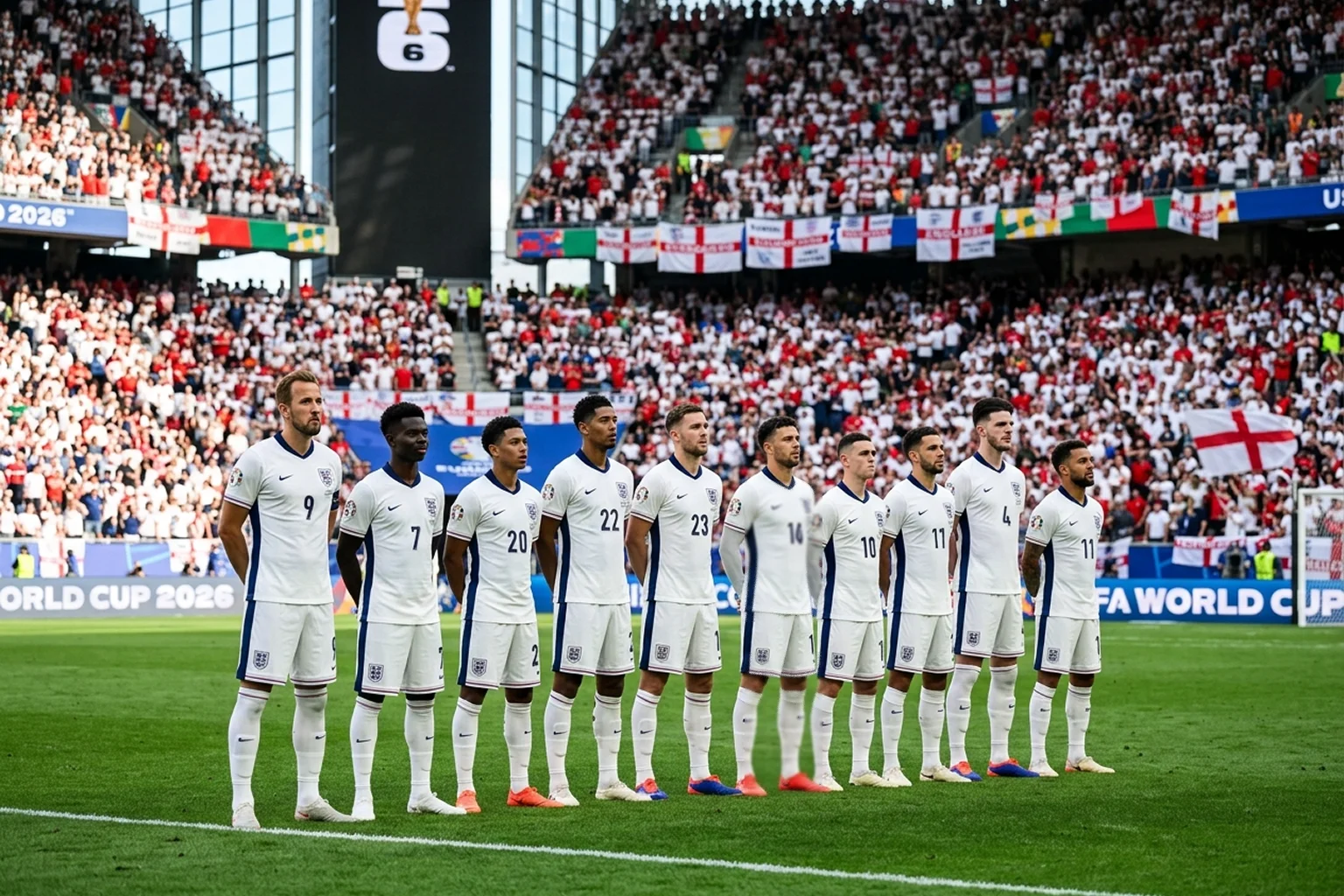
Sixty years. That number haunts English football with every major tournament that passes without adding to the 1966 triumph. I have covered four World Cups and three European Championships where England entered as legitimate contenders, reached decisive stages, and failed to convert opportunity into silverware. The pattern repeats with remarkable consistency: group-stage qualification, knockout progress, semifinal or final heartbreak. England World Cup 2026 betting requires understanding this historical context — not as superstition, but as data that shapes expectation and pricing.
The 2018 semifinal loss to Croatia. The 2020 Euro final loss to Italy on penalties. The 2022 quarterfinal exit against France. The 2024 Euro final defeat to Spain. Each near-miss adds to a narrative of consistent quality failing at decisive moments. England enters 2026 with perhaps their deepest squad in generations, market pricing that reflects genuine title contention, and the weight of history pressing against their ambitions.
Squad Depth That Should Have Won Something By Now
The talent assembled across English Premier League clubs and European giants creates a selection headache that most nations would envy. Every position features multiple world-class options. The question is not whether England have quality, but whether they can organize that quality into tournament-winning cohesion.
Jude Bellingham has emerged as the squad’s transformative presence. His move to Real Madrid and subsequent dominance — Champions League winner, La Liga champion, individual awards accumulating — establishes him among the world’s elite midfielders at just twenty-two years old. Bellingham carries the ball through pressure, arrives in scoring positions, and influences matches with a directness that England previously lacked from central areas. His integration into the national team tactical system remains ongoing, but his ceiling exceeds any English midfielder since Gascoigne or Lampard.
Harry Kane continues as the primary goal threat despite approaching thirty-three during the tournament. His Bundesliga success at Bayern Munich maintains his sharpness, and his international scoring record — consistently among England’s all-time leaders — proves his tournament reliability. Kane’s movement creates space for others even when goals do not come, and his penalty-taking removes conversion variance from spot kicks. Betting on Kane to score in any given match rarely offers value at standard prices; his odds reflect expected output accurately.
Phil Foden represents the technical excellence that English football historically lacked. His Manchester City development under Guardiola refined a game already exceptional, producing a winger-midfielder hybrid capable of unlocking defenses through close control and vision. Foden’s tournament performances have lagged behind domestic brilliance — whether this reflects tactical usage, pressure, or coincidence remains debated. The 2026 World Cup offers opportunity to convert club form into international output.
Bukayo Saka provides directness and end product from wide positions. His development at Arsenal mirrors Foden’s trajectory, with Premier League excellence awaiting international confirmation. Saka’s penalty miss in the 2020 Euro final added psychological dimension to his profile — how he handles subsequent pressure moments reveals character that matters in knockout football.
Defensive personnel has improved significantly since England’s historically vulnerable back lines. Trent Alexander-Arnold offers creative passing from right-back that no peer matches, though defensive positioning generates criticism. John Stones and Harry Maguire have anchored tournament runs with varying degrees of success. Declan Rice provides midfield shielding that protects the back line while contributing progressive play. The overall defensive structure under recent managers has prioritized solidity, producing clean sheets at rates that support deep tournament runs.
Goalkeeping remains stable through Jordan Pickford’s established number-one status. His shot-stopping and penalty-saving record in major tournaments exceeds his domestic reputation, creating a separation between club perception and international reality. Pickford’s distribution has improved, though remains inferior to elite ball-playing goalkeepers. His experience across multiple tournaments provides composure that younger alternatives cannot match.
The coaching situation following Gareth Southgate’s departure affects England’s tactical identity. Southgate’s conservative approach drew criticism for underutilizing attacking talent, yet produced consistent advancement to semifinals and finals. His successor inherits a squad conditioned for pragmatic tournament football, with adaptation required to balance ambition with stability. This transition period creates uncertainty that betting markets may not fully price.
Bench strength matches starting quality in ways few nations can claim. Cole Palmer’s emergence at Chelsea adds creative options. Marcus Rashford’s pace and direct running provide alternative attacking profiles. Kobbie Mainoo’s development offers midfield depth with youthful energy. England can field multiple starting-quality elevens, creating rotation flexibility that matters across tournament formats requiring depth utilization.
The captain question — who leads if Kane’s role diminishes — affects squad dynamics beyond tactical considerations. Leadership voices matter in pressure moments, and England’s next captain must command respect from established stars while managing expectations. This intangible influences performance in ways betting markets cannot directly price but certainly affects.
Set-piece delivery has improved markedly from historical English weaknesses. Trent Alexander-Arnold’s crossing quality and Foden’s delivery create opportunities from dead balls that previous generations lacked. Corner and free-kick efficiency affects totals betting and goalscorer markets, with England now capable of scoring from situations that once produced minimal threat.
Group L — Croatia Awaits Again
England draws Group L alongside Croatia, Ghana, and Panama. The draw includes a familiar rival, an unpredictable African qualifier, and a limited CONCACAF representative. Navigation should be straightforward; complications could arise from the Croatia fixture specifically.
Croatia and England share recent tournament history that adds psychological dimension to their 2026 encounter. Croatia eliminated England in the 2018 World Cup semifinal — a match England led before succumbing to Croatian midfield dominance and Mandžukić’s extra-time winner. That result haunts English football memory, creating motivation and pressure simultaneously. Croatia has aged since that peak, with Modrić now approaching retirement age, but their tactical intelligence and tournament experience remain formidable. The England-Croatia match profiles as the group’s most competitive fixture.
Ghana brings unpredictability that characterizes African tournament participants. Their 2022 World Cup showing featured moments of brilliance alongside organizational lapses. The Black Stars possess athletic players capable of producing individual moments that decide matches. Against England’s occasionally fragile defensive coordination, Ghana’s pace and directness could generate chances. However, Ghana’s inconsistency likely produces a defeat against England rather than an upset — the gap in overall squad quality exceeds what individual moments typically overcome.
Panama returns to the World Cup after their 2018 debut ended with a 6-1 loss to England. The Central American side lacks the personnel to compete with Group L’s top teams but will defend resolutely and seek set-piece opportunities. England versus Panama should produce comfortable English victory, with betting interest focusing on margin (over 2.5 England goals, correct scores like 3-0 or 4-0) rather than result uncertainty.
England should top Group L, though Croatia could claim first position if the direct match favors them. The group-stage approach — whether England prioritize first place aggressively or manage player loads knowing advancement is likely — affects individual match outcomes. Betting on England to win the group at short prices offers limited value; the Croatia fixture introduces enough uncertainty to question heavy favorites pricing.
Venue assignments for Group L matches affect preparation and atmosphere considerations. North American venues with significant Croatian or English expatriate communities could create quasi-home environments for either team. Understanding which cities host specific fixtures helps project crowd influence on match dynamics.
Time zone adjustments from European base locations matter for all Group L teams. England’s Premier League players maintain schedules aligned with British time; adjusting to North American kickoffs requires preparation. Croatian and Ghanaian players face similar challenges. Panama’s regional familiarity provides minor advantage that matters little against squad quality disparities.
Third-place advancement possibilities add strategic complexity to final group matches. If England secure advancement before playing their third match, rotation could affect lineup quality and match outcomes. Third-place advancement rules — eight of twelve third-place teams advance — create scenarios where losing a final group match still allows progression. These dynamics affect betting on specific group fixtures.
England’s World Cup History — So Close, Repeatedly
The 1966 triumph remains England’s only major international trophy. Every tournament since then has ended in some form of disappointment — some expected, some devastating. Understanding this pattern matters for betting because it establishes baseline expectations for how England performs in decisive moments.
Recent history provides encouragement without confirmation. The 2018 semifinal represented England’s deepest World Cup run since 1990. The 2020 Euro final reached unprecedented proximity to ending the drought. The 2024 Euro final repeated that agonizing nearness. England now routinely reach the final stages where titles are decided — the problem is converting those opportunities.
Penalty shootouts have defined multiple England exits. The historical record — losses to Germany in 1990 and 1996, to Portugal in 2004 and 2006, to Italy in 2021 — creates psychological baggage that affects both players and public perception. Recent improvement in shootout performance (wins against Colombia in 2018, Switzerland in 2024) suggests this weakness may be historical rather than structural, but the sample size remains small for confident conclusions.
For betting purposes, England’s historical pattern suggests progression markets offer value while outright winner prices carry historical penalty. England reaching quarterfinals or semifinals prices reasonably given their consistent advancement to those stages. England winning the tournament requires breaking a sixty-year pattern — possible, but not reflected in prices that often match nations without this specific burden.
Media pressure creates an environment that affects player performance in ways unique to England. British tabloid culture generates scrutiny that exceeds what other nations’ players experience. This pressure has historically contributed to underperformance in decisive moments — tight muscles, conservative decisions, fear of mistakes. Modern sports psychology has reduced this impact, but cultural factors persist across generations. International observers often underestimate how much England’s media environment affects tournament outcomes.
The weight of expectation compounds with every near-miss. Players who failed to convert previous opportunities carry those memories into new tournaments. Saka’s penalty miss, Rashford’s penalty miss, Sterling’s missed chances — these moments live in public consciousness and private psychology. New players entering the squad inherit collective anxiety alongside collective hope. This emotional context distinguishes England from nations where tournament participation itself represents achievement.
Odds and Market Analysis
England typically prices between six and nine to one for outright tournament winner, alongside France and Argentina as shortest favorites. This pricing reflects squad quality, tournament pedigree, and public backing from one of football’s largest betting markets. Whether these prices offer value depends on your assessment of England’s ability to convert opportunities they historically waste.
The English betting public backs England disproportionately, creating market dynamics where domestic prices undervalue England while international markets may offer slight premiums. Comparing odds across Canadian, European, and British sportsbooks reveals arbitrage opportunities in England markets that do not exist for less publicly-backed nations.
Group L winner prices heavily favor England, often below 1.50 decimal odds. Croatia at longer prices — perhaps 3.50 or higher — may offer value given the direct-match uncertainty and Croatia’s tournament credentials. Finding alternative group-winner positions provides better risk-reward than backing England at compressed favorites pricing.
England to reach semifinals prices around even money, reflecting near-certainty of group advancement and confidence in early knockout performance. This market captures England’s strength — reaching later rounds consistently — without requiring them to convert those opportunities into titles. The semifinal threshold offers cleaner value than outright winner for bettors who believe in England’s quality without trusting their closing ability.
Player props concentrate heavily on Kane, Bellingham, and Foden. Kane’s scoring props price accurately given historical output. Bellingham’s assist and goal combination props offer value if his Real Madrid form translates to international tournaments. Foden’s tournament stats have underperformed club expectations, creating potential buying opportunities if markets continue pricing on reputation rather than international evidence.
England clean sheet props deserve attention given their defensive improvement. Matches against Panama and potentially Ghana offer clean sheet probability exceeding what typical match-winner markets imply. Pickford’s penalty-save record creates value in markets offering odds on saves during shootouts — inevitable if England advance deep into knockout rounds.
Cards markets for physical English players offer angles in matches against physical opponents. Declan Rice’s tactical fouling generates bookings at rates that accumulator bets capture. Center-backs facing pacey attackers may commit fouls that produce cards. These secondary markets receive less attention from sharp bettors, creating potential inefficiencies.
Corners props in England matches reflect their territorial dominance against inferior opponents. Games against Panama and Ghana should produce high corner counts for England through sustained pressure in wide areas. Over corner totals in these specific fixtures may price favorably.
First goalscorer markets in England matches concentrate on obvious names — Kane, Bellingham, Foden — but set-piece threat from defenders creates value at longer odds. Stones, Maguire, and other aerial threats score from corners at rates that justify consideration in specific match contexts.
The Transition Factor
England’s coaching change creates tactical uncertainty that affects betting analysis. Gareth Southgate’s system — defensive organization, controlled possession, releasing quality in transition — is established but not necessarily continued. His successor must balance continuity with ambition, keeping what worked while addressing criticisms of underperforming attacking resources.
If the new coaching approach emphasizes attacking football, England matches may produce higher totals than Southgate-era norms. If continuity prevails, established patterns persist. The early matches of any new coaching tenure provide data for adjusting expectations, making group-stage matches informative for knockout-round betting.
Player relationships with new coaching staff affect form and selection. Southgate’s loyalty to certain players — sometimes criticized as excessive — may not transfer to new management. Different tactical requirements could elevate currently underused players while marginalizing established figures. This rotation potential affects player prop markets that assume consistent usage patterns.
Squad harmony under pressure represents Southgate’s underappreciated contribution. England camps historically featured tension, cliques, and media drama that undermined performance. Southgate cultivated environment and culture that eliminated these distractions. Whether new management maintains this culture remains uncertain — the benefits are invisible until they disappear.
The timing of coaching transition matters for tournament preparation. A manager appointed shortly before the World Cup lacks time to implement new systems; one appointed years earlier has established relationships and tactical identity. England’s specific timeline affects how much change to expect and how betting markets should adjust expectations from Southgate-era baselines.
International breaks before the tournament provide glimpses of new tactical approaches. Friendly matches and Nations League fixtures reveal formation preferences, player roles, and stylistic tendencies that inform betting analysis. Monitoring these pre-tournament fixtures helps anticipate World Cup approaches that markets may not yet reflect.
Player motivation under new coaching varies by individual circumstance. Those underused by Southgate may embrace new opportunities; those favored previously may feel threatened. This dynamic affects form entering the tournament and could create player prop value where usage patterns differ from historical norms.
Value Bets on England
After analyzing squad, group dynamics, historical patterns, and market positioning, several value angles emerge for England betting.
England to reach the final at odds around three to one captures their consistent advancement to decisive matches without requiring the title-winning finish they have not delivered in sixty years. This bet structure manages historical risk while participating in England’s genuine quality. The path to a final requires advancing from Group L and winning three knockout matches — difficult but within England’s capability given recent tournament runs.
Croatia to beat England in Group L at significant longshot odds offers contrarian value for bettors who remember 2018. Croatia’s midfield experience against England’s occasionally chaotic defensive transitions could produce the upset that resets group dynamics. The price should exceed 4.00 for this bet to offer positive expected value given probability assessment.
Jude Bellingham to record three or more assists across the tournament captures his creative role if England advance deep. His positioning, passing quality, and involvement in English buildup produce assist opportunities that accumulate across six or seven matches. This market may price on historical international data rather than current ability levels.
Under 2.5 goals in England versus Croatia reflects both teams’ tactical approaches in high-stakes matches. Croatia control tempo through midfield possession; England’s setup prioritizes defensive stability before transitions. Neither profile produces high-scoring affairs. This market often prices near even money when probability favors the under significantly.
England’s tournament represents the same value proposition it has for recent cycles: genuine quality capable of reaching finals, historical burden suggesting they will not convert, and public backing that compresses prices beyond probability. Finding value requires specific market selection rather than wholesale backing of English progression.
The sixty-year narrative creates emotional resonance that affects public betting behavior. Casual bettors back England from hope rather than analysis, inflating prices on progression while creating potential value on fading England in specific matches. Sophisticated bettors exploit this sentiment by taking contrarian positions when pricing overreacts to English public demand.
Ultimately, England World Cup 2026 betting requires separating squad quality — which genuinely rivals any nation — from tournament execution — where historical patterns raise legitimate concerns. The talent is there. The depth is there. Whether the mentality to convert decisive moments has developed remains the question that sixty years of evidence cannot definitively answer.
