
How to Build World Cup 2026 Parlays — Step-by-Step | KICKSTAKE
 Available in US
Loading...
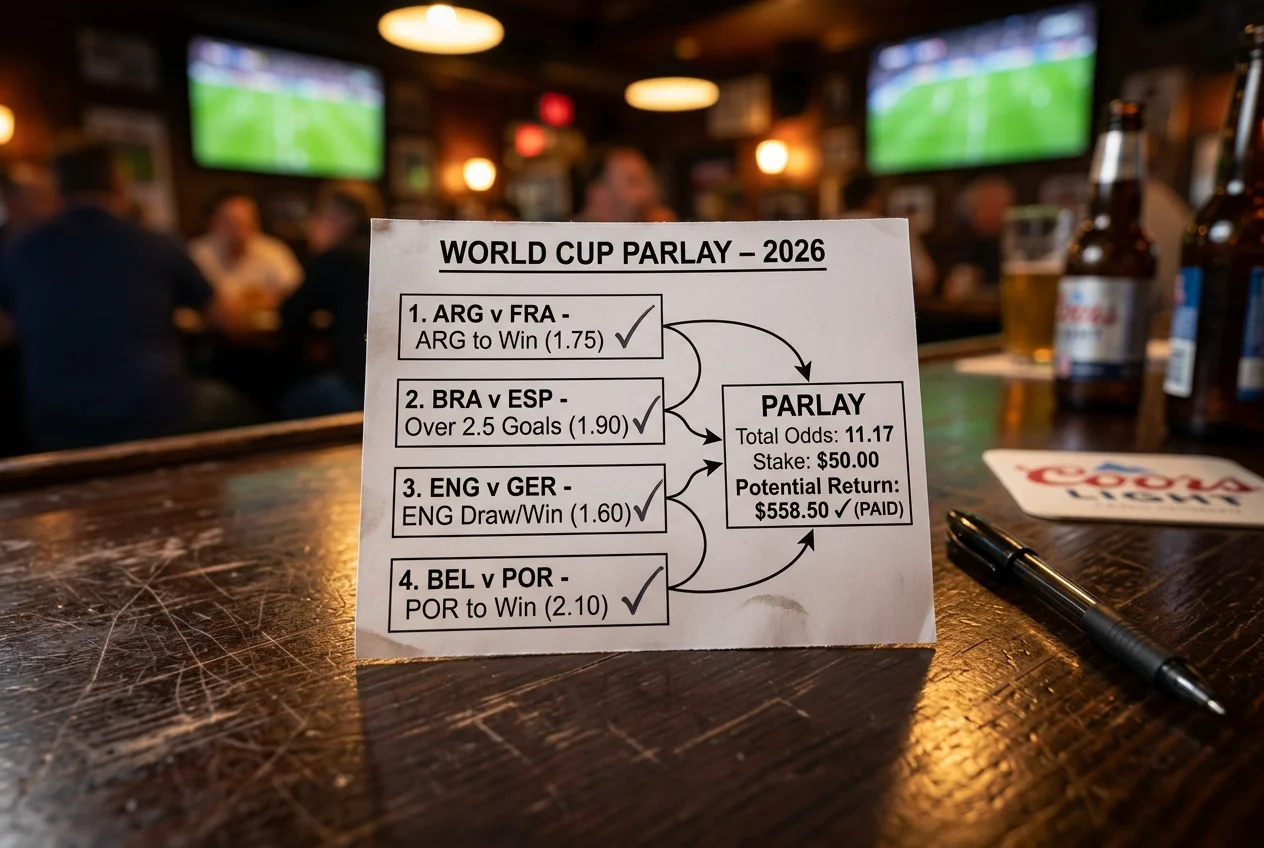
The first parlay I ever won paid 11.00 on a three-match accumulator during the 2014 World Cup — Germany over France, Brazil over Colombia, and Argentina over Belgium. I remember the math feeling like magic: three individual bets at roughly 2.00 each combining into a single ticket worth more than five times my stake. Nine years and countless busted parlays later, I understand the mathematics behind that magic — and why disciplined parlay construction separates profitable bettors from those feeding the bookmaker’s hold.
World Cup 2026’s 48-team format creates parlay opportunities that previous tournaments couldn’t offer. More matches mean more selections, more variation in odds, and more ways to construct accumulators that capture correlated outcomes. This guide walks through parlay mechanics, group-stage strategies, common mistakes, and sample constructions that apply sound betting principles to the biggest football tournament on earth.
What Is a Parlay and How Does It Work?
A parlay — called an accumulator or multi-bet depending on your sportsbook’s terminology — combines multiple selections into a single wager where all legs must win for the bet to pay out. The mathematical appeal comes from multiplied odds: a two-leg parlay at 2.00 each pays 4.00 total, while three legs at 2.00 each pays 8.00. Each additional selection compounds returns exponentially.
Here’s the catch that makes parlays profitable for sportsbooks: the individual probability of each leg multiplies just as the odds do. If each 2.00 selection has a 50% true probability of winning, a two-leg parlay has 25% true probability (0.50 × 0.50), and a three-leg parlay drops to 12.5% (0.50 × 0.50 × 0.50). The hold — the bookmaker’s edge built into odds — compounds at each stage, meaning the effective hold on a three-leg parlay exceeds the hold on any individual selection.
For World Cup betting, parlays make sense when you’ve identified multiple selections where you believe the true probability exceeds what the odds imply. Stacking three value bets into a parlay compounds that edge rather than diluting it. Stacking three bets where the odds accurately reflect probability just compounds the house edge — you’re making the bookmaker’s job easier, not harder.
Canadian sportsbooks offer parlay betting across all World Cup markets. Most platforms allow combining match results, totals, both teams to score, and even cross-tournament selections like group winners with individual match outcomes. The flexibility creates opportunity but also temptation — just because you can add a sixth leg doesn’t mean you should.
Building a World Cup Parlay in Four Steps
Discipline separates parlay construction from parlay gambling. These four steps provide a framework that applies sound betting principles to accumulator building.
First, identify value selections independently. Before thinking about parlays, analyze individual matches and markets to find where you believe the true probability exceeds the odds. If you wouldn’t bet a selection as a single, don’t include it in a parlay to “boost odds.” Each leg needs standalone justification. For the 2026 World Cup, this means evaluating group fixtures, team form, and historical performance at major tournaments before combining selections.
Second, assess correlation between legs. Some parlay combinations make logical sense; others introduce contradictions. Backing Canada to win Group B and Switzerland to win Group B creates a contradiction — both can’t happen. Backing Canada to beat Bosnia and Herzegovina and Canada to top Group B creates positive correlation — if the first happens, the second becomes more likely. Correlated parlays can offer value when bookmakers price legs independently without accounting for their relationship.
Third, limit parlay size based on hold tolerance. The effective hold compounds with each leg added. A three-leg parlay typically carries 15-18% effective hold, a five-leg parlay approaches 25-30%, and anything beyond five legs ventures into lottery ticket territory where the bookmaker’s edge overwhelms any analytical edge you might possess. My recommendation: cap parlays at three or four legs for World Cup betting where match variance already runs high.
Fourth, size stakes appropriately. Parlays should represent a smaller percentage of your bankroll than singles because they carry higher variance. If your standard unit on a single bet is 2% of bankroll, consider 0.5-1% units on parlays. The higher potential return compensates for lower probability; the reduced stake protects against the variance that multiple legs introduce.
Best Parlay Strategies for the Group Stage
Group stage matches offer the richest parlay opportunities because outcomes are more predictable than knockout fixtures. Three matches per team across 16 days means 36 fixtures per matchday — plenty of canvas to paint accumulator combinations.
The favourite stack works when several short-priced favourites play on the same matchday. Germany at 1.40 versus Curaçao, France at 1.35 versus Iraq, and Brazil at 1.50 versus Haiti individually offer minimal value, but combining all three produces a parlay around 2.85 with reasonable probability. This strategy works best on opening matchday when motivation asymmetries favour established teams and debutants haven’t yet adjusted to tournament intensity.
The totals correlation strategy exploits how certain teams play. Brazil matches historically produce high-scoring affairs regardless of opponent. Canada at home will attack against Bosnia. These tendencies suggest over 2.5 goals in multiple fixtures. A two-leg over parlay at 1.75 each produces 3.06 combined odds — less risky than stacking match results and grounded in team tendencies rather than outcome prediction.
The same-group parlay identifies consistency within groups. If Group E looks high-scoring because Germany, Côte d’Ivoire, Ecuador, and Curaçao all attack, backing overs across multiple Group E fixtures creates a coherent thesis. If Group I looks defensive because France and Senegal both protect leads, unders across Group I matches makes sense. Group-level analysis often reveals patterns that individual match analysis misses.
The value accumulator inverts the favourite stack approach. Instead of combining short-priced favourites, combine underdog or mid-priced selections where you’ve identified genuine value. Morocco at 3.50 to win Group C, Japan at 3.25 to win Group F, and Croatia at 3.50 to win Group L produce a parlay around 40.00 — low probability but grounded in analytical assessment rather than hope. These value accumulators require all three upsets to hit, but the payoff compensates for the difficulty.
One structural advantage of group stage parlays: matches are scheduled across different days, allowing for partial information updates. A three-leg parlay across Monday, Wednesday, and Friday lets you see the first two results before the third settles. Some sportsbooks offer cash-out options that let you lock in profit after two legs hit while the third remains pending. This flexibility distinguishes group stage parlays from same-day accumulators.
Three Parlay Mistakes to Avoid
Parlay betting invites errors that disciplined single bettors would never make. Recognizing these patterns helps avoid them.
Adding legs for entertainment destroys expected value. The temptation to add a sixth or seventh leg because “it’s basically a lock” ignores how even high-probability selections compound into parlay busters. A 90% probability leg reduces parlay win probability by 10% while adding minimal return. If a selection doesn’t offer standalone value, don’t include it — you’re paying edge to the bookmaker for the privilege of entertainment.
Chasing losses through parlay size increases variance exposure at exactly the wrong moment. After a losing streak, the temptation to build a bigger parlay that would “get it all back” introduces catastrophic risk. Parlays should be sized based on bankroll and edge assessment, not emotional response to recent results. If your discipline breaks down when losses mount, avoid parlays entirely until equilibrium returns.
Ignoring correlation in non-obvious ways creates contradictions that reduce parlay probability without reducing odds proportionally. Backing Germany to beat Côte d’Ivoire and backing Côte d’Ivoire to qualify from Group E aren’t contradictions — Côte d’Ivoire can lose that match and still advance. But backing Germany to win 4-0 and backing under 2.5 goals in the same match is a mathematical contradiction. Less obvious examples include backing a team to score three goals and backing their star striker to score zero. Review parlay legs for internal consistency before placing.
Sample World Cup Parlays for 2026
These sample constructions illustrate sound parlay principles applied to actual tournament fixtures. They represent frameworks, not recommendations — odds will shift between now and tournament start, and any parlay requires independent assessment of each leg’s value.
The opening day favourite stack combines three group openers where established powers face weaker opponents. Germany moneyline versus Curaçao at approximately 1.35, France moneyline versus Iraq at approximately 1.30, and Brazil moneyline versus Haiti at approximately 1.25 produce a three-leg parlay around 2.20. The thesis: tournament debutants and playoff qualifiers struggle against elite opposition on opening matchday. Variance enters through potential draws, but the probability of all three favourites winning exceeds 45%, making 2.20 odds represent marginal value.
The Canada home sweep backs all three Canada group matches to produce favourable results. Canada to beat Bosnia and Herzegovina at approximately 1.85, Canada to beat Qatar at approximately 1.55, and Canada draw-no-bet versus Switzerland at approximately 2.30 combine for a parlay around 6.50. The thesis: home advantage creates atmospheric conditions that favour Canada across all three fixtures. The draw-no-bet selection on the Switzerland match provides downside protection while maintaining parlay viability. If Canada navigates Group B as expected, this parlay delivers strong returns.
The dark horse group winner accumulator combines three value selections identified in group winner analysis. Morocco to win Group C at 3.50, Japan to win Group F at 3.25, and Colombia to win Group K at 2.75 produce a parlay around 31.00. The thesis: mid-tier teams with tournament pedigree are undervalued relative to favourites in competitive groups. All three selections require upsets, but the analytical case for each stands independently. This represents a lottery ticket with intellectual grounding rather than wishful thinking.
The totals consistency parlay targets teams whose playing styles reliably produce specific goal totals. Over 2.5 goals in Brazil versus Morocco at approximately 1.85, over 2.5 goals in Netherlands versus Japan at approximately 1.90, and over 2.5 goals in Argentina versus Austria at approximately 1.75 combine for a parlay around 6.15. The thesis: attacking teams produce high-scoring affairs regardless of opponent quality. These fixtures feature offensive quality on both sides, supporting the over selection across all three.
Making Parlay Betting Work at the World Cup
Parlays should represent 10-15% of your total World Cup betting allocation — enough to capture the upside of combined odds without exposing your bankroll to excessive variance. The remaining 85-90% belongs in singles and targeted doubles where analytical edge compounds without catastrophic downside.
Track parlays separately from singles to evaluate your construction discipline. If your singles win at 54% but your parlays hit at 15% on four-leg combinations, the math suggests your parlay construction adds variance without adding edge. If parlays outperform singles on a per-leg basis, you’ve identified something worth expanding. The data tells you whether parlays suit your betting approach.
Consider parlay insurance options where available. Some Canadian sportsbooks offer money-back promotions where three-leg parlays return stakes if one leg loses. These reduce effective variance and can tip marginal parlays into positive expected value territory. Read the terms carefully — minimum odds requirements and market restrictions often apply — but don’t ignore these promotional edges.
The 48-team World Cup creates more parlay opportunities than previous tournaments, which means more ways to win and more ways to lose. The framework above — independent value assessment, correlation awareness, size discipline, and stake management — applies regardless of leg count or market type. Build parlays that compound analytical edge rather than entertainment impulse, and the mathematics that make accumulators appealing can work in your favour rather than the bookmaker’s.
