
How to Bet on the 2026 World Cup — Complete Guide | KICKSTAKE
 Available in US
Loading...

You want to bet on the World Cup but aren’t sure where to start. I get it. When I placed my first tournament wager back in 2010, I lost C$200 in two days because I had no system, no understanding of odds formats, and no clue that bankroll management even existed. That tournament taught me more about betting than any book ever could — mostly what not to do.
The 2026 FIFA World Cup arrives on Canadian soil in June, and everything about this tournament is different. Forty-eight teams instead of thirty-two. A hundred and four matches spread across thirty-nine days. Three host nations — Canada, the United States, and Mexico — sharing the spotlight. And for the first time ever, Canadians can legally bet on single-game outcomes through provincially regulated platforms, thanks to Bill C-218 which came into effect in August 2021.
This guide walks you through every step of betting on the 2026 World Cup as a Canadian. I’m covering the legal landscape province by province, breaking down how decimal and American odds actually work, explaining every bet type from simple moneylines to complex prop markets, and sharing the practical strategies I’ve refined over nine years of covering international tournaments. Whether you’ve never placed a sports bet or you’re looking to sharpen your approach for the biggest soccer event in history, this is your starting point.
TL;DR — What You Need to Know Right Now
Single-game sports betting became legal across Canada in August 2021 following the passage of Bill C-218. Ontario operates an open market where private operators hold AGCO licenses and compete for your business. Every other province runs a government-operated monopoly platform — PlayNow in British Columbia, Mise-o-jeu through Loto-Québec, Play Alberta in Alberta. The minimum age sits at nineteen in most provinces, dropping to eighteen in Alberta, Manitoba, and Québec.
The 2026 World Cup runs from June 11 to July 19. Canada plays all three group-stage matches on home soil — two in Vancouver at BC Place and one in Toronto at BMO Field. The tournament features a new format where the top two teams from each group plus the eight best third-place finishers advance to a Round of 32 knockout bracket. Decimal odds dominate Canadian sportsbooks, though American odds appear frequently due to cross-border operator influence. If you’re placing your first World Cup bet, start with a simple moneyline wager on a group-stage match, set a budget you’re comfortable losing entirely, and treat the tournament as a learning experience rather than a money-making opportunity.
Is World Cup Betting Legal in Canada?
A friend from Montréal asked me this question three years ago, assuming that because he could bet on hockey through the provincial lottery site, soccer must work the same way. He was half right. The Criminal Code amendment that legalized single-game betting doesn’t distinguish between sports — it simply removed the federal prohibition that had forced Canadians into parlay-only wagers for decades. But how that legalization plays out depends entirely on where you live.
Before August 2021, betting on a single sporting event was technically a criminal offence in Canada. The government allowed parlay betting — combining multiple selections into one wager — through provincial lottery corporations, but if you wanted to bet on just one game, you had to use offshore sites operating in a legal grey area. Bill C-218, the Safe and Regulated Sports Betting Act, changed everything by decriminalizing single-game wagering at the federal level and leaving regulation to individual provinces.
The result is a patchwork system where your betting options vary dramatically based on your postal code. Understanding this landscape matters because it affects which platforms you can legally access, what protections you have as a consumer, and how your winnings are taxed — or more accurately, not taxed, since Canada doesn’t impose income tax on gambling winnings for recreational bettors.
Ontario’s Open Market
Ontario took a different path than every other province. In April 2022, the Alcohol and Gaming Commission of Ontario opened the market to private operators, creating the only jurisdiction in Canada where multiple sportsbooks compete for customers. If you live in Ontario, you can choose from dozens of AGCO-registered operators — the same brands you see advertised during NHL broadcasts, each offering different odds, promotions, and user experiences.
The AGCO enforces strict standards that registered operators must meet. Every Ontario sportsbook must verify your identity, implement responsible gambling tools, segregate player funds from operational accounts, and submit to regular audits. When you bet with an AGCO-registered platform, you’re protected by Canadian consumer law in a way that offshore alternatives simply cannot match. If a dispute arises, you have a regulatory body to appeal to. If an operator mishandles your funds, insurance mechanisms exist to make you whole.
This competitive market has pushed Ontario operators to offer sharper odds than their government-operated counterparts in other provinces. Shopping for lines — comparing the same bet across multiple sportsbooks — becomes a genuine strategy here. I’ve seen differences of 0.15 in decimal odds on identical World Cup markets, which translates to meaningful value over dozens of wagers.
Ontario also leads in restricting gambling advertising, having banned the use of athletes and celebrities in betting promotions since 2024. You won’t see Wayne Gretzky or Drake pushing sportsbook apps here anymore. For the 2026 World Cup, this means marketing will focus on odds and features rather than star endorsements.
Provincial Platforms — British Columbia, Québec, and Alberta
Outside Ontario, each province operates its own government-run monopoly platform. These aren’t necessarily worse options — they’re just your only legal options within provincial borders.
British Columbia runs PlayNow through the BC Lottery Corporation. The platform covers every World Cup market you’d expect — match results, group winners, outright tournament odds, goalscorer props — and integrates seamlessly with the province’s broader online gambling ecosystem. Odds tend to be slightly less competitive than Ontario’s private operators, but the trade-off is a single trusted platform backed by provincial government oversight. You can fund your account through Interac, credit card, or in-person at any lottery retailer.
Québec operates Mise-o-jeu through Loto-Québec, offering French and English interfaces for the province’s bilingual population. The platform has evolved significantly since single-game betting became legal, adding live betting options and expanding its soccer markets ahead of the 2026 tournament. One quirk worth noting — Mise-o-jeu historically offered slightly different odds than English-Canadian platforms, sometimes favouring underdogs in ways that create value for sharp bettors.
Alberta launched Play Alberta in late 2020, initially with limited sports betting options. The platform has expanded dramatically, and Alberta is actively developing legislation to open its market to private operators by 2026 — potentially before the World Cup kicks off. If you’re in Alberta, it’s worth monitoring regulatory announcements, as you may have additional options by tournament time.
Every other province relies on similar government-operated platforms: Sport Select in Manitoba and Saskatchewan, Pro-Line in Atlantic Canada. The interfaces vary, the odds differ slightly, but the fundamental model remains the same — a single provincially regulated option with all the consumer protections that implies.
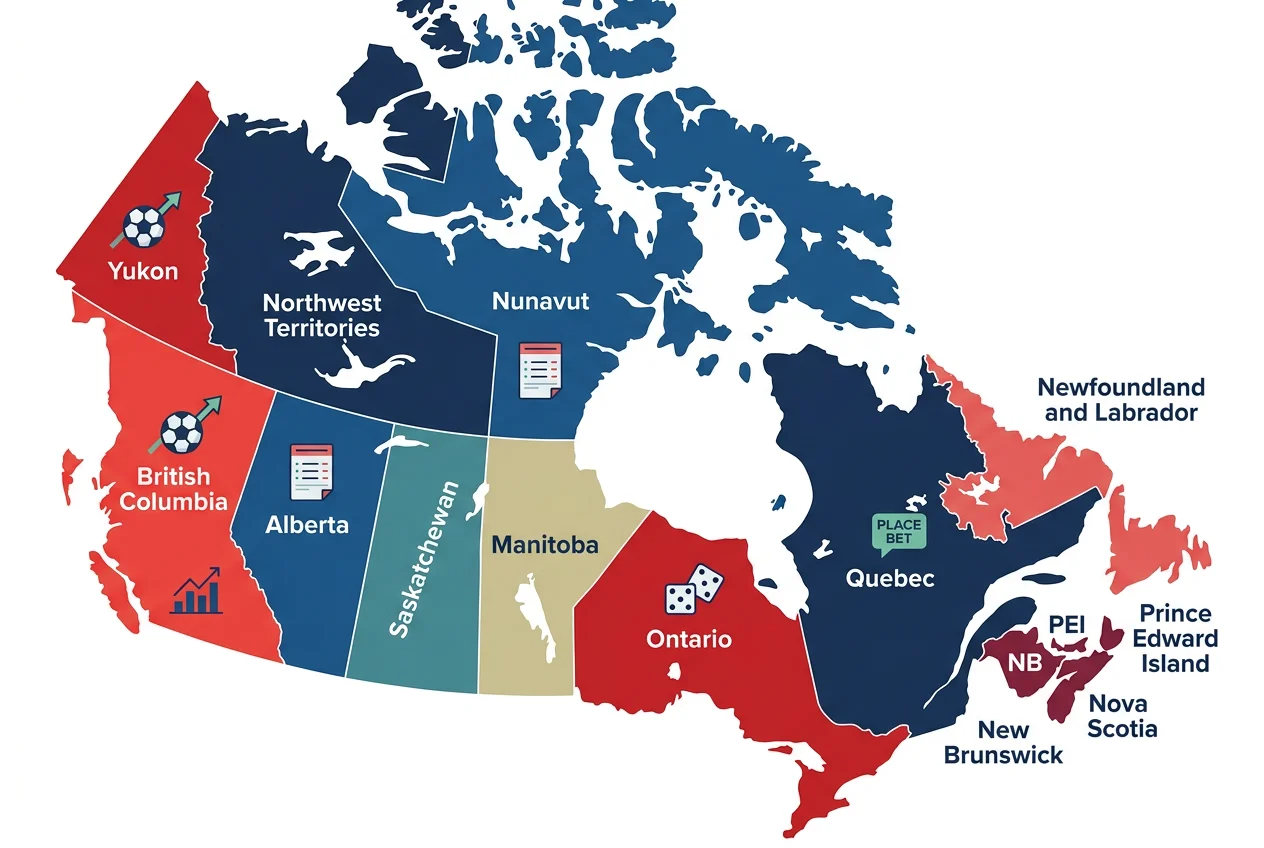
One reality I need to address directly — offshore sportsbooks remain accessible throughout Canada. These platforms operate outside provincial regulation, often from jurisdictions like Malta, Gibraltar, or Curaçao. They’re not explicitly illegal for Canadian bettors to use, but they exist in a grey zone where consumer protections evaporate. If an offshore site decides not to pay your World Cup winnings, you have no regulatory recourse. I’ve covered enough horror stories over nine years to recommend sticking with provincially regulated options, even if offshore competitors occasionally offer flashier promotions or marginally better odds.
How to Read World Cup Odds
The first bet I ever placed at a legal Canadian sportsbook displayed odds of 2.40. I stared at that number for five minutes, Googled “what does 2.40 odds mean,” and still wasn’t confident I understood it when I clicked “Place Bet.” If that sounds familiar, you’re not alone. Odds notation is the single biggest barrier preventing casual fans from engaging with sports betting, and it doesn’t have to be.
Think of odds as a multiplier that tells you exactly what you’ll receive if your bet wins. A decimal odd of 2.40 means you multiply your stake by 2.40 to calculate your total return. Bet C$50 at 2.40 odds, win, and you receive C$120 back — your original C$50 stake plus C$70 in profit. That’s it. No complex formulas, no mental gymnastics. Decimal odds make this calculation trivially easy, which is exactly why they dominate Canadian sportsbooks.
Decimal Odds Step by Step
Decimal odds express the total payout per dollar wagered, including your original stake. They range from just above 1.00 to hundreds or even thousands for extreme long shots. The lower the number, the higher the probability implied by the market. The higher the number, the bigger the potential payout — and the less likely that outcome is to occur, at least according to the sportsbook setting the line.
Let me walk through a concrete World Cup example. Suppose Canada opens as 1.75 favourites against Bosnia and Herzegovina in their Group B opener at BMO Field. Here’s how to read that number:
A C$100 bet on Canada at 1.75 returns C$175 total. You subtract your original stake to find your profit: C$175 minus C$100 equals C$75 profit. Conversely, if Bosnia and Herzegovina sits at 5.00, a C$100 wager returns C$500 total — a C$400 profit if the underdog pulls off the upset.
To convert decimal odds into implied probability — the market’s assessment of how likely that outcome is — divide 1 by the decimal odd and multiply by 100. At 1.75 odds, the calculation runs: 1 divided by 1.75 equals 0.571, times 100 equals 57.1% implied probability. The market believes Canada has roughly a 57% chance of winning that match.
Here’s where it gets interesting. If you sum the implied probabilities of all possible outcomes in a market, the total exceeds 100%. This excess represents the sportsbook’s margin — how they guarantee profit regardless of the result. A three-way match result market might show Canada at 1.75 (57.1%), Draw at 3.60 (27.8%), and Bosnia at 5.00 (20.0%). Add those together: 57.1% plus 27.8% plus 20.0% equals 104.9%. That extra 4.9% is the house edge built into the odds.
American Odds at a Glance
American odds confuse everyone not raised on them. They use positive and negative numbers to indicate underdogs and favourites respectively, with +100 representing even money. A positive number tells you how much you win on a C$100 stake. A negative number tells you how much you must stake to win C$100.
Using the same Canada match — if Canada shows at -133 (favourite), you need to bet C$133 to win C$100 profit. If Bosnia sits at +400 (underdog), a C$100 bet wins you C$400 profit. The draw at +260 means a C$100 wager returns C$260 profit.
American odds appear frequently on Canadian platforms because many operators serve both Canadian and U.S. markets. Some bettors prefer them for quickly identifying favourites (negative) versus underdogs (positive), but for calculating payouts and comparing value, I find decimal odds far more intuitive. Most Canadian sportsbooks let you toggle between formats in your account settings.
Converting Between Formats
Converting odds formats becomes essential when comparing lines across different sportsbooks or following international betting analysis that uses fractional odds common in the UK.
To convert American to decimal: for positive American odds, divide by 100 and add 1 (so +400 becomes 4.00 plus 1 equals 5.00). For negative American odds, divide 100 by the absolute value and add 1 (so -133 becomes 100 divided by 133, or 0.75, plus 1 equals 1.75).
To convert decimal to American: for decimal odds of 2.00 or higher, subtract 1 and multiply by 100 (so 5.00 minus 1 equals 4.00 times 100 equals +400). For decimal odds below 2.00, divide -100 by the decimal minus 1 (so for 1.75: -100 divided by 0.75 equals -133).
Fractional odds, written as 4/1 or 3/2, express profit relative to stake. A 4/1 bet wins you four dollars for every dollar wagered. To convert fractional to decimal, divide the first number by the second and add 1 (so 4/1 becomes 4 divided by 1 plus 1 equals 5.00). You’ll rarely encounter fractional odds on Canadian platforms, but they appear in British coverage and some European betting analysis.
I keep a conversion chart bookmarked for quick reference during live matches when I need to compare odds across formats in real time. After nine years, I can eyeball most conversions instantly, but even veterans double-check when money is on the line.
World Cup Bet Types — From Simple to Advanced
During the 2022 World Cup in Qatar, I tracked over four hundred distinct betting markets available on a single group-stage match. Four hundred. The options ranged from straightforward win-draw-win to absurdly specific propositions like “Lionel Messi to score a header in the second half while Argentina leads by exactly one goal.” The variety can overwhelm newcomers, so let me organize these markets from simplest to most complex.
Every World Cup bet falls into one of three categories: match-level wagers that resolve within a single game, tournament-level futures that span the entire competition, and prop bets focused on individual performances or specific events. Understanding these categories helps you identify which markets suit your knowledge and risk tolerance.
Moneyline, Spread, and Over/Under
The moneyline bet is pure simplicity — pick which team wins, or pick the draw. In the 2026 World Cup’s group stage, every match offers three outcomes: Team A wins, Team B wins, or the match ends level after ninety minutes. Knockout rounds eliminate the draw option since matches must produce a winner through extra time and penalties if necessary, though some sportsbooks offer separate markets for “to win in 90 minutes” versus “to advance.”
Consider a Group B clash between Canada and Switzerland at BC Place. The moneyline might show Canada at 2.60, Draw at 3.20, Switzerland at 2.75. Betting C$100 on Canada to win outright returns C$260 if they triumph in regulation. The tightly grouped odds reflect what bookmakers see as an evenly matched contest where no outcome would shock anyone.
Spread betting — known as handicap or Asian handicap betting — levels the playing field by assigning a virtual deficit to the favourite or advantage to the underdog. If Germany faces Curaçao with a -2.5 spread, Germany must win by three or more goals for that bet to cash. Conversely, Curaçao +2.5 wins if the debutants lose by two or fewer goals, draw, or somehow pull off the upset.
Spread betting proves especially valuable in mismatched group-stage encounters. When a powerhouse like Brazil meets Haiti, the moneyline on Brazil might sit at 1.08 — risking a hundred dollars to profit eight. The spread market offers more interesting propositions: Brazil -3.5 at 1.95 asks whether they’ll dominate by four or more, while Haiti +3.5 at 1.90 asks whether they can keep it respectable.
Over/under betting focuses on total goals scored by both teams combined. A match might be lined at 2.5 total goals, with odds attached to both “over 2.5” and “under 2.5.” If you expect a defensive battle, back the under. If you anticipate an open attacking game, back the over. The half-goal prevents pushes — every bet wins or loses definitively.
These three bet types form the foundation of soccer wagering. Master them before exploring more exotic options, and you’ll handle ninety percent of the markets you encounter during the World Cup.
Parlays, Futures, and Props
Parlays combine multiple selections into a single wager where every leg must win for the bet to cash. The appeal is obvious — combine three moderate favourites at 1.50 each, and your parlay pays roughly 3.38 (1.50 × 1.50 × 1.50). The trap is equally obvious — one upset busts your entire ticket.
I approach World Cup parlays with extreme caution. Tournament soccer is wildly unpredictable, with at least one shock result per matchday historically. The 2022 World Cup opened with Argentina losing to Saudi Arabia at odds above 20.00, busting millions in parlay tickets worldwide. If you build parlays, keep them small — two or three legs maximum — and accept that you’re trading probability for excitement.
Same-game parlays, offered by most Canadian sportsbooks, combine multiple outcomes from a single match. A typical SGP might include Canada to win, over 2.5 total goals, and Alphonso Davies to record an assist. These bets correlate positively — a Canada victory becomes more likely when they’re scoring multiple goals and creating chances — which means the combined odds are adjusted downward from a true multiplication. Still, they offer a way to bet on a specific match narrative rather than isolated outcomes.
Futures betting targets outcomes that resolve after the tournament concludes — or at specific milestones during it. The marquee futures market asks who will win the World Cup outright, with odds ranging from single digits for heavy favourites to triple digits for minnows. Other futures include group winners, top goalscorer (Golden Boot), best young player, and team-specific achievements like “Canada to reach the quarter-finals.”
Futures require patience and capital lockup. A bet placed in April 2026 won’t resolve until July 19 at the earliest. The upside is that early-bird bettors often capture better odds than those who wait until tournament day, as markets adjust to news, injuries, and form leading up to kickoff.
Prop bets — short for proposition bets — focus on specific occurrences within matches. Player props ask whether an individual will score, assist, receive a card, or take a certain number of shots. Match props cover events like the timing of the first goal, exact scorelines, both teams to score, or the margin of victory. Tournament props span the entire competition — total goals scored, number of penalty shootouts, whether a host nation reaches the semi-finals.
Props offer edges for bettors with specialized knowledge. If you follow Canadian soccer closely enough to know that Jonathan David scores most of his goals from inside the six-yard box while Cyle Larin tends to score headers from crosses, you can exploit prop markets that don’t reflect these tendencies. The counterpoint is that props carry higher margins than standard markets — sportsbooks know casual bettors gravitate toward them and price accordingly.
Bankroll Management for a 39-Day Tournament
The 2014 World Cup in Brazil taught me about variance the hard way. I started the tournament hot — four winners in four days, account up forty percent. Then Germany demolished Brazil 7-1, a result I hadn’t remotely prepared for, and a reckless live bet trying to chase value wiped out my entire profit plus another chunk of my starting bankroll. I finished the tournament down money despite correctly predicting the champion.
Bankroll management exists to prevent that kind of implosion. The 2026 World Cup spans thirty-nine days and one hundred four matches — a marathon that will test every bettor’s discipline. Without a structured approach to stake sizing and loss limits, even skilled handicappers can find themselves broke by the knockout rounds.
The core principle is deceptively simple: never risk more than a small percentage of your total bankroll on any single bet. The most common guideline suggests one to three percent per wager. If you’ve set aside C$1,000 for World Cup betting, individual stakes should range from C$10 to C$30. This approach ensures that even a brutal losing streak — five, eight, ten consecutive losses — doesn’t catastrophically deplete your funds.
Flat betting means wagering the same amount on every selection regardless of confidence level. It’s the most straightforward system and the one I recommend for first-time tournament bettors. Choose your unit size — say C$25 — and bet exactly that on every match. The simplicity prevents emotional scaling, where you double down after a loss or pile onto a “lock” that feels unbeatable.
Variable staking adjusts bet size based on confidence and edge. A strong conviction play might warrant two units while a speculative punt rates half a unit. This approach demands honest self-assessment of your analytical edge and the discipline to truly reduce stakes on low-confidence selections. Most bettors overestimate their abilities and end up concentrating too much capital on supposed “sure things” that aren’t nearly as sure as they believe.
For a thirty-nine day tournament, I structure my bankroll into three phases. The group stage (June 11 to June 26) accounts for about forty percent of my total budget — that’s forty-eight matches across sixteen days, roughly three matches per day. The Round of 32 and Round of 16 (June 28 to July 6) allocates thirty percent across twenty-four knockout matches. The final ten days — quarter-finals through the final — reserve the remaining thirty percent for the tournament’s climax.
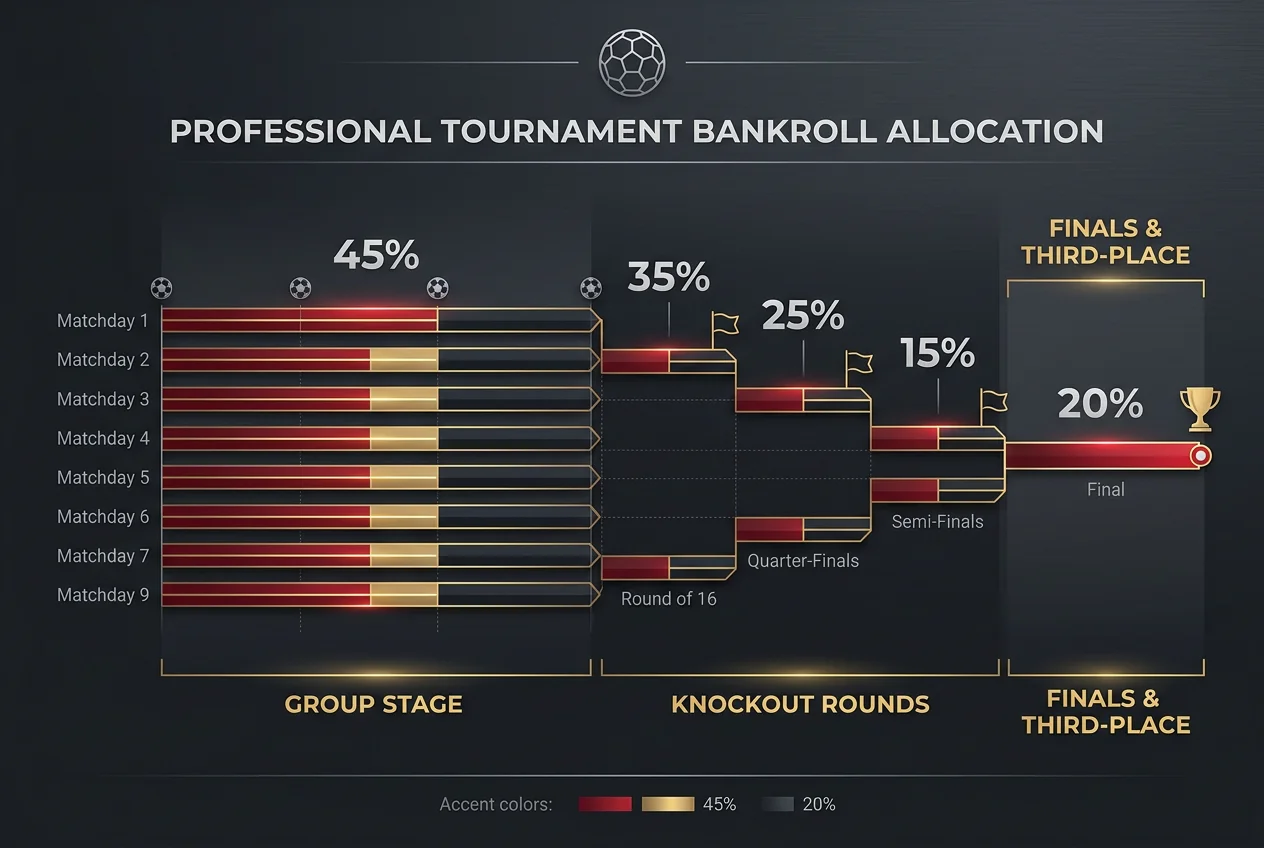
This phased approach prevents the common mistake of shooting your entire wad during the group-stage excitement when four to six matches run daily. I’ve watched bettors burn through their tournament budget by June 20, leaving them as spectators for the knockout rounds that typically offer the most predictable outcomes and best betting opportunities.
Loss limits protect against catastrophic sessions. Before the tournament, decide on a maximum daily drawdown — perhaps ten percent of your starting bankroll — beyond which you stop betting for the day regardless of opportunities. If you begin June 15 with C$900 and lose C$90 by the afternoon matches, walk away. Tomorrow brings four more games. The tournament spans thirty-nine days. No single afternoon requires you to chase losses into oblivion.
Win limits are equally important and universally ignored. When you’re running hot, the temptation is to press your advantage and bet bigger, faster, more aggressively. This is exactly when variance tends to humble you. I set profit targets for hot streaks — if I’m up twenty-five percent on the tournament, I’ll skim some winnings into a separate “locked” pile that doesn’t re-enter the bankroll. Whatever happens next, I’ve banked real gains.
Finally, record everything. Every bet placed, every outcome, every stake size, every return. Without data, you can’t evaluate your actual performance versus your perceived performance. Bettors consistently overremember wins and underremember losses — a documented log prevents this selective memory and reveals your true World Cup ROI when the confetti falls on July 19.
Five Practical Strategies for Group-Stage Betting
At the 2018 World Cup, Germany entered as defending champions, ranked number one in the world, and departed in the group stage after losses to Mexico and South Korea. Anyone who had blindly backed Germany across their three matches lost money despite them being among the tournament’s shortest-priced favourites. Group-stage betting rewards pattern recognition and context analysis far more than reputation alone.
These five strategies come from nine years of covering international tournament wagering. None guarantees profit — if such strategies existed, sportsbooks wouldn’t exist either — but each provides a structured approach to finding value during the most chaotic phase of the World Cup.
The first strategy involves targeting motivated underdogs in matches where favourites have already secured advancement. Consider a hypothetical scenario where Brazil wins their first two Group C matches by comfortable margins. Their third match against Scotland becomes a dead rubber — key players rest, intensity drops, the squad’s focus shifts to the knockout round. Scotland, meanwhile, might need a result to finish as a best third-place team. This motivation asymmetry rarely reflects fully in the odds because casual bettors still see “Brazil versus Scotland” and back the bigger name.
Strategy two centers on historical patterns specific to tournament football. Host nations consistently outperform their market expectations in early matches — the crowd advantage, reduced travel fatigue, and psychological comfort translate into measurable edges. Canada playing at BMO Field and BC Place isn’t comparable to Canada playing a World Cup qualifier in Honduras. The 2010 South Africa, 2014 Brazil, and 2018 Russia World Cups all saw hosts exceed their pre-tournament odds during the group phase, though not always deep into the knockout rounds.
Third, I focus heavily on total goals markets during the group stage rather than match results. The first round of group-stage fixtures typically produces more goals than later rounds — teams haven’t yet established defensive patterns against specific opponents, and the urgency of needing early points encourages attacking play. By matchday three, teams with secured positions play conservatively while eliminated squads either give up or gamble wildly. The 2022 World Cup averaged 2.66 goals per game in the group stage, but the distribution wasn’t uniform — day one and two fixtures ran higher than day three fixtures across multiple groups.
The fourth strategy exploits live betting opportunities that pre-match markets can’t capture. Formations become clear after kickoff. You see which team controls possession, which goalkeeper looks shaky, which attackers are finding space. The 2026 World Cup’s expanded format means more matches between mismatched teams, and these blowouts often reveal themselves within fifteen minutes through shot maps and expected goals data. If Germany dominates Curaçao territorially but hasn’t scored by the twentieth minute, the in-play odds on “over 3.5 goals” might offer better value than the pre-match line once frustration forces the favourite into even more aggressive attacks.
Strategy five requires patience — identifying which teams show improved form during the tournament versus their pre-event assessment. Every World Cup produces at least one surprise package that nobody saw coming. Morocco in 2022 was widely expected to exit in the group stage and instead reached the semi-finals. These emergent narratives become apparent by matchday two or three, yet futures markets adjust slowly because most capital was placed pre-tournament. If a team demonstrates cohesion and quality beyond expectations, their knockout-round advancement odds may still reflect outdated assumptions.
None of these strategies involves blindly backing favourites or chasing long-shot accumulators. They require engagement with the tournament as it unfolds — watching matches, tracking lineup news, understanding which results are already locked and which remain meaningful. The bettors who profit from World Cups treat it as a month-long analytical project rather than a series of isolated gambles.
Common Mistakes and How to Avoid Them
I once lost money betting against Australia at the 2022 World Cup because I dismissed them as a weaker team without watching their qualification campaign. They proceeded to beat Tunisia and Denmark before narrowly falling to eventual champions Argentina. My ignorance cost me directly — I had acted on assumptions rather than analysis. This mistake repeats itself across betting communities every four years.
The most expensive World Cup betting error involves overweighting historical reputation. Brazil has five World Cup titles, but their last came in 2002. Germany won in 2014, crashed out in the group stage in 2018, and was eliminated in the groups again in 2022. Argentina won in 2022 but hadn’t lifted the trophy in thirty-six years prior. Historical prestige correlates loosely with current squad strength, coaching quality, and tactical preparation. Odds reflect current realities, not Wikipedia trophy counts. Betting as if it’s still 2006 because you grew up watching that Italian squad win it all is a recipe for burned money.
Emotional betting on home nations inflicts heavy damage on Canadian bankrolls. I understand the impulse — this is Canada’s first time hosting a World Cup, and CanMNT features genuinely exciting players in Alphonso Davies, Jonathan David, and Tajon Buchanan. But betting with your heart rather than your analysis means accepting suboptimal odds and ignoring inconvenient weaknesses. If you want to support Canada with money, buy a jersey. If you want to bet profitably, assess them as dispassionately as you’d assess any other team.
Chasing losses during live betting destroys more bankrolls than bad pre-match analysis ever could. A losing morning of group-stage bets tempts you to recover by hammering afternoon and evening fixtures with larger stakes and riskier selections. The 2026 World Cup will feature multiple matches per day for the entire group stage — four to six games daily during some stretches. Each losing bet offers an immediate opportunity to chase on the next kickoff. Resist this pattern. Losing streaks end when you stop betting, not when you increase stakes.
Ignoring the third-place advancement dynamic unique to expanded World Cups causes systematic errors. In a 48-team tournament, the top two teams from each group plus the eight best third-place finishers advance to the Round of 32. This format radically changes incentives in matchday three fixtures. Teams sitting on three or four points with poor goal difference need to calculate whether a draw helps or hurts their advancement chances. These mathematical considerations produce strange results — teams playing for draws, teams needing to lose by only one goal, teams with nothing to play for being used as pawns in goal-difference calculations. Understanding the advancement math prevents betting on matches whose outcomes might not align with conventional competitive logic.
Parlays destroy casual bettors during World Cup tournaments. The siren song of combining six favourites into a longshot accumulator at triple-digit odds lures bettors away from rational stake sizing. One upset — inevitable across a hundred-match tournament — nukes the entire parlay. Sportsbooks offer parlay insurance promotions specifically because they profit handsomely from these bets. If you must parlay, limit yourself to two or three legs and accept that the reduced edge isn’t worth the excitement tax.
Finally, neglecting to shop for odds across multiple sportsbooks leaves value on the table. If you’re in Ontario with access to the open market, comparing odds takes seconds and occasionally reveals significant discrepancies. A 0.10 difference in decimal odds — Canada at 2.50 versus 2.60 — translates to four percent extra profit on winning bets. Over fifty wagers across a World Cup, that margin compounds into meaningful money.
Placing Your First World Cup Bet
June 11, 2026, arrives whether you’re prepared or not. Mexico and South Africa will kick off at Estadio Azteca, and the betting markets will be open for business across every province. The question is whether you enter those markets with a framework or stumble in blind the way I did sixteen years ago.
This guide covered the fundamentals — where you can legally bet depending on your province, how decimal and American odds translate into real money, what distinguishes a moneyline from a spread from a prop, how to size your bets across a five-and-a-half week tournament, which group-stage strategies have demonstrated historical value, and which mistakes consistently drain recreational bankrolls. That’s more preparation than most World Cup bettors will ever do.
My recommendation for first-time tournament bettors is almost boring in its simplicity. Choose one provincially regulated platform, deposit an amount you would feel comfortable losing entirely, calculate a fixed stake size between one and two percent of that bankroll, and bet moneylines on group-stage matches where you’ve actually watched both teams play. Skip parlays. Skip exotic props. Skip live betting until you understand how rapidly odds shift during in-play action.
After ten matches, review your results. Are you accurately assessing matchups, or do your losses reveal systematic blind spots? Adjust, refine, and continue learning. By the knockout rounds, you’ll have developed enough experience to make more informed decisions — and probably enough humility to recognize that even nine years of professional analysis doesn’t eliminate the fundamental unpredictability of tournament soccer.
The 2026 World Cup will feature upsets. Goals will come from nowhere. Referees will make controversial calls. VAR will intervene at the worst possible moments. Favourites will collapse and underdogs will triumph and the only certainty is that certainty doesn’t exist in this sport. Accepting that variance rules tournament betting, despite all the analysis and strategy and odds calculations, is the first step toward actually enjoying the experience rather than white-knuckling through every ninety minutes.
