
Portugal World Cup 2026 — Betting Guide & Group K Analysis | KICKSTAKE
 Available in US
Loading...
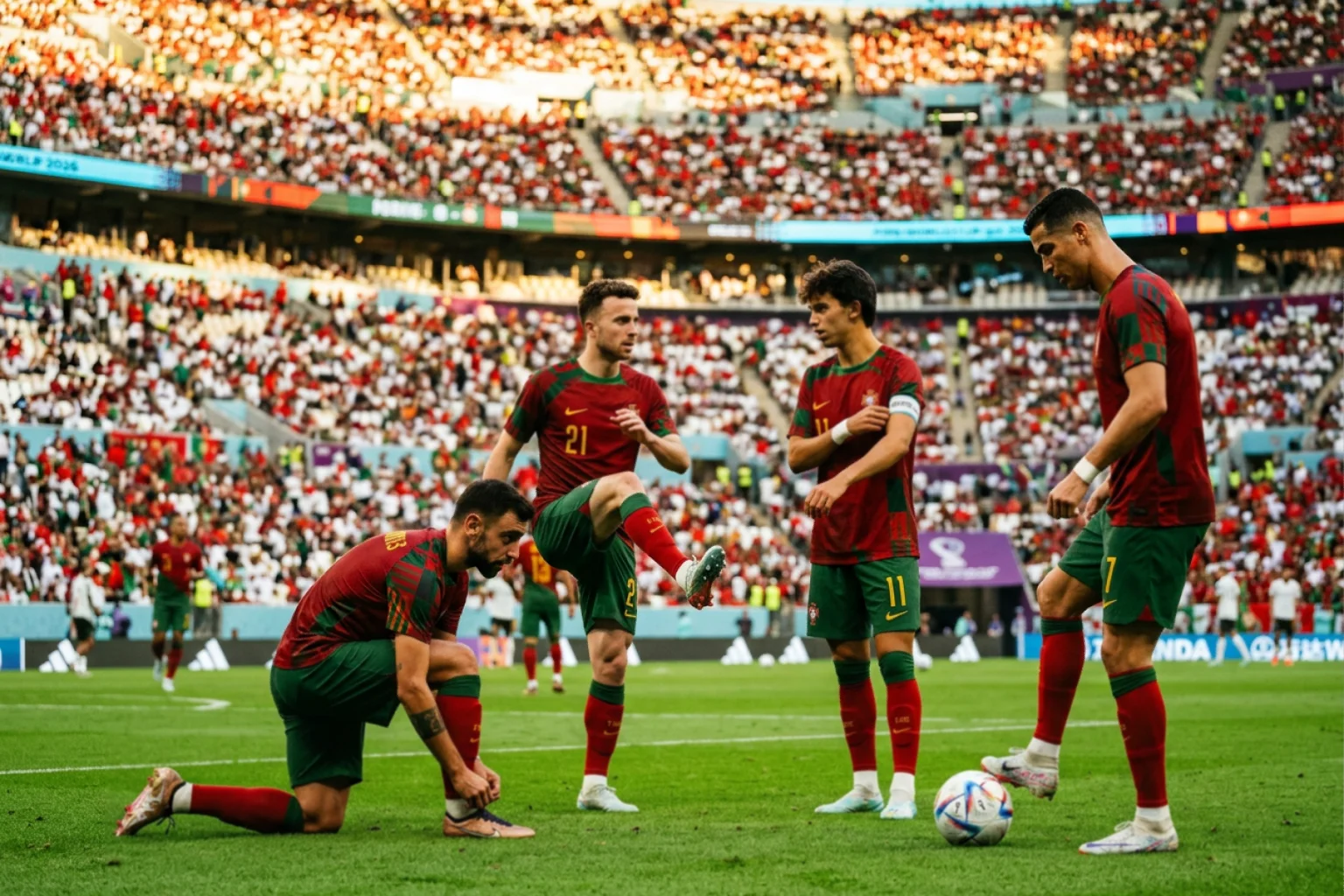
The Ronaldo question dominated Portuguese football for nearly two decades. Now, as the 2026 World Cup approaches, Portugal faces a different question: who have they become without him as the centerpiece? The transition from Cristiano Ronaldo’s era to whatever comes next has progressed unevenly — moments of brilliance from emerging talents alongside adjustment pains as roles redistribute. Portugal World Cup 2026 betting requires assessing where this transition stands and whether the squad can convert undeniable talent into tournament success.
Euro 2024’s quarterfinal exit to France on penalties demonstrated both Portuguese quality and limitations. They possess players capable of matching anyone; they also struggle to close decisive matches when pressure peaks. This guide examines squad composition, Group K dynamics, and where betting value exists for a team whose ceiling and floor span wide ranges.
Squad and Key Players
Rafael Leão represents the attacking future that Portugal’s system must maximize. His AC Milan development produced a winger capable of devastating defenders through pace, dribbling, and finishing. Leão’s inconsistency — brilliant one match, anonymous the next — creates the variance that defines Portuguese attacking output. When engaged, he matches any winger globally; when drifting, he disappears from matches entirely. Prop betting on Leão requires accepting this variance rather than assuming consistent production.
Bruno Fernandes provides creative impetus from central areas. His Manchester United role has fluctuated, but international duty consistently extracts his best performances. Fernandes’ passing range, set-piece delivery, and shooting from distance create opportunities that pure possession cannot generate. His leadership fills gaps left by departing veterans, adding intangible value beyond statistical contribution.
João Félix remains the enigma whose potential exceeds demonstrated output. His technical quality suggests world-class ceiling; his application suggests inconsistency that limits reliability. Félix thrives in specific tactical contexts and struggles in others — his inclusion depends on opponent characteristics and coach preference. Betting on Félix’s individual performance carries uncertainty that his talent theoretically shouldn’t permit.
Bernardo Silva offers the consistency that others lack. His Manchester City role refined a game already exceptional, producing a midfielder-winger hybrid capable of controlling matches through intelligence rather than physical dominance. Silva’s involvement in Portuguese buildup provides the reliable foundation that explosive talents require. His tournament experience and big-game composure represent assets that younger teammates still developing.
Rúben Dias anchors the defense with the authority that elite center-backs project. His positioning, aerial ability, and composure under pressure set the tone for Portuguese defensive organization. Dias’ partnership options have rotated through qualification, but his presence remains constant. Defensive clean sheet probability correlates strongly with Dias’ availability and fitness.
Diogo Costa has established himself as the number-one goalkeeper following years of development. His shot-stopping and distribution meet international standards without reaching elite goalkeeper levels. Costa provides competent goalkeeping rather than match-winning saves — adequate for tournament advancement but not a strength that separates Portugal from competitors.
Roberto Martínez’s coaching tenure followed the Belgian project that produced consistent results without major trophies. His system emphasizes possession, controlled buildup, and releasing attacking quality in specific moments. Martínez understands tournament management through extensive experience, providing stability that newer coaches cannot replicate.
Squad depth varies significantly by position. Attacking options beyond the primary names include Gonçalo Ramos’ finishing instincts and Francisco Conceição’s direct running. Midfield alternatives provide tactical flexibility without matching starting quality. Defensive depth beyond Dias creates concerns that injuries would expose — the drop-off from first-choice to second-choice remains substantial.
The Ronaldo departure has shifted tactical identity more than expected. Portugal no longer organize around a single focal point; instead, fluid attacking rotations distribute responsibility across multiple players. This evolution creates unpredictability that opponents must respect while demanding collective chemistry that takes time to develop. The transition continues; whether it completes before the World Cup affects betting assessments.
Set-piece organization represents a Portuguese strength. Bruno Fernandes’ delivery quality creates opportunities from corners and free kicks. Dias and other aerially dominant players convert chances that technical play alone cannot generate. Backing Portuguese set-piece goals in specific matches captures this dimension at prices calibrated to open-play data.
Pressing intensity has increased under Martínez compared to previous Portuguese regimes. The willingness to win the ball high and transition quickly adds dimensions that possession-based approaches sometimes lack. However, this aggression creates spaces behind that pacey opponents can exploit — a vulnerability that quality opposition will target.
Group K — Colombia Provides the Test
Portugal draws Group K alongside Colombia, Uzbekistan, and DR Congo. The draw features one genuine rival, a debutant nation, and an African qualifier whose quality varies by assessment. Portugal should advance comfortably; topping the group requires defeating Colombia head-to-head.
Colombia represents the primary threat. Copa América finalists with a vibrant attacking approach, Colombia possess the quality to match Portugal across ninety minutes. Luis Díaz provides wing threat that mirrors Leão’s danger from the opposite side. James Rodríguez’s creative vision creates chances from nothing. Colombia versus Portugal profiles as the group’s defining fixture, with either team capable of victory depending on which attacking threats fire.
Uzbekistan makes their World Cup debut after qualifying through Asian pathways. The Central Asian nation represents one of football’s emerging regions without yet producing tournament contenders. Uzbekistan will compete resolutely without threatening Portugal for points. This fixture should produce comfortable Portuguese victory, with betting interest focusing on margin and totals.
DR Congo qualified through African playoffs, demonstrating knockout-format resilience that group stages do not always replicate. The Congolese side possesses athletic players capable of individual moments without the collective organization that threatens established nations. Portugal versus DR Congo should favor Portugal clearly, though African unpredictability prevents complete certainty.
Portugal should top the group, with Colombia the primary challenger for first position. The Colombia fixture determines positioning that affects bracket paths. Betting on Portugal to win Group K at short prices offers limited value; finding Colombia at longer odds may provide better risk-reward if the head-to-head profiles competitively.
Match scheduling affects preparation and rotation decisions. The order of opponents changes how Martínez manages squad loads. Opening against Uzbekistan or DR Congo allows confidence-building; opening against Colombia presents immediate test. Understanding fixture sequences helps identify where lineup changes might affect individual match outcomes.
North American venues create logistics for European teams. Portugal’s resources minimize travel challenges, but tournament distances exceed typical European competition. Time zone adjustment from Western European schedules and climate acclimatization affect early-match performances. These factors matter most in opening fixtures before full adjustment occurs.
Third-place advancement rules create strategic complexity in final group matches. If Portugal secure advancement before their third game, rotation could affect lineup quality against remaining opponents. The forty-eight-team format’s advancement structure means even disappointing results might still allow progression — reducing stakes in scenarios where qualification is mathematically assured.
Odds and Where the Value Lies
Portugal typically prices between ten and fifteen to one for outright tournament winner, reflecting their squad quality and recent tournament performances. This pricing acknowledges both ceiling — capable of reaching late rounds — and floor — prone to knockout disappointments against elite opponents.
At twelve to one, Portugal implies roughly seven-to-eight-percent win probability. Given their squad talent and transitional state, this pricing may fairly reflect actual chances. Value emerges if you believe the post-Ronaldo transition has succeeded more than markets perceive — a judgment call rather than certainty.
Group K winner markets price Portugal as favorites, typically around 1.70 decimal odds with Colombia at 2.50 or similar. The competitiveness of the Portugal-Colombia match suggests value may exist on Colombia at these prices if the fixture profiles as unpredictable.
Portugal to reach quarterfinals prices around even money or slight odds-on, reflecting expected group advancement plus a Round of 32 win. This market captures Portuguese quality without requiring deep knockout runs against elite opposition. The quarterfinal threshold offers cleaner value than outright winner for bettors seeking Portuguese exposure.
Player props concentrate on Leão, Fernandes, and Silva. Leão’s scoring potential creates goal props at prices reflecting his inconsistency — finding value requires expecting his engaged performances rather than anonymous ones. Fernandes’ assist props capture his creative role and set-piece involvement. Silva’s influence manifests through possession metrics more than scoresheets.
Portugal clean sheet props vary by opponent. Fixtures against Uzbekistan and DR Congo should produce higher clean sheet probability than Colombia, where both teams possess attacking quality. Selectively backing clean sheets against inferior opponents captures defensive capability without assuming consistency against all competition.
Cards markets for Portuguese players reflect the physical intensity Martínez demands. Midfielders committing tactical fouls and defenders competing aerially accumulate bookings across tournament matches. Accumulator bets on Portuguese players receiving cards capture this tendency at potentially favorable prices.
Corners props in Portuguese matches reflect their possession dominance against inferior opponents. Wide play and crossing generates corner opportunities. Over corner totals in fixtures against Uzbekistan and DR Congo may price favorably given expected territorial control.
Half-time markets reflect Portugal’s tendency toward controlled starts before accelerating in second halves. Level or narrow leads at half-time followed by comfortable final margins characterize matches against weaker opponents. This pattern informs both half-time betting and second-half scorer props.
Value Bets on Portugal
After analyzing squad, group dynamics, and market positioning, several value angles emerge for Portugal betting.
Colombia to beat Portugal at odds around 3.50 or higher offers contrarian value. The South American side possesses attacking quality capable of matching Portuguese talent. Luis Díaz’s form, James Rodríguez’s creativity, and Colombia’s collective intensity create upset potential that markets may undervalue.
Under 2.5 goals in Portugal versus Colombia reflects both teams’ potential for tactical matches where quality cancels rather than combines. Neither side’s defense is weak enough to expect high-scoring affairs. This fixture profiles as tighter than combined attacking reputations suggest.
Rafael Leão to score in at least one group match at accumulator odds captures his explosive potential across three fixtures. Against Uzbekistan and DR Congo especially, Leão’s quality should produce opportunities his finishing converts when engaged. This threshold remains achievable even accounting for his inconsistency.
Portugal to reach semifinals at odds around three to one offers exposure to their tournament-run capability. The path through Group K and early knockouts appears manageable; semifinal rounds test them against elite opposition. This threshold captures Portuguese quality while acknowledging their ceiling may fall short of actual trophy contention.
The broader approach to Portugal betting involves recognizing their genuine quality without overstating their tournament pedigree. Euro 2016 represents their only major trophy despite decades of producing world-class players. Converting talent into titles requires something beyond squad quality — whether Portugal possess that intangible remains uncertain. Selective market positioning manages this uncertainty better than concentrated outright backing.
The post-Ronaldo era creates opportunities for fresh assessment. Markets conditioned by years of pricing Portuguese success through Ronaldo’s presence must now recalibrate to a different tactical identity. This transition period creates potential mispricings as markets adjust to new realities. Identifying where recalibration has lagged helps locate value that steady-state analysis might miss.
