
Uruguay World Cup 2026 — Betting Guide & Group H Odds | KICKSTAKE
 Available in US
Loading...
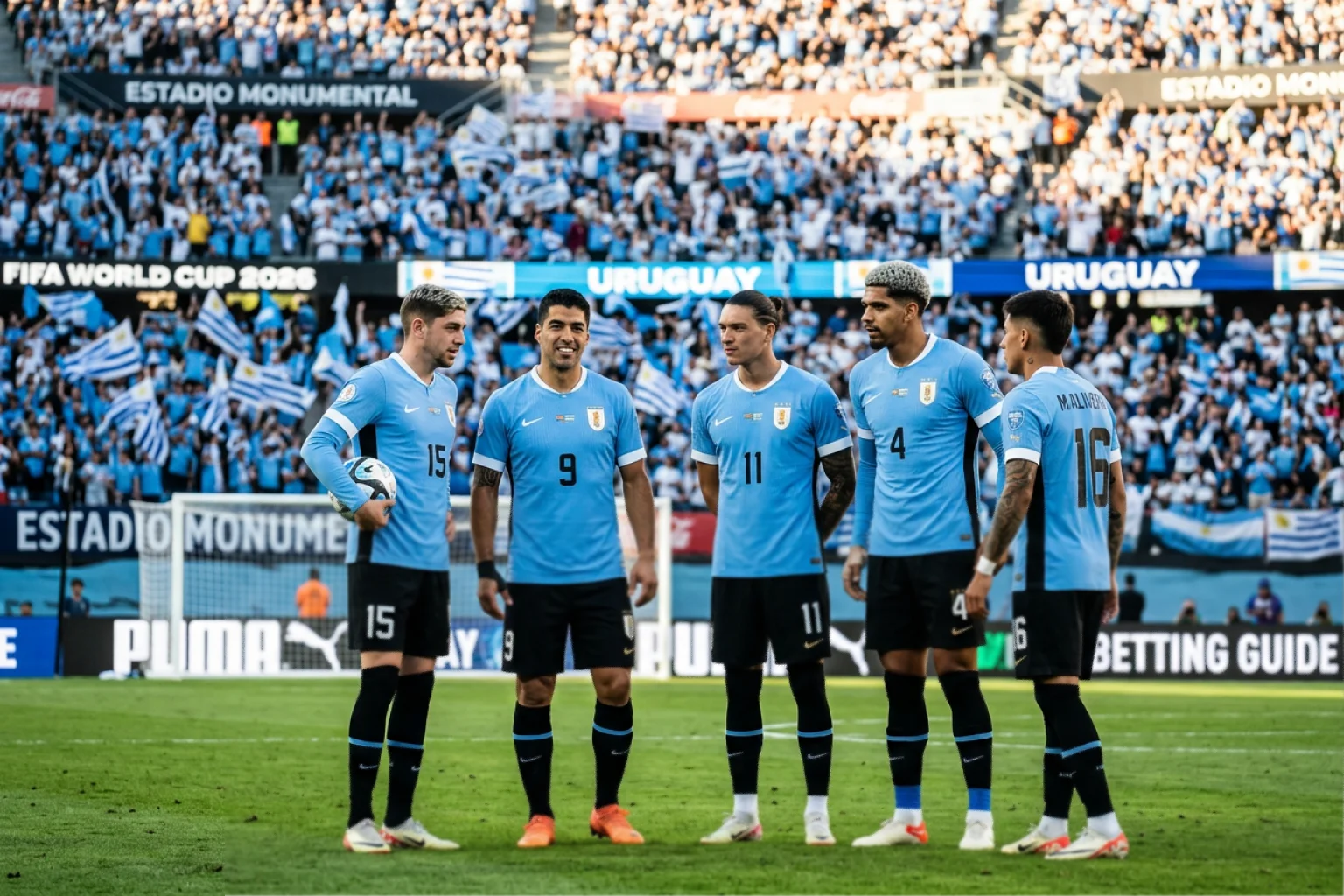
Two World Cup titles for a nation of 3.5 million people. Uruguay’s footballing history defies demographic logic, producing champions in 1930 and 1950 whose legacy still shapes how the Celeste approach major tournaments. The fierce Garra Charrúa — a fighting spirit that embodies Uruguayan identity — has carried them through eras where squad talent alone could not explain results. Uruguay World Cup 2026 betting requires respecting this cultural dimension alongside tactical analysis.
The generational transition from Suárez, Cavani, and Godín toward younger talents has progressed further than expected. Darwin Núñez leads the attack. Federico Valverde controls midfield. The blend of emerging stars and remaining veterans creates a squad capable of competing with anyone while still finding its definitive identity. This guide examines Uruguay’s squad composition, their challenging Group H draw featuring Spain, and where betting value exists for South American football’s most consistently competitive small nation.
Squad and Key Players
Darwin Núñez represents the attacking future that Uruguay’s system maximizes. His Liverpool development produced a striker whose pace, physicality, and finishing instincts create consistent goal threat. Núñez’s movement stretches defenses vertically, creating spaces for others while generating his own opportunities. His inconsistency — brilliant one match, frustrating the next — creates variance in individual scoring props while maintaining overall team threat.
Federico Valverde provides the midfield quality that elevates Uruguay beyond typical small-nation expectations. His Real Madrid development produced a player capable of influencing matches through box-to-box dynamism, defensive contribution, and attacking runs from deep. Valverde’s engine and quality suit tournament football where controlling midfield determines advancement. His presence alone makes Uruguay dangerous against any opponent.
Ronald Araújo anchors defense with Barcelona pedigree that few South American defenders match. His aerial dominance, recovery pace, and composure under pressure set standards for Uruguayan defensive organization. Araújo’s availability and fitness directly correlate with Uruguayan clean sheet probability — his absence creates vulnerability that opponents exploit.
Rodrigo Bentancur’s midfield partnership with Valverde creates a double pivot that combines technical quality with physical presence. His Tottenham role refined aspects of his game while maintaining the passing ability developed earlier. Bentancur’s discipline and positioning free Valverde for attacking contributions without exposing defensive gaps.
José María Giménez provides defensive experience and leadership alongside Araújo. His Atlético Madrid career produced a center-back comfortable with defensive organization and physical confrontation. Giménez’s tournament experience adds composure that younger defenders still developing.
Marcelo Bielsa’s coaching tenure brought tactical innovation that transformed Uruguayan football. His pressing intensity, positional play, and demanding standards elevated squad performance beyond individual talent levels. Bielsa’s reputation attracts player commitment while his tactical acumen creates competitive advantages against less organized opponents. His influence makes Uruguay greater than the sum of their parts.
Squad depth provides options across positions. Facundo Pellistri’s width creates attacking alternatives. Manuel Ugarte’s defensive midfield presence adds tactical flexibility. Sergio Rochet has established himself as capable goalkeeper. The bench provides quality without matching starting-eleven levels — adequate for tournament rotation without dramatic drop-offs.
The Garra Charrúa spirit manifests in Uruguayan tournament performances through collective effort that exceeds individual talent sums. Players compete with intensity that wears down technically superior opponents. This cultural dimension affects ninety-minute outcomes in ways tactical analysis cannot capture. Uruguay grind out results through determination when skill alone falls short.
Set-piece organization has improved under Bielsa’s staff. Aerial threat through Araújo, Giménez, and Núñez creates corner and free-kick opportunities. Defensive set-piece organization has historically produced vulnerabilities that quality opponents exploit — a concern against Spain’s delivery quality.
Pressing intensity reflects Bielsa’s philosophical demands. Uruguay now win the ball higher than previous iterations, creating turnovers in dangerous areas. This evolution suits athletic players like Núñez and Valverde while requiring discipline that tournament pressure tests. Managing pressing energy across seven potential matches affects squad performance curves.
Group H — Spain, Saudi Arabia, Cape Verde
Uruguay draws Group H alongside Spain, Saudi Arabia, and Cape Verde. The draw features a heavyweight rival, a 2022 giant-killer, and a tournament debutant. This group will not produce comfortable advancement for anyone; every match carries stakes.
Spain represents the headline matchup. Euro 2024 champions with a young, talented squad that profiles as tournament favorites. Spain versus Uruguay creates a fixture where either team can win depending on which tactical approach prevails. Uruguayan defensive organization against Spanish technical dominance produces chess matches rather than open contests. The Spain fixture likely determines whether Uruguay finishes first, second, or faces a more difficult path.
Saudi Arabia carries momentum from their stunning 2022 World Cup victory over Argentina. That result proved Saudi ability to produce elite-level performances against superior opponents. Saudi Arabia will not fear Uruguay; they have beaten better. Their defensive organization and counter-attacking efficiency create upset potential that markets may undervalue.
Cape Verde makes their World Cup debut, representing one of the tournament’s great underdog stories. The small island nation lacks squad quality to threaten Group H’s established teams but will compete with intensity. Uruguay versus Cape Verde should produce comfortable victory, though fatigue and distraction could introduce variance.
Uruguay should advance from Group H, likely competing with Spain for first position. Saudi Arabia’s presence introduces uncertainty that prevents assuming comfortable qualification. Betting on Uruguay to win the group requires expecting victory or draw against Spain — achievable but not probable given Spain’s current form.
Match scheduling affects tactical preparation significantly. The order of opponents changes how Bielsa manages squad rotation and physical loads. Opening against Cape Verde allows confidence-building; opening against Spain presents immediate test. Understanding fixture sequences helps identify where upset potential or comfortable wins most likely occur.
North American venues create logistics for South American teams. Uruguay’s travel from the Southern Hemisphere mirrors European challenges. Time zone adjustment from Montevideo schedules affects early-match performances. These factors matter most in opening fixtures before full acclimatization occurs.
Odds Analysis
Uruguay typically prices between twenty and thirty to one for outright tournament winner, reflecting South American qualification alongside realistic squad assessment. This pricing acknowledges Uruguayan competitive spirit while recognizing that two-time champions last won in 1950 — seventy-six years ago.
At twenty-five to one, Uruguay implies roughly four-percent win probability. Given their squad talent, difficult group draw, and historical inconsistency at recent World Cups, this pricing may fairly reflect actual chances. Value emerges if you believe Bielsa’s tactical influence elevates this squad beyond objective assessment.
Group H advancement markets price Uruguay around 1.50 for qualification, reflecting expected advancement behind Spain. Finding value requires either backing Uruguayan group victory at longer odds or identifying Saudi Arabia’s upset potential in the direct match.
Uruguay to reach quarterfinals prices around 2.00, capturing expected group advancement plus a Round of 32 win. This market offers clean value for bettors who believe Uruguayan tournament pedigree sustains through early knockout rounds.
Player props concentrate on Núñez and Valverde. Núñez’s goal props reflect his inconsistent finishing that produces variance. Valverde’s influence manifests through assists and key passes rather than goals. Both players’ involvement in Uruguayan buildup creates combination props worth exploring.
Uruguay clean sheet props vary by opponent. Cape Verde fixtures should produce higher clean sheet probability than Spain or Saudi Arabia. Araújo’s availability directly affects defensive projections — monitoring his fitness entering matches helps calibrate clean sheet expectations.
Cards markets for Uruguayan players reflect their physical style. Tactical fouls, aggressive challenges, and passionate reactions accumulate bookings across tournament matches. South American nations historically receive more cards than European counterparts; Uruguay fits this pattern.
Corners props in Uruguayan matches reflect their aerial threat. Set-piece situations create corner opportunities at above-average rates. Over corner totals against Cape Verde may price favorably given expected territorial control.
Half-time markets reflect Uruguay’s tendency toward tight first halves followed by decisive second-half moments. Level scores at half-time frequently convert to Uruguayan victories as Bielsa’s adjustments take effect. This pattern informs both half-time betting and live positioning.
Value Bets on Uruguay
After analyzing squad, group dynamics, and market positioning, several value angles emerge for Uruguay betting.
Uruguay to draw Spain at odds around 3.50 or higher captures the tactical match profile. Neither team’s approach produces high-scoring affairs when facing organized opposition. Draw probability in this fixture exceeds what match-winner pricing implies.
Under 2.5 goals in Uruguay versus Spain reflects both teams’ potential for tactical chess. Spanish possession dominance meets Uruguayan defensive organization in a fixture where goals come at a premium. This market often prices near even money when probability favors the under.
Darwin Núñez to score in at least one group match at short accumulator odds captures his overall threat across three fixtures. Cape Verde and potentially Saudi Arabia offer scoring opportunities that his finishing should convert at least once despite inconsistency.
Uruguay to reach semifinals at odds around six to one offers exposure to their tournament-run capability. The path through Group H and early knockouts presents challenges but remains navigable. This threshold captures Uruguayan competitiveness at prices reflecting realistic assessment.
Federico Valverde to score across the tournament at longer odds captures his arriving into the box from deep positions. His shooting quality from outside the area and willingness to join attacks creates goal opportunities that midfielder pricing may undervalue. Tracking his involvement in Uruguayan attacks supports this prop selection.
Uruguay to finish above Saudi Arabia in Group H at short odds offers accumulator value with reasonable probability. Head-to-head quality favors Uruguay despite Saudi Arabia’s 2022 upset history. This leg combines well with other selections where probability exceeds pricing implications.
The broader approach to Uruguay betting involves recognizing their consistent competitiveness without overstating their championship ceiling. Two titles seventy-plus years ago does not predict current success. Value exists in progression markets that capture their ability to advance; outright winner backing requires discounts that markets rarely offer for teams outside the elite tier.
Historical patterns suggest Uruguay outperform objective squad assessment at major tournaments. Their small population, modest domestic league, and limited resources should produce modest results. Instead, they compete consistently against larger nations. This pattern creates value whenever markets price Uruguay based purely on squad comparison rather than demonstrated tournament capability.
The Bielsa factor deserves specific consideration. His coaching influence elevates squad performance beyond individual talent sums. Teams under Bielsa consistently compete above expectations through tactical organization and collective commitment. This coaching premium may not appear in market pricing that focuses on player quality rather than system quality.
Uruguayan betting requires accepting variance that their style produces. Garra Charrúa creates results through determination and physicality that technical analysis cannot predict. Matches swing on momentum and mentality rather than expected-goals models. Position sizing should reflect this variance — exposure to Uruguayan success without overcommitment to outcomes that style variance affects.
