
Switzerland World Cup 2026 — Betting Guide & Group B Rival | KICKSTAKE
 Available in US
Loading...
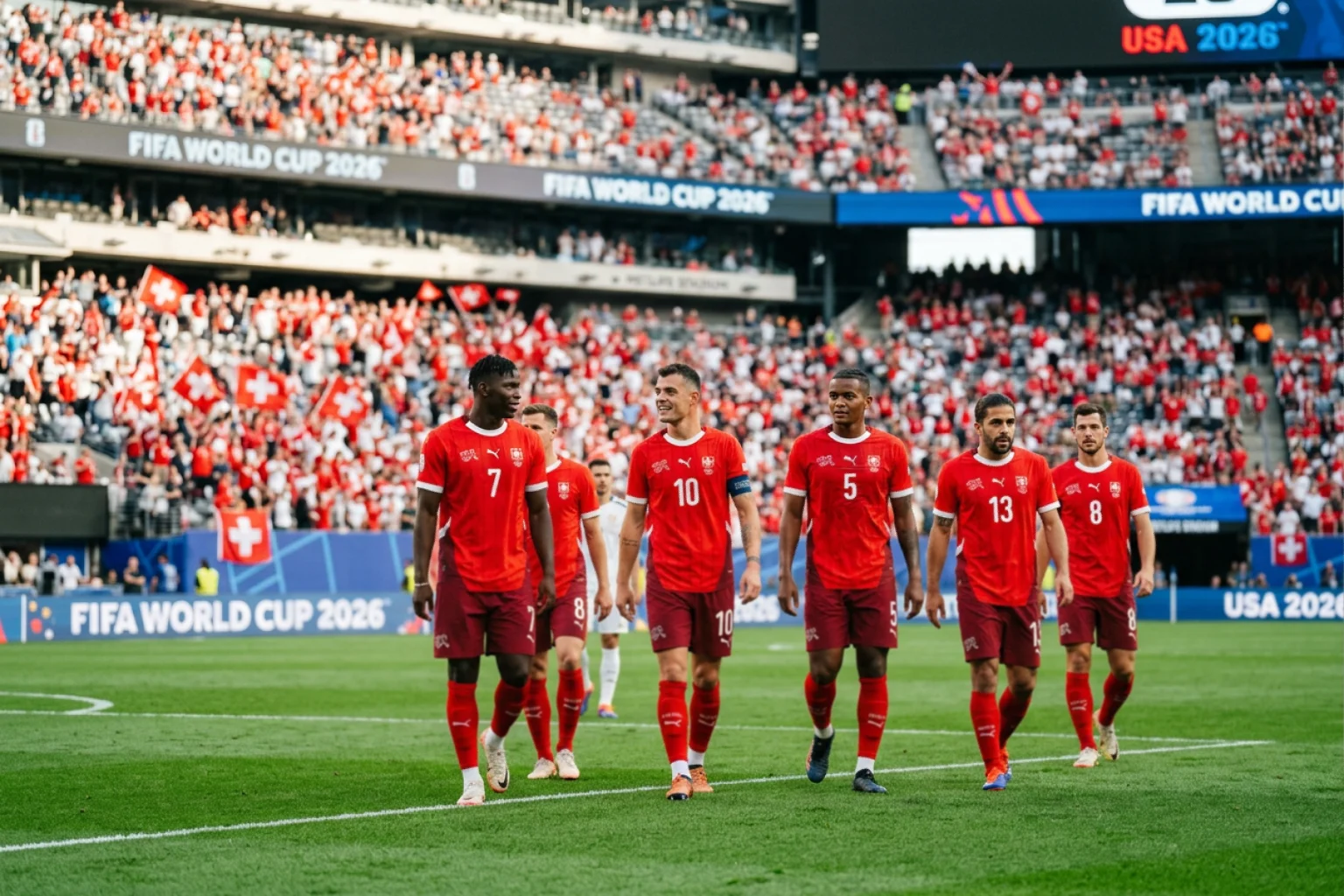
Consistent without being spectacular. Switzerland has qualified for five consecutive World Cups, reaching knockout rounds in four of them, without ever threatening tournament victory. The Swiss model combines tactical organization, disciplined defending, and transition efficiency into a formula that frustrates favorites while rarely producing dominant performances. Switzerland World Cup 2026 betting rewards understanding this identity — a team built to compete without pretending to championship ceiling.
For Canadian bettors, Switzerland represents the primary obstacle to Group B dominance. The June 24 fixture in Vancouver pits co-hosts against their most dangerous group rival. This guide examines Swiss squad composition, Group B dynamics from their perspective, and where betting value exists for a team whose consistency creates predictable outcomes that markets sometimes misprice.
Squad and Key Players
Granit Xhaka orchestrates Swiss football from central midfield. His Bayer Leverkusen renaissance under Xabi Alonso transformed perception of a player whose Arsenal career ended with frustration. Xhaka’s distribution range, tactical intelligence, and leadership define how Switzerland control matches. His absence through injury or suspension fundamentally changes Swiss capability — bet accordingly.
Manuel Akanji provides defensive foundation with Manchester City pedigree that few European defenders match. His composure under pressure, aerial ability, and ball-playing suit the Swiss buildup that Xhaka orchestrates. Akanji’s Premier League experience at the highest level adds quality that elevates Swiss defensive organization beyond typical second-tier European assessment.
Yann Sommer’s goalkeeping has anchored Swiss tournament runs for a decade. His shot-stopping, distribution, and penalty-saving capability provide consistency that field players rely upon. Sommer’s experience in high-pressure matches — including penalty heroics against France in Euro 2020 — offers composure that younger goalkeepers lack.
Breel Embolo leads the attacking line with physical presence and movement that creates space for others. His inconsistent finishing frustrates at times, but his overall contribution to Swiss attacking play justifies consistent selection. Embolo’s willingness to work without the ball suits Swiss transition game.
Ruben Vargas provides width and directness that Swiss attacks require. His ability to beat defenders one-on-one creates situations that organized defensive blocks cannot prevent through positioning alone. Vargas represents the individual quality that Swiss collective play sometimes lacks.
Murat Yakin’s coaching has maintained Swiss consistency since taking over in 2021. His pragmatic approach maximizes squad capabilities without demanding what players cannot provide. Yakin understands Swiss football culture — the technical quality, the tactical discipline, the limitations that honest assessment reveals. His management suits a squad built for competitiveness rather than glory.
Squad depth provides adequate rotation options without dramatic quality. Denis Zakaria offers midfield alternatives. Fabian Schär adds defensive experience. The bench maintains Swiss quality levels without providing dramatic upgrades — consistent with a squad whose strength lies in collective organization rather than individual brilliance.
The generational transition has progressed smoothly. Xhaka and Sommer remain from the 2014 breakthrough squad; Akanji and others represent the current peak generation; younger players develop through gradual integration. This continuity provides stability that squads undergoing dramatic transition cannot match.
Pressing intensity has increased under Yakin’s continued development. Switzerland now win the ball higher up the pitch than previous iterations, creating turnovers in dangerous areas. This evolution suits athletic players while requiring Xhaka to contribute defensively in ways his game accommodates. Managing pressing energy across tournament matches affects performance curves.
Set-piece organization represents Swiss strength. Xhaka’s delivery quality creates corner and free-kick opportunities. Aerial presence through Akanji and others converts chances that open play struggles to create. Backing Swiss set-piece goals captures this dimension at prices calibrated to overall offensive limitations.
Group B — The Battle with Canada
Switzerland draws Group B alongside Canada, Qatar, and Bosnia and Herzegovina. The draw features co-hosts Canada as primary rivals, 2022 hosts Qatar in their second consecutive World Cup, and Bosnia and Herzegovina in their second-ever tournament appearance. This group allows Swiss advancement without guaranteeing comfortable passage.
Canada represents the headline matchup from Swiss perspective. Co-host advantage provides Canadian support that visitors cannot match. Canadian talent — Alphonso Davies, Jonathan David — matches Swiss quality across the pitch. The June 24 fixture in Vancouver determines which nation tops Group B and claims easier knockout pathway.
Qatar carries experience from hosting 2022 despite limited squad quality compared to European teams. Their defensive organization and transition efficiency produced competitive performances on home soil. Away from Qatar, in North American conditions, their capabilities diminish — but underestimating Asian champions invites disappointment.
Bosnia and Herzegovina qualified through European playoffs, demonstrating resilience that knockout formats demand. Their talent level suggests group-stage exit probability, but competitive matches against Switzerland and Canada remain plausible. Swiss points dropped to Bosnia would damage advancement scenarios.
Switzerland should advance from Group B, likely competing with Canada for first position. The direct fixture determines group outcome; Qatar and Bosnia matches should produce Swiss victories that secure advancement regardless. Betting on Switzerland to top Group B requires expecting victory in Vancouver — achievable against co-hosts but not favorable.
Match scheduling affects preparation significantly. Playing Canada last allows Swiss adjustment to North American conditions while observing Canadian performances. This sequencing may favor Swiss preparation if earlier matches reveal Canadian vulnerabilities to exploit.
Switzerland vs Canada — What to Expect
The June 24 fixture at BC Place carries stakes that determine both nations’ tournament trajectories. Winner claims Group B and an easier Round of 32 draw. Loser faces more challenging knockout pathway. Understanding this match specifically helps Canadian bettors position for the most relevant Swiss fixture.
Swiss tactical approach against co-hosts likely emphasizes defensive organization and transition efficiency. Conceding space to Canadian possession while remaining compact creates counter-attacking opportunities that Embolo and Vargas can exploit. Switzerland will not attempt to dominate possession against talented opponents in hostile environment.
Canadian vulnerabilities that Swiss preparation targets include defensive organization against quick transitions and aerial weaknesses that set-pieces exploit. Swiss delivery quality from Xhaka creates corner and free-kick opportunities. Canadian inexperience at this level shows in moments where Swiss tournament pedigree provides composure.
Swiss vulnerabilities that Canadian preparation targets include pace in wide areas that Davies exploits and attacking creativity that organized defenses frustrate. Canadian pressing intensity may disrupt Xhaka’s distribution that Swiss buildup requires. Home advantage amplifies Canadian strengths while limiting Swiss comfort.
The draw represents a likely outcome that both nations should accept given stakes. Level scores preserve advancement for both while postponing decisive confrontation until knockout rounds. Betting markets may undervalue draw probability in fixtures where neither team can afford defeat.
Swiss Odds and Market Value
Switzerland typically prices between thirty and fifty to one for outright tournament winner, reflecting consistent advancement alongside realistic ceiling assessment. This pricing acknowledges Swiss ability to reach knockout rounds while recognizing that championship requires defeating elite opponents that Swiss squads historically cannot beat.
At forty to one, Switzerland implies roughly 2.5-percent win probability. Given their knockout-round consistency, this pricing fairly reflects actual chances — reaching quarterfinals is realistic; reaching semifinals requires favorable draws; winning requires something unprecedented from Swiss football.
Group B advancement markets price Switzerland around 1.40 for qualification, reflecting expected advancement alongside Canada. Finding value requires backing Swiss group victory at longer odds if you believe the Vancouver fixture favors European visitors.
Switzerland to reach quarterfinals prices around 2.50, capturing expected group advancement plus a Round of 32 win. This market offers clean value for bettors who believe Swiss tournament pedigree sustains through four matches.
Player props concentrate on Xhaka and Embolo. Xhaka’s assist and key pass props capture his creative role. Embolo’s goal props reflect inconsistent finishing that produces variance while overall threat remains consistent. Both players’ involvement in Swiss attacks creates combination props worth exploring.
Swiss clean sheet props offer value against Qatar and Bosnia where defensive organization should limit quality chances. The Canada fixture presents lower clean sheet probability where co-host attacking quality threatens Swiss defensive structure.
Cards markets for Swiss players reflect their tactical discipline. Fewer reckless challenges mean fewer bookings than more aggressive nations. This tendency creates value in under cards markets for Swiss fixtures.
Corners props in Swiss matches reflect their organized play. Set-piece opportunities arise from controlled buildup rather than desperate late pressure. Corners totals in Swiss matches often run lower than attacking matches featuring more chaotic styles.
Half-time markets reflect Swiss tendency toward tight first halves. Level scores at half-time frequently occur as Yakin’s tactical discipline limits early-match variance. This pattern informs both half-time betting and live positioning during Swiss fixtures.
Value Bets on Switzerland
After analyzing squad, group dynamics, and market positioning, several value angles emerge for Switzerland betting.
Switzerland to draw Canada at odds around 3.50 captures the tactical match profile. Neither team’s approach produces high-scoring affairs in decisive fixtures. Draw probability exceeds what match-winner pricing implies when stakes demand caution from both sides.
Under 2.5 goals in Switzerland versus Canada reflects both teams’ potential for tight tactical chess. Swiss defensive organization meets Canadian attacking quality in a fixture where neither side can afford defensive errors. This total often prices near even money when probability favors the under.
Switzerland to reach quarterfinals at odds around 2.50 captures their consistent tournament advancement. Group B presents manageable challenges; early knockout opponents should prove beatable. This threshold reflects achievable Swiss performance without requiring unprecedented success.
Granit Xhaka to record an assist across the tournament at reasonable odds captures his creative role. Three group matches plus potential knockout appearances provide opportunities for Xhaka’s delivery and passing to produce goal-creating contributions.
The broader approach to Switzerland betting involves respecting their consistency without overstating ceiling. Swiss football produces predictable outcomes — advancement to knockout rounds, competitive matches against elite opponents, eventual elimination against genuine title contenders. Value exists in progression markets at appropriate prices; outright winner backing wastes money on outcomes Swiss football cannot produce.
Historical patterns confirm Swiss tournament reliability. Five consecutive World Cup qualifications, four consecutive knockout-round appearances — this consistency creates value whenever markets price Switzerland based on limited ceiling rather than demonstrated advancement capability. The floor is high even when the ceiling is moderate.
Swiss betting requires accepting the predictability that their style produces. Organized defense, efficient transitions, and tactical discipline create outcomes that models can forecast. Position sizing should reflect this predictability — confident backing of realistic outcomes, limited exposure to championship scenarios that Swiss football cannot achieve.
The Canada fixture specifically offers Canadian bettors unique insight. Understanding Swiss strengths and weaknesses informs both Swiss-specific betting and Canadian positioning for the decisive Group B match. Respecting Swiss quality while recognizing home advantage creates balanced assessment for the Vancouver showdown.
